



Diverse Fleets, Skills and Services Help Brown Coach Stay Ahead
Brothers Robert and Stephen Brown have spun a nine-motorcoach operation, purchased in 1980, into a 49-vehicle fleet that provides charter, commuter and tour services, primarily in the northeastern U.S. and eastern Canadian provinces.
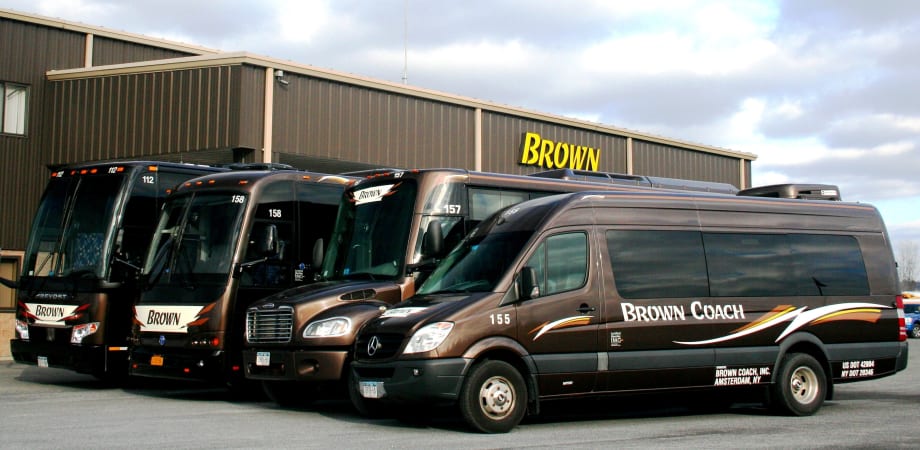
To say that Brown Coach is well diversified is an understatement. From the types of vehicles in its fleet, to the various services offered, to the differing management skill sets of its owners, brothers Robert and Stephen Brown, diversification is the key to the Amersterdam, N.Y.-based charter, commuter and tour company’s success.
Robert, who serves as president of Brown Coach, got his start in the school bus business prior to serving in Vietnam, and returned to eventually open his own school bus operation in 1976. In 1980, an opportunity arose to purchase a nine-motorcoach charter business, and thus was born Brown Coach.
Robert was joined by his brother Stephen, who serves as the company’s vice president and graduated from nearby Union College with a degree in mechanical engineering.
“I found that working part-time nights, weekends and summers at the bus business was a good fit during college,” Stephen Brown explains. “By the end of college, the business had grown to the point there was an opportunity to get involved full time. The rest, as they say, is history, and 30-plus years have passed quickly.”
Together, the Browns have built Brown Coach, and its affiliate Upstate Transit of Saratoga LLC, which the brothers purchased in 2005, into a fleet of 49 vehicles, providing charter, commuter and tour services, focusing primarily on the northeastern U.S. and eastern Canadian provinces. It has also maintained its 225-vehicle school bus businesses and operates Brown Tours, which offers motorcoach tours to destinations all over the country. The company has offices in Schenectady and Saratoga Springs in addition to its headquarters in Amsterdam, N.Y.
“Brown Coach is an extraordinarily progressive company and represents what the future of the motorcoach industry could look like,” says Victor S. Parra, president/CEO of UMA. “They are diversified well beyond the charter business, with operations in scheduled services, school buses, paratransit and other services, ensuring growth for the long term. And because they are invested in multiple transportation lines, they are able to better withstand downturns in the economy.”
In addition to its successful businesses, both Robert and Stephen are actively involved in the industries they are part of, including in the motorcoach sector, the International Motorcoach Group (IMG), the United Motorcoach Association (UMA), the American Bus Association (ABA) and Bus Association of New York.
It is for these reasons and more that Robert and Stephen were named METRO Magazine’s 2015 Motorcoach Operators of the Year. METRO’s GM James Blue presented the brothers with the award at the UMA EXPO in New Orleans in January.
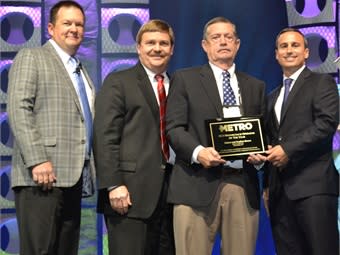
In January, Brown Coach received METRO’s 2015 Motorcoach Operator of the Year award at UMA Expo. From left to right: Brian Annett, chairman UMA; Stephen Brown, VP Brown Coach; Robert Brown, president Brown Coach; and METRO’s GM James Blue.
Vehicles and Services
Stephen explains that what he thinks sets Brown Coach apart from the competition is the diversity of vehicles the company offers.
“We are the only charter coach company in our local market that is also a school bus operator,” he says. “This gives our customers a wider vehicle choice than any of our competitors.”
Vehicle sizes range from seven-passenger mini-vans to 55-passenger coaches and include school vans, full-size school buses and several different types of wheelchair-equipped vehicles, including 55-passenger wheelchair-equipped coaches.
Brown said one trend he is currently seeing in the market is more people requesting smaller vehicles, partially because group sizes have shrunk, and partially because more customers are becoming more environmentally conscious, so the company has recently added some 35-foot Temsa coaches.
Brown adds the diversity of services also enables more opportunities for its employees in a northeastern market that is mostly seasonal.
“The fact that we provide many different types of transportation — charter, tour, commuter, school, school charter, rural transit — also gives our drivers increased wage earning opportunities, even in slow charter months,” Brown says. “The more things you can do in different areas, the more stability you’ve got to what you do. It’s better to have a whole lot of small revenue streams then one large one.”
In 2008, Brown Coach was named one of METRO’s Innovative Operators. At the time, due in part to Stephen’s background as a mechanical engineer, the operation was implementing a computerized system for the controlling of engine block heater electrical outlets to improve efficiency and reduce cost.
“That system has been improved and enhanced to allow it to utilize our coach’s onboard diesel-fired coolant heaters to not only preheat the engine but also preheat the coach interior prior to scheduled departure or vehicle servicing,” he explains. “This goes hand-in-hand with a more recent ongoing New York State Energy and Research Authority project that is a feasibility study to explore viable options for shore-powered heating and cooling of motorcoach interiors.”
Brown adds that it is hoped these initiatives will lead to more cost-effective, efficient and environmentally-friendly methods of providing creature comfort for the company’s passengers.
Community, company growth
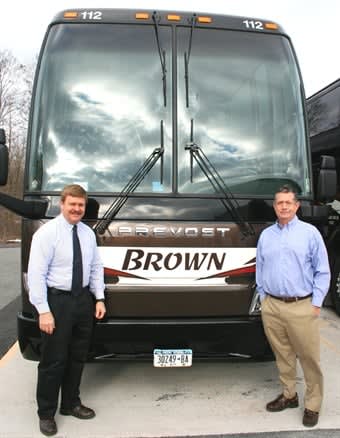
Several years ago, the Brown’s designed and built a 27,000-square-foot facility in Amsterdam, N.Y., that houses administrative offices and repair facilities for both the motorcoach and school bus operations. Stephen explains that he believes one of the biggest benefits to having everything under one roof, so to speak, is the value added to its customers.
“With our affiliate school transportation, tour and travel companies, we can provide almost any mode of travel our customer requires,” Brown adds. “Our industry partnerships with other IMG, UMA and ABA members allow us to serve our customer’s needs with confidence, even when outside of our service area.”
Aside from being active in many associations, both in the motorcoach and school bus industries, Brown explains both he and his brother Robert are active in their local Rotary Club chapters.
“It is a great place to get to know the business and community leaders in your area while helping with projects in our hometowns,” he explains.
They also give back via charitable work, including Honor Flights and Wounded Warriors.
“For a number of years, we have worked to see that our local WWII and Korean Veterans are transported to Albany Airport so that they can fly to Washington, D.C., and see their Memorials,” Brown says. “We have also assisted a local organization, S.T.R.I.D.E, in giving a group of Wounded Warriors a ski weekend each winter at the Jiminy Peak Resort in Hancock, Mass.”
While running a family business can be challenging, Brown believes the key to his operation’s success is the fact that he and his brother have different skill sets and areas of expertise.
“[My brother] is more actively involved in the bidding process, contract management, RFP development, financing and administrative oversight,” he says. “With my engineering background, I am more involved in the operational, maintenance and technical oversight.”
With much of Brown’s growth over the years happening organically — often through purchasing operations that are either selling or exiting the market — Brown says the family has no immediate plans for expansion.
With the operation growing over the years to more than 300 employees, Brown says that he and his brother not only think of the well-being of their own families, but also, the families of all of their employees when weighing important decisions that will impact the company.
“It would be great to have a whole fleet of new buses out there, but is it financially prudent? Is the economy going to take a turn for the worse next week, next month and can you weather the storm?” Brown says. “You always have to be in a position where you weigh the worst case scenario and expand and grow when it makes sense, but also always make sure you are in a position to be here tomorrow for the people who count on you for employment.”
More Motorcoach

METRO Opens Submissions for 2026 Motorcoach Awards
Nominations are now being accepted for METRO Magazine’s Operator of the Year and Innovative Operator of the Year awards.
Read More →
Biz Briefs: Alstom Lands Canadian Contract, LYT to Supply California TSP, and More
In METRO's latest installment, we take a look at recent news from Complete Coach Works, Beep, FlixBus, and more partnerships making headlines across the transportation sector.
Read More →
Biz Briefs: RIPTA Unveils New Frontrunners, Clevland RTA Adds New Siemens, and More
In METRO's latest installment, we take a look at recent news from Siemens, Prevost, Dodge, and more partnerships making headlines across the transportation sector.
Read More →
People Movement: Holly Arnold Joins Transdev and More
In this edition, we also cover recent appointments and announcements at Pace, CamTran, MCI, and more, showcasing the individuals helping to shape the future of transportation.
Read More →
ABA Report: Motorcoach Travel Generates $161.6B Economic Impact
The 2025 analysis finds motorcoach travel supported nearly 900,000 jobs and generated $28 billion in federal, state, and local taxes.
Read More →
CharterUP’s Armir Harris on Technology, AI, and the Future of Group Mobility
In a recent episode of METROspectives, CharterUP Founder/CEO Armir Harris discussed the company’s evolution from an online charter bus marketplace into a technology platform supporting public- and private-sector mobility and much more.
Read More →
People Movement: ABC Names John Walsh as Chief Commercial Officer
In this edition, METRO also covers recent appointments and announcements at the DART, STV, and more, showcasing the individuals helping to shape the future of transportation.
Read More →
From Surviving to Thriving: Building Stronger Transportation Organizations
Bus Business Consultants founder Brian Dickson shares lessons on leadership, organizational health, and creating options for long-term success in a changing transportation industry.
Read More →
Biz Briefs: Luminator Marks Milestone and More
From manufacturers and suppliers to transit agencies and motorcoach operators, these updates offer a snapshot of the projects, partnerships and business moves driving the industry forward.
Read More →
ABAF Study Reveals Growing Insurance Crisis for Motorcoach Operators
Preliminary findings show 98% of operators faced premium increases over the past five years, while shrinking insurer participation is putting added pressure on businesses and customers.
Read More →