



UMA lauds independent report on FMCSA's Safety Measurement System
The report referred to the ad hoc nature of the system and recommended that the agency adopt "a more statistically principled approach" that can be empirically validated.

The United Motor Coach Association's concerns about the federal compliance scoring system for motor carriers were validated by a recent report from the National Academies of Sciences, Engineering, and Medicine, according to the association. The report referred to the ad hoc nature of the current Safety Measurement System (SMS) employed by the Federal Motor Carrier Safety Administration (FMCSA) and recommended that the agency adopt "a more statistically principled approach" that can be empirically validated.
"The report confirms many of UMA's concerns relating to disparities contained in the SMS," said UMA President/CEO Stacy Tetschner. "UMA has been particularly concerned about how small fleet operators can be adversely affected."
The report states that "...much of what is now done is ad hoc and based on subject-matter expertise that has not been sufficiently empirically validated. This argues for FMCSA adopting a more statistically principled approach that can include the expert opinion that is implicit in SMS in a natural way."
Another key recommendation is for FMCSA to develop a new and improved approach over the next two years; and, when proven to be effective, replace SMS in a manner akin to the way SMS replaced the old SafeStat program.
The report left open the issue of crash accountability, which remains a top concern for UMA members. However, the report recommends capturing better crash and operations data, such as vehicle miles traveled, a practice UMA has suggested may help differentiated carriers. Typical scheduled service companies often travel five times the miles of a typical charter bus annually.
"We are grateful to Congress and the National Academies of Sciences, Engineering, and Medicine panel that worked so diligently to prepare this report," said Tetschner. "This will report will help FMCSA identify commercial motor vehicle carriers that require intervention more accurately and fairly. At the end of the day, an improved SMS will save lives; a goal we all share. "
The UMA advocated for the review of SMS that was written into the FAST Act of 2015, mandating a study by the National Academies of Sciences, Engineering, and Medicine to evaluate SMS.
The National Academies of Sciences, Engineering, and Medicine are private, nonprofit institutions that provide expert advice on some of the most pressing challenges facing the nation and the world. Their work helps to shape public policy and inform public opinion.
The UMA has once again teamed up with BusCon to create a training track at this year's event in Indianapolis Sept. 11 to 13. For more information, click here.
More Motorcoach

METRO Opens Submissions for 2026 Motorcoach Awards
Nominations are now being accepted for METRO Magazine’s Operator of the Year and Innovative Operator of the Year awards.
Read More →
Biz Briefs: Alstom Lands Canadian Contract, LYT to Supply California TSP, and More
In METRO's latest installment, we take a look at recent news from Complete Coach Works, Beep, FlixBus, and more partnerships making headlines across the transportation sector.
Read More →
Biz Briefs: RIPTA Unveils New Frontrunners, Clevland RTA Adds New Siemens, and More
In METRO's latest installment, we take a look at recent news from Siemens, Prevost, Dodge, and more partnerships making headlines across the transportation sector.
Read More →
People Movement: Holly Arnold Joins Transdev and More
In this edition, we also cover recent appointments and announcements at Pace, CamTran, MCI, and more, showcasing the individuals helping to shape the future of transportation.
Read More →
ABA Report: Motorcoach Travel Generates $161.6B Economic Impact
The 2025 analysis finds motorcoach travel supported nearly 900,000 jobs and generated $28 billion in federal, state, and local taxes.
Read More →
CharterUP’s Armir Harris on Technology, AI, and the Future of Group Mobility
In a recent episode of METROspectives, CharterUP Founder/CEO Armir Harris discussed the company’s evolution from an online charter bus marketplace into a technology platform supporting public- and private-sector mobility and much more.
Read More →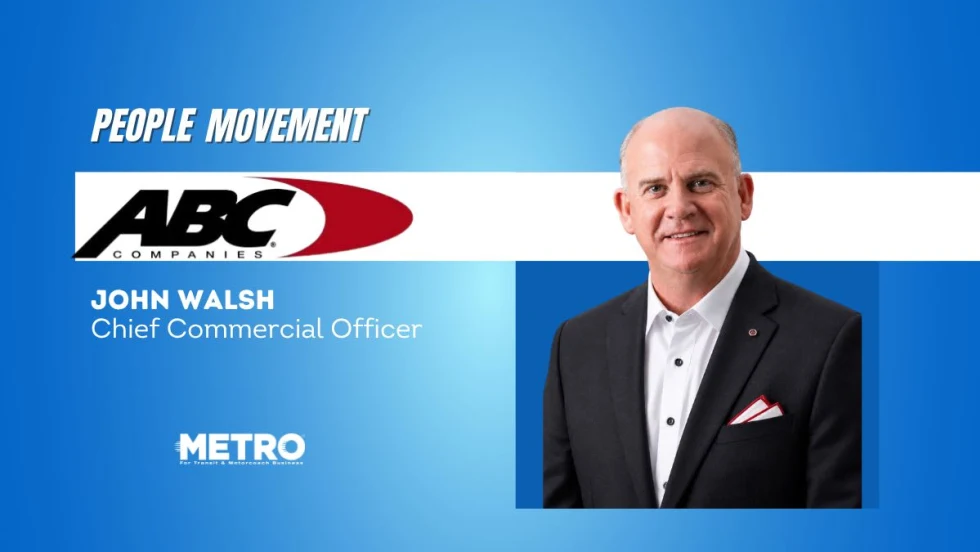
People Movement: ABC Names John Walsh as Chief Commercial Officer
In this edition, METRO also covers recent appointments and announcements at the DART, STV, and more, showcasing the individuals helping to shape the future of transportation.
Read More →
From Surviving to Thriving: Building Stronger Transportation Organizations
Bus Business Consultants founder Brian Dickson shares lessons on leadership, organizational health, and creating options for long-term success in a changing transportation industry.
Read More →
Biz Briefs: Luminator Marks Milestone and More
From manufacturers and suppliers to transit agencies and motorcoach operators, these updates offer a snapshot of the projects, partnerships and business moves driving the industry forward.
Read More →
ABAF Study Reveals Growing Insurance Crisis for Motorcoach Operators
Preliminary findings show 98% of operators faced premium increases over the past five years, while shrinking insurer participation is putting added pressure on businesses and customers.
Read More →