



Environmental group honored for Mexico Metrobus project
Award recognizes outstanding public-private partnerships that enhance environmental quality through the use of novel and creative approaches. EMBARQ helped create the public-private partnership with the Mexico City government to the make the transit project a reality.

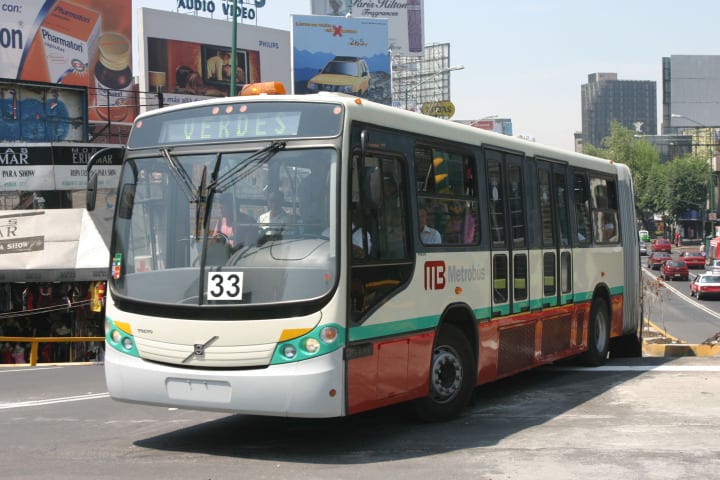
Photo courtesy of the Center for Sustainable Transport in Mexico (CTS-Mexico).
[IMAGE]Mexico-metrobus2-full.jpg[/IMAGE]EMBARQ,the World Resources Institute Center for Sustainable Transport, was honored by Harvard University for its work in establishing Mexico City’s Metrobus, a sustainable transit project in one of the world’s most populated and congested cities.
The bi-annual 2009 Roy Family Award for Environmental Partnership, presented by Harvard’s John F. Kennedy School of Government, celebrates outstanding public-private partnerships that enhance environmental quality through the use of novel and creative approaches. EMBARQ helped create the public-private partnership with the Mexico City government to the make the transit project a reality.
“We’re honored to receive this award,” said Nancy Kete, director of EMBARQ. “We always knew that creating a public-private partnership model was necessary to overcome the political challenges that often impede sustainable transportation.” Mexico City’s Metrobus is a bus rapid transit (BRT) system designed to reduce air pollution, greenhouse gas emissions and traffic, while improving the quality of life for commuters.
“Our goal was to pull the disparate groups together and help them find compromises. We wanted to show that cooperation was a better strategy than competition,” Kete added.
In 2005, after several years of planning and development, Metrobus opened along approximately 12 miles of the central transport artery in Mexico City, Avenida Insurgentes. The route was extended an approximate 5.5 miles in 2008, and later extended by about another 13.7 miles with the launch of the Eje 4 Sur corridor. It’s estimated the new buses transport more than 450,000 passengers per day.
By introducing cleaner, more efficient buses, and convincing many commuters to leave their cars at home, Metrobus has reduced carbon dioxide emissions from Mexico City traffic by an estimated 60,000 tons to 80,000 tons a year. Also, due to the expansion of the system, a total of 839 polluting mini-buses that once traveled along the Metrobus route have been permanently removed from the roads, thanks to successful negotiations with former mini-bus owners and operators.
Mexico City Mayor Marcelo Ebrard wants to extend the system to 10 lines from two. “If we make [the city] greener, the city will be able to survive.”
EMBARQ worked on the project with three Mexico City government agencies - the Secretary of the Environment, Secretary of Transportation and Secretary of Urban Development -- and the Interdisciplinary Center for Biodiversity and Environment (CeIBA).
Together, these groups established the Center for Sustainable Transport in Mexico (CTS-México), a not-for-profit organization that has provided ongoing technical assistance to the Metrobus system from its inception through its expansion. The World Bank; Global Environment Facility; and the Shell, Caterpillar and Hewlett Foundations provided significant financial support for the project.
EMBARQ and CTS-México are now advising other cities in Mexico on developing their own BRT systems. One project launched recently is Guadalajara’s Macrobus, which opened last spring.
“This model is transferable to cities throughout the developing world wrestling with the dual problem of moving people around in a highly congested area, while combating very high pollution levels,” said Henry Lee, director of the Environment and Natural Resources program at Harvard University’s Kennedy School’s Belfer Center for Science and International Affairs.
Metrobus was selected from a group of 30 highly qualified projects from around the world that tackled tough environmental problems ranging from clean fuel adoption to nuclear waste cleanup. More than 20 experts from and outside of Harvard reviewed the nominations.
More Bus

People Movement: Dan Dipert Coaches Adds Third-Generation Leader, Keolis Names New Valley Metro VP/GM, and More
In this edition, we also cover recent appointments and announcements at the Wabtec, SilverRide, HNTB, and more, showcasing the individuals helping to shape the future of transportation.
Read More →
New York MTA Plans Largest Bus Fleet Upgrade in More Than a Decade
The agency is seeking manufacturers for 650 new CNG buses to replace aging vehicles, improve reliability, and advance its broader fleet modernization strategy.
Read More →
Building a Flexible Path to Transit Electrification
John Hroncich discusses BAE Systems’ modular and scalable approach, lessons learned from decades of real-world operations, and how agencies can identify electrification strategies that fit their fleets.
Read More →
Bus Tech Talk: Keeping Transit Technicians Ahead of the Technology Curve
LA Metro’s Obed Mejia discusses technician training, evolving maintenance technology, fleet replacement, and strategies for getting the most out of today’s transit fleets.
Read More →
Biz Briefs: RIPTA Unveils New Frontrunners, Clevland RTA Adds New Siemens, and More
In METRO's latest installment, we take a look at recent news from Siemens, Prevost, Dodge, and more partnerships making headlines across the transportation sector.
Read More →
People Movement: Holly Arnold Joins Transdev and More
In this edition, we also cover recent appointments and announcements at Pace, CamTran, MCI, and more, showcasing the individuals helping to shape the future of transportation.
Read More →
The High Cost of Transit Buses: Industry Leaders Look to Procurement Reform
Transit leaders and policymakers examine how standardized bus designs, streamlined procurement, and predictable funding could help agencies stretch budgets and deliver better service.
Read More →
The Business Voice Behind Public Transportation
As chair of APTA’s Business Members Board of Governors, Ray Melleady explains how more than 850 business members are partnering with transit agencies to advance funding, innovation, and industry-wide collaboration.
Read More →
From Surviving to Thriving: Building Stronger Transportation Organizations
Bus Business Consultants founder Brian Dickson shares lessons on leadership, organizational health, and creating options for long-term success in a changing transportation industry.
Read More →
Finding the ‘Happy Medium’: Optimizing Maintenance Without Sacrificing Reliability
The key to maintenance optimization isn’t doing less work—it’s doing the right work at the right time on the right assets.
Read More →