



Ariz.'s Sun Tran unveils 'green' transit facility
Features solar panels for power generation, the use of natural lighting to save energy, the use of reclaimed water and water efficient features to reduce water consumption, and a comfortable state-of-the-art work space for employees.

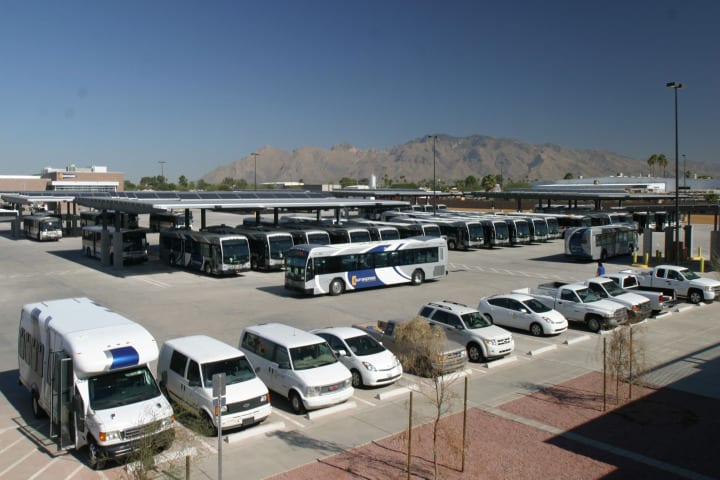
[IMAGE]Sun-Tran-LEED-facility-full.jpg[/IMAGE]The Regional Transportation Authority (RTA), City of Tucson and Sun Tran held a ribbon cutting ceremony to celebrate the unveiling of Sun Tran’s new bus storage and maintenance facility.
This is Tucson’s first “green” transit facility built to LEED (Leadership in Energy and Environmental Design) specifications. This facility was built to store and maintain Sun Tran’s expanding fleet of buses and to allow the agency to continue adding service and resources funded by the RTA.
LEED is an internationally recognized green building certification system developed by the U.S. Green Building Council (USGBC). LEED focuses on using less water, energy and resources, while creating less waste throughout the construction process.
In 2006 the City of Tucson’s mayor and council adopted LEED Silver standards for all new city-owned buildings and renovations over 5,000 square feet. Sun Tran’s Northwest Facility is LEED Silver registered, which is only the third city-owned facility to be completed using the USGBC specifications for green building.
Specifically, this facility features solar panels for power generation, the use of natural lighting to save energy, the use of reclaimed water and water efficient features to reduce water consumption, and a comfortable state-of-the-art work space for employees.
When fully built out, Sun Tran’s new Northwest Facility will have the capacity to operate and maintain 250 buses. The current Park Avenue facility, only designed for 150 buses, now maintains 230 buses in the fleet. Sun Tran is currently operating out of both facilities until the Northwest Facility’s 25 acres are fully built-out in mid-2011.
This project has been designed and constructed in three phases. Phase I, $8 million funded by the FTA and 1994 City of Tucson bonds, included the completion of Sun Tran Boulevard and the fueling facility completed in October 2005.
Phase II involved building the maintenance and operations buildings capable of operating up to 150 buses with funding of $32 million provided by the RTA and FTA. Phase II includes the state-of-the-art facility with 17 bus bays to repair and maintain the fleet, a fare retrieval area, bus wash and dispatch center. Operations began at this new facility on Nov. 15.
Phase III, currently being designed, will expand the maintenance building and construct an administration building for regional transit operations with $16 million in funding from American Recovery and Reinvestment Act stimulus funds. Construction is scheduled to begin in mid-2010 and is anticipated to be completed in mid-2011.
More Bus
Biz Briefs: New Flyer Delivers in Columbus, Houston, Beep and Freebee Merge, and More
In this edition of Biz Briefs, we spotlight the latest developments shaping the future of mobility.
Read More →
People Movement: Dan Dipert Coaches Adds Third-Generation Leader, Keolis Names New Valley Metro VP/GM, and More
In this edition, we also cover recent appointments and announcements at the Wabtec, SilverRide, HNTB, and more, showcasing the individuals helping to shape the future of transportation.
Read More →
New York MTA Plans Largest Bus Fleet Upgrade in More Than a Decade
The agency is seeking manufacturers for 650 new CNG buses to replace aging vehicles, improve reliability, and advance its broader fleet modernization strategy.
Read More →
Building a Flexible Path to Transit Electrification
John Hroncich discusses BAE Systems’ modular and scalable approach, lessons learned from decades of real-world operations, and how agencies can identify electrification strategies that fit their fleets.
Read More →
Bus Tech Talk: Keeping Transit Technicians Ahead of the Technology Curve
LA Metro’s Obed Mejia discusses technician training, evolving maintenance technology, fleet replacement, and strategies for getting the most out of today’s transit fleets.
Read More →
Biz Briefs: RIPTA Unveils New Frontrunners, Clevland RTA Adds New Siemens, and More
In METRO's latest installment, we take a look at recent news from Siemens, Prevost, Dodge, and more partnerships making headlines across the transportation sector.
Read More →
People Movement: Holly Arnold Joins Transdev and More
In this edition, we also cover recent appointments and announcements at Pace, CamTran, MCI, and more, showcasing the individuals helping to shape the future of transportation.
Read More →
The High Cost of Transit Buses: Industry Leaders Look to Procurement Reform
Transit leaders and policymakers examine how standardized bus designs, streamlined procurement, and predictable funding could help agencies stretch budgets and deliver better service.
Read More →
The Business Voice Behind Public Transportation
As chair of APTA’s Business Members Board of Governors, Ray Melleady explains how more than 850 business members are partnering with transit agencies to advance funding, innovation, and industry-wide collaboration.
Read More →
From Surviving to Thriving: Building Stronger Transportation Organizations
Bus Business Consultants founder Brian Dickson shares lessons on leadership, organizational health, and creating options for long-term success in a changing transportation industry.
Read More →