



Exclusive: California Transit Association tackles transit challenges
Conference highlights included updates on state legislative affairs, tips on low-cost marketing, finding new sources of ad revenue, and offering Google Transit.

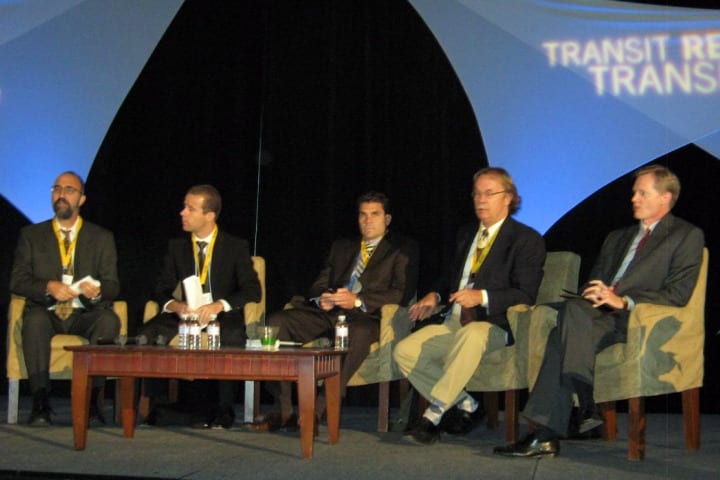
Plenary session speakers (from left): Richard A. Marcantonio, Dr. Richard Bernard, Brandon A. Castillo, Denny Zane and Russell Hancock discussed the future of state transit funding.
[IMAGE]CalifTransitAssocPlenarySpeakersFULL.jpg[/IMAGE] Taking place from Oct. 27 to 29 in Pasadena, Calif., The California Transit Association’s 44th Annual Fall Conference and Expo, “Transit Revival, Transit Survival” brought transit professionals from all over the state together to discuss budget and marketing issues, new technology and the latest legislative developments.
In the opening general session, speakers discussed the unprecedented changes that the public transportation industry is facing, and pointed to success stories throughout the state.
Bill Bogaard, mayor of hosting city Pasadena, said that the conference underscored why the topic of transit is more important now than ever, and recalled that when the L.A. Metro Gold Line was completed in 2002, the city pooled its resources, and came together around that event. He added that it has been a major factor in successful development in the city. “More than three-fourths of development takes place in that corridor,” Bogaard noted.
Bogaard also remarked that the past decade has been a pivotal one for Los Angeles transit, in particular with the passing of Measure R, the sales tax measure that appeared on the November 4, 2008 ballot in Los Angeles County, Calif., presenting an opportunity to move forward with a portfolio of projects for southern California.
Therese McMillan, deputy administrator, Federal Transit Administration, shared with attendees the latest on the Obama Administration’s positions on State of Repair, livability, Green House Gases (GHGs) and climate change. In particular, she explained that three federal agencies (the U.S. Department of Transportation, the Environmental Protection Agency, and the U.S. Department of Housing and Urban Development) joined to form the Livability Initiative.
“Decisions need to be made more swiftly to expand rail and bus as much as possible. Livability must be available to all. It’s important as we pursue transit oriented development that the notion of livability is hinged closer to ridership,” she added.
Funding’s future
In the Plenary Session “What Happened? What’s Next?” panelists walked conference attendees through the steps to be taken after the State Supreme Court of California’s decision in favor of the California Transit Association on the recent litigation against the state of California to prevent borrowing from the gas tax funds meant for public transportation.
Moderator Joshua Shaw, executive director, California Transit Association, reminded the audience that more hurdles lie ahead beyond going to the Supreme Court with the proposed law, including figuring out how to permanently stop the illegal transfer of funds. “This litigation result is no guarantee against future raids. The second strategy is going to the people. [We’re] exploring the feasibility of putting this on the ballot,” he said.
Technology tips, tapping resources
Sessions to help conference-goers learn how to enhance their marketing efforts with little to no funds, navigate the process necessary to offer riders online trip planning through Google Transit, and identify new sources of ad revenue were well-attended.
In “Marketing on a Shrinking Budget,” speakers discussed how transit agencies can form effective partnerships and pinpoint what they have to offer.
Metrolink’s Charlene Ariza, marketing and sales program manager, provided tips on partnering the with private sector, using the agency’s partnership package with the professional ice hockey team, the L.A. Kings, as an example.
Meanwhile, in the “Trip Planning through Partnerships with Google Transit” session, speakers imparted words of wisdom after going through the process.
Francisco Oaxaca, spokesman, Metrolink, explained that while offering the service is free, there are upfront costs with converting data, portraying it on the Website, and making it as easy as possible for users to generate an itinerary. Adding a station locator feature was one of the agency’s solutions, and, as a result of having to convert all their data, Metrolink and a number of local major providers upgraded their scheduling software.
In the session, “New Sources of Ad Revenue”, speakers said that political advertising is growing rapidly, and $50 billion out of $3 billion spent on outdoor advertising, presenting a prime opportunity for transit agencies.
Robb Schupp, Metropolitan Transit Systems San Diego shared his agency’s recent experiences with shoring up ad revenue by identifying opportunities on their bus shelters and trolleys. “It’s harder for smaller agencies to get this attention, so our job is tougher. We’re packaging all our assets together to attract advertisers,” explained Schupp.
More Bus
Frontrunner Bus Group Expands with New Massachusetts Headquarters
The significantly larger facility will provide the infrastructure needed to support the company’s growing workforce, advanced technologies, and expanding product line.
Read More →
Joshua Schank on Transportation Innovation, Risk, and the Future of Mobility
In this edition of METROspectives, Joshua Schank discusses lessons from launching LA Metro’s Office of Extraordinary Innovation, the challenges of advancing new mobility technologies, and much more.
Read More →
Reinventing Fleet Maintenance with Real-time Visibility and AI
Transit leaders need to know what needs fixing, where to look, who is responsible, when work is completed, and what it costs without having to chase information across disconnected systems.
Read More →
SamTrans Sets Priorities for Potential Connect Bay Area Revenue
The board-approved framework allocates future funding to maintaining service, rider improvements, equity initiatives, and infrastructure repairs.
Read More →
When Routine Fails: How Public Transit Must Adapt for the World Cup
The 2026 FIFA World Cup will test transit agencies’ ability to manage unpredictable travel patterns, making real-time data and operational flexibility critical to moving millions of visitors efficiently.
Read More →
Photo Highlights from APTA's 2026 Mobility Conference
The photo gallery captures scenes from the conference, including the International Bus Roadeo, exhibit hall activities, the Bus Showcase, and much more.
Read More →
Chicago's NITA Act Moves Into Next Phase as Service Improvements Begin
Rider-focused improvements will begin rolling out across the system immediately as CTA, Metra, and Pace increase service this summer in the six-county region.
Read More →
Philadelphia's SEPTA Approves Annual Transit Service Plan
Between 2021 and 2024, SEPTA held more than 200 public meetings — including 144 in-person sessions — throughout the SEPTA service region.
Read More →
A True Low-Floor Minibus Design Delivers Better Accessibility and Efficiency for Everyone
As transit demands evolve, so should your fleet. Download the whitepaper to see how the Low-Floor Frontrunner Minibus compares to traditional options.
Read More →
WMATA Debuts 'Fares Pay for Service' Awareness Campaign
The campaign was highlighted during a media event at the Paul S. Sarbanes Transit Center in Silver Spring, where WMATA’s GM/CEO Randy Clarke joined Metro Transit Police officers, WMATA management team, board members, and staff to expand fare enforcement and customer education efforts on Metro Bus routes throughout the region.
Read More →