



Web Extra: Sound Transit commences Univ. of Washington tunneling project
University Link will extend the region's first modern light rail system by about three miles and serve an estimated 70,000 additional daily riders in one of the most densely populated areas of the university and the nation.

Courtesy of Sound Transit
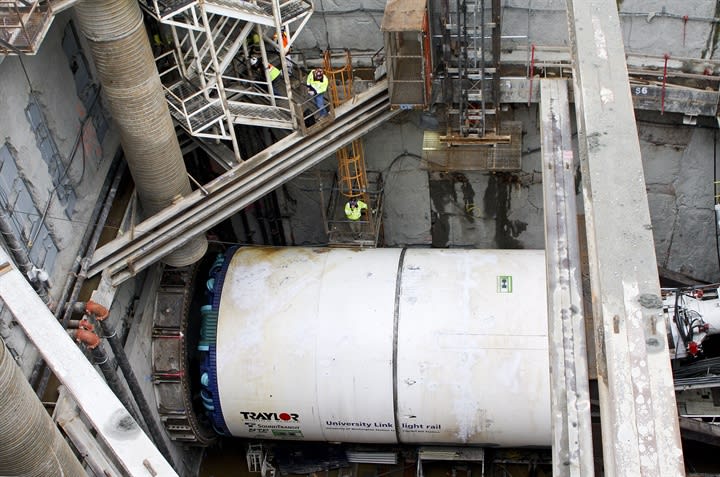
[IMAGE]UWS-TBMLaunch-TBM-5-11-2.jpg[/IMAGE]Last week, Sound Transit dedicated the first of the three tunnel boring machines that will dig twin tunnels from the University of Washington (UW) to downtown Seattle as part of the transit system's University Link light rail extension.
"We're a couple of years into construction, but this marks a huge milestone of getting the tunnel boring machines in place and ready to go," said Bruce Gray spokesman for Sound Transit.
University Link will extend the region's first modern light rail system by about three miles and serve an estimated 70,000 additional daily riders in one of the most densely populated areas of the university and the nation.
"The station will be right next to Husky Stadium and the university's medical center," explained Bob Roseth, director, news and information, at UW. "Half of the university's activity is concentrated on what is called south campus, so it's a key destination point for lots and lots of people, not just students."
Roseth added that on any given day, UW can have up to 75,000 people on campus including students, faculty, staff and visitors. He also said that the University Link will be beneficial for those going to Husky Stadium for football games.
When complete, it will take six minutes to get from Husky Stadium to downtown Seattle via Link. Riders can also transfer downtown to reach Sea-Tac Airport.
University Link will provide a reliable option for drivers and transit users who are stuck on Interstate 5, a facility that operates over capacity for up to eight hours a day, with vehicle speeds running between 15 mph and 35 mph, according to Sound Transit.
With UW focused on lowering its economic footprint and use of single occupancy vehicles, it has been a long-time supporter of public transit to campus and worked in tandem with Sound Transit to help the project become a success, explained Roseth.
"The issue for us has been sighting of the stations," he added. "We also have a lot of high-end research going on here that uses very sensitive equipment, so we had extensive discussions, and productive ones, that were ultimately satisfying in terms of the sighting of the station, routing of the lines and digging of the tunnels."
[IMAGE]UWS-TBM-Launch-diplomats-banner-2.jpg[/IMAGE]The population of the corridor served by University Link is expected to increase by a projected 56 percent by 2030, further increasing congestion and the need for fast, reliable light rail service. Based on its benefits, the University Link project received the highest possible FTA ranking in the extremely competitive federal funding process, Gray explained.
The University Link extension is expected to be completed in 2016. An additional light rail project that will provide transportation to the north side of campus, which voters approved in 2008, is in the works with UW and Sound Transit continuing to work together to achieve the proper alignment. That extension is expected to open by 2021.
More Rail

The Invisible Infrastructure of Passenger Flow
What a seat reservation system on Austria’s Railjet trains reveals about the future of rider experience, and why U.S. agencies should pay attention.
Read More →
Caltrain Board Approves FY27 Budget, Endorses Efficiency Measures
The move ensures Caltrain service will continue operating as usual in the near term, but long-term financial challenges remain for the rail agency absent a new revenue source.
Read More →
Alstom Acquires Delaware Site to Support Amtrak NextGen Acela Fleet
The company is investing more than $55 million to acquire and improve the property and will employ approximately 100 people at this site once it is operational.
Read More →
When Routine Fails: How Public Transit Must Adapt for the World Cup
The 2026 FIFA World Cup will test transit agencies’ ability to manage unpredictable travel patterns, making real-time data and operational flexibility critical to moving millions of visitors efficiently.
Read More →
California Selects Team for Nation’s First True High-Speed Rail Track and Systems Contract
The board action follows completion of track installation at the 150-acre southern railhead in Kern County, which will serve as the staging and distribution hub for high-speed track and systems installation.
Read More →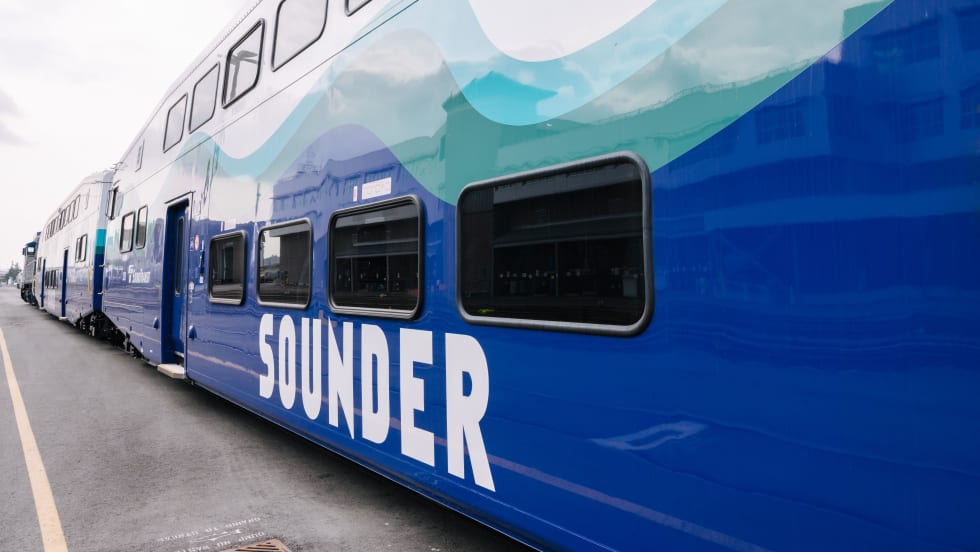
Seattle's Sound Transit Launches New Sounder Railcars into Service
Alstom manufactured all the cars under a $46.5 million contract and came into service in anticipation of summer crowds for soccer and baseball.
Read More →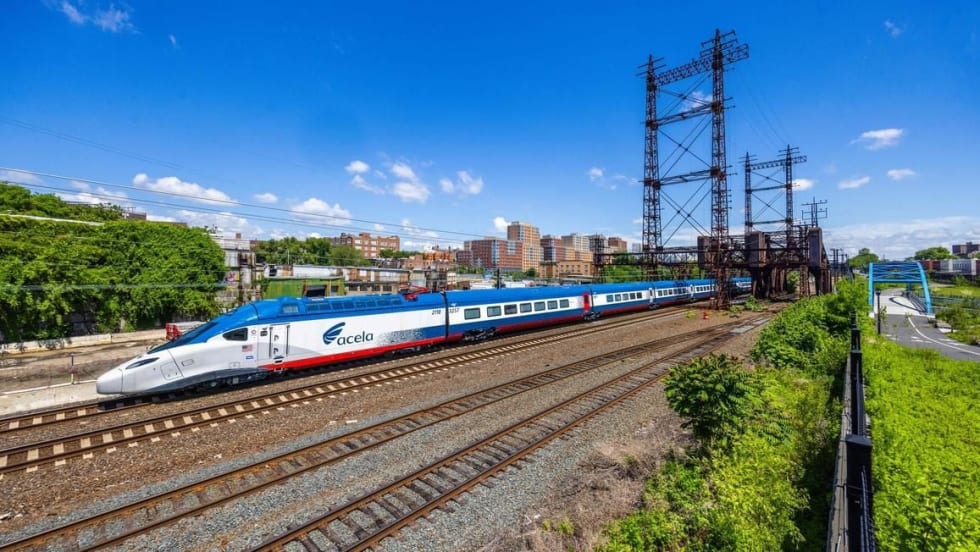
Alstom Partners With Universities to Build Rail Talent Pipeline
The partnerships include a new engineering scholarship fund at Alfred State College in Western New York and collaborations with transportation centers at the University of Pennsylvania and New York University.
Read More →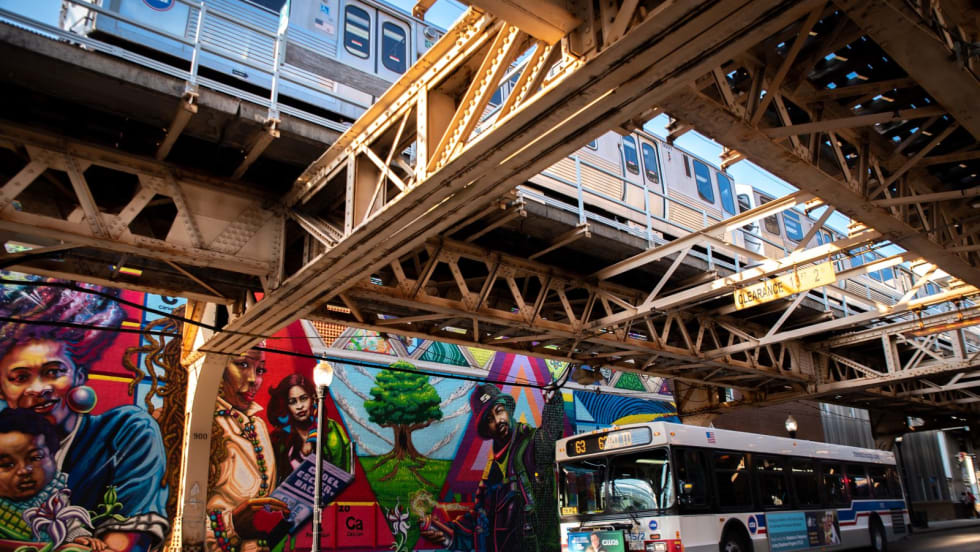
Chicago's NITA Act Moves Into Next Phase as Service Improvements Begin
Rider-focused improvements will begin rolling out across the system immediately as CTA, Metra, and Pace increase service this summer in the six-county region.
Read More →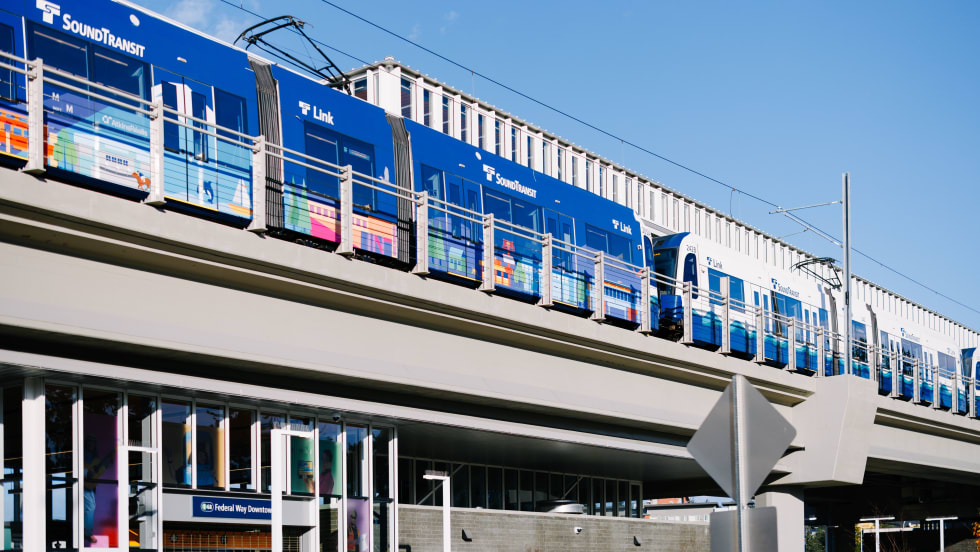
Seattle’s Sound Transit Adopts Updated ST3 System Plan
The updated system plan incorporates cost savings across the agency, including new revenue sources and financial policies, to set the agency on a sustainable path for the future.
Read More →
Inside Look: EMBARK Expands Fare-Free Transit Program Through New Public-Private Partnership
The OKC transit agency says sponsorship helps subsidize the Third Friday Free initiative while reducing barriers for first-time riders and boosting ridership across buses, streetcars, and river cruises.
Read More →