



UT Profile: Diverse fleet helps Yale service navigate urban routes
The fleet includes 45 vehicles that run on B20 biodiesel. At peak times, there are 20 to 22 vehicles on the road and 12 to 15 in the evenings. Peak school year ridership is between 40,000 to 50,000 passengers a week.

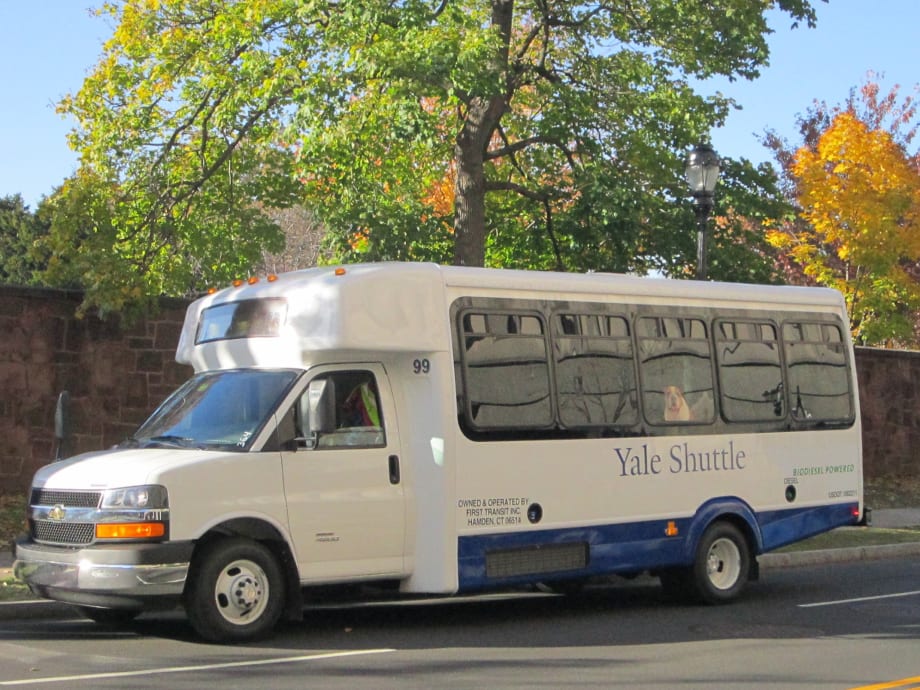
One year after taking over Yale University’s bus system, Greg Tower, GM for First Transit, touts the service's ability to effectively move students, staff and faculty in an urban environment.
“Here at Yale, you have to compete with all the city commotion, which includes delivery trucks, public transportation and rush hour, one of our biggest challenges is operating in New Haven, where the crime rate isn’t exactly ideal and you have all those variables that can impact service,” said Tower.
To help navigate the urban environment, Yale launched a unique door-to-door service that enables the university’s community to contact the dispatch center and get picked up by a Yale University Shuttle bus driver.
“We upgraded to wireless tablets on the buses, so after the passenger calls into the dispatch center, the manifest populates on that tablet and the driver will go pick up the passenger,” explained Tower. “When they’re close, the passenger receives a call and we bring them to their destination using the door-to-door service. It keeps them safe and keeps them from having to walk at night. During the day, our door-to-door service is for the handicap only.”
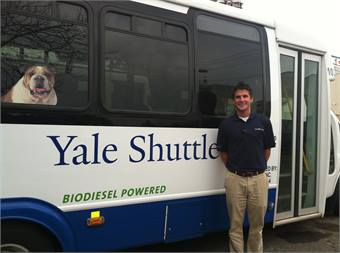
Greg Tower, GM for First Transit, has lead Yale Shuttle since July 2011.
The fleet includes 45 vehicles that run on B20 biodiesel. At peak times, there are 20 to 22 vehicles on the road and 12 to 15 in the evenings. Peak school year ridership is between 40,000 to 50,000 passengers a week, according to Tower.
Yale’s shuttle service recently added two new MV-1s from VPG, one of which runs on compressed natural gas.
The American designed and made MV-1 is the first of its kind designed specifically for wheelchair accessibility. The new vehicles include ample head room, a low step-in flat floor, and deployable ramp that is electric-powered for quick and easy passenger access. It can comfortably fit two wheelchairs and two additional passengers.
Over the next few years, Yale’s Parking and Transit will collect data for a side-by-side comparison of fuel usage, fuel cost and miles driven. These statistics will be used for future fleet purchases, especially when Yale units are considering buying natural gas vehicles, which is in keeping with goal of diversifying the Yale fleet by purchasing more alternative fuel vehicles.
The MV-1s were set to hit the road this summer.
“Having this type of vehicle that is ADA-equipped right from the start is very exciting,” said Tower.
While Tower explained that the well-established shuttle system has needed only a little tweaking, he added that the system hopes it will rely more heavily on its TransLoc automatic vehicle locator system, rather than rigid time points.
“We’ve worked on training the passengers to be more aware of TransLoc and to use it as a tool, which is phenomenal,” said Tower. “That is just one way we continue to change with the times just as everyone else is.”
BUSCON: Want to know more about alternative fuels? A presentation on this and other hot topics will be featured at the 17th Annual BusCon Expo, taking place September 11-12 at Chicago’s Navy Pier. Visit www.BusConExpo.com or call (800) 576-8788 for more information.
More Bus

New York MTA Plans Largest Bus Fleet Upgrade in More Than a Decade
The agency is seeking manufacturers for 650 new CNG buses to replace aging vehicles, improve reliability, and advance its broader fleet modernization strategy.
Read More →
Building a Flexible Path to Transit Electrification
John Hroncich discusses BAE Systems’ modular and scalable approach, lessons learned from decades of real-world operations, and how agencies can identify electrification strategies that fit their fleets.
Read More →
Bus Tech Talk: Keeping Transit Technicians Ahead of the Technology Curve
LA Metro’s Obed Mejia discusses technician training, evolving maintenance technology, fleet replacement, and strategies for getting the most out of today’s transit fleets.
Read More →
Biz Briefs: RIPTA Unveils New Frontrunners, Clevland RTA Adds New Siemens, and More
In METRO's latest installment, we take a look at recent news from Siemens, Prevost, Dodge, and more partnerships making headlines across the transportation sector.
Read More →
People Movement: Holly Arnold Joins Transdev and More
In this edition, we also cover recent appointments and announcements at Pace, CamTran, MCI, and more, showcasing the individuals helping to shape the future of transportation.
Read More →
The High Cost of Transit Buses: Industry Leaders Look to Procurement Reform
Transit leaders and policymakers examine how standardized bus designs, streamlined procurement, and predictable funding could help agencies stretch budgets and deliver better service.
Read More →
The Business Voice Behind Public Transportation
As chair of APTA’s Business Members Board of Governors, Ray Melleady explains how more than 850 business members are partnering with transit agencies to advance funding, innovation, and industry-wide collaboration.
Read More →
From Surviving to Thriving: Building Stronger Transportation Organizations
Bus Business Consultants founder Brian Dickson shares lessons on leadership, organizational health, and creating options for long-term success in a changing transportation industry.
Read More →
Finding the ‘Happy Medium’: Optimizing Maintenance Without Sacrificing Reliability
The key to maintenance optimization isn’t doing less work—it’s doing the right work at the right time on the right assets.
Read More →
LA Metro, City of West Hollywood, and Partners Advance Smarter Bus Lane Enforcement
The award-winning partnership combines AI-powered detection with human oversight to improve bus reliability, accessibility, and enforcement efficiency.
Read More →