



UC Davis lauded for sustainability efforts
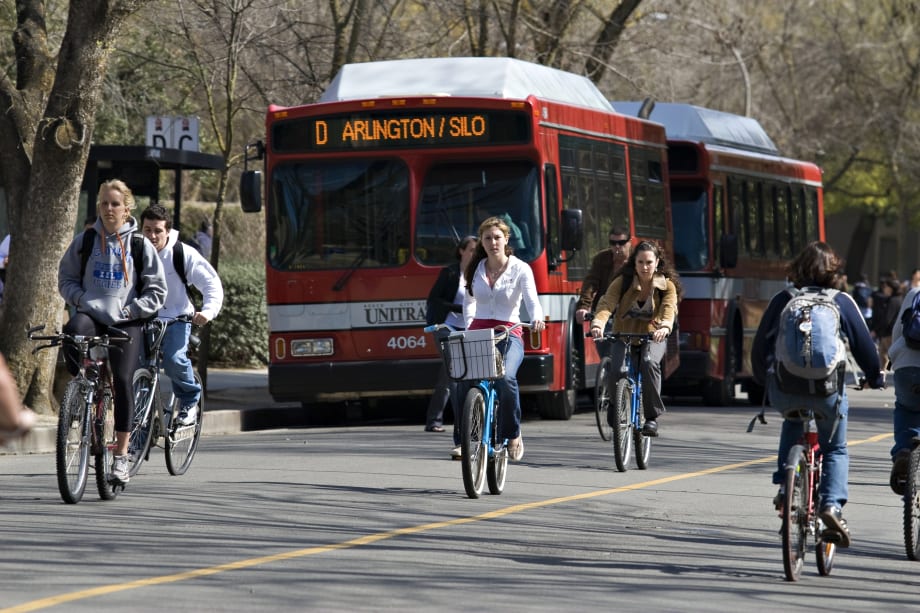
Offers extensive transportation system that includes the student-run Unitrans bus service, which serves the campus and adjoining city with 49 natural-gas-powered buses that carry 21,000 riders a day, 42 miles of bike paths and more than 20,000 bicycle parking spaces.

The University of California, Davis, was named the nation’s “Coolest School,” by SierraMagazine for its efforts to address climate change and operate sustainably.
The 5,300-acre campus, internationally acclaimed for its research in environmental sciences, ranked No. 1 among the 96 top colleges and universities surveyed.
“At UC Davis, sustainability is one of our core values,” said UC Davis chancellor Linda P.B. Katehi. “I am very proud of the students, faculty and staff who have worked so hard to make this achievement possible and to invest in a more sustainable future for our campus.”
In bestowing the “Coolest School” ranking, the Sierra Club’s official publication praised UC Davis for establishing rigorous green purchasing standards; diverting nearly 70% of campus trash from landfills; and offering an extensive transportation system that includes the student-run Unitrans bus service, which serves the campus and adjoining city with 49 natural-gas-powered buses that carry 21,000 riders a day, 42 miles of bike paths and more than 20,000 bicycle parking spaces.
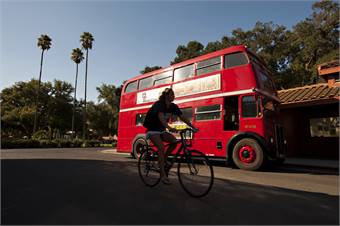
Photos courtesy UC Davis.
UC Davis drew international attention for its commitment to sustainability last fall, when it officially opened the doors to UC Davis West Village, the nation’s largest planned zero net energy community. The 130-acre development, which will house about 3,000 students, faculty and staff, is designed to generate as much electricity as it uses over the course of a year.
UC Davis has also established itself as a leader in environmental sustainability through:
A Climate Action Plan that has reduced campus greenhouse gas emissions below year 2000 levels and expects to reach year 1990 levels by 2020.
A $39 million Smart Lighting Initiative that is on track to reduce campus electrical use by 60% by 2015, saving $3 million on the annual electricity bill. In June, UC Davis became the first campus in the nation to introduce adaptive, networked exterior lighting, a project that alone will save $100,000 annually in electricity costs.
Planning that helps 85% of students and 46% of employees to use sustainable transportation (walking, bicycling, carpooling, riding a bus or taking a train) as their primary means of commuting to and getting around on campus.
Aggressive recycling, composting and reuse efforts that in 2011 prevented 64% of campus waste from entering landfills annually. Aggie Stadium has won the EPA’s Wastewise Game Day Challenge diversion rate championship for the past two years. In 2011, the stadium diverted more than 93% of its waste on challenge day. Throughout the year, the stadium prevents about 80% of its waste from entering landfills.
The campus spends more than 20% of its $5.6 million food budget for residential dining services on local products, buys organic items such as poultry and grains, and sources olive oil and tomatoes from campus farms.
Visitors to campus can take a self-guided tour of these and other sustainability highlights by downloading a map or obtaining a print version on campus. A website, Sustainable 2nd Century, launched in 2009 to celebrate UC Davis’ first 100 years, also catalogues sustainable achievements.
Four UC Davis building complexes are certified LEED Platinum, the highest ranking awarded by the U.S. Green Building Council and more than any other UC campus. Among them is the world’s first LEED Platinum winery, brewery and food processing facility, in which a new generation of students is learning to produce fine wine, beer and food using less water and electricity.
In addition:
UC Davis research informs state water, transportation, lighting, construction, and air quality policies, which often influence national policy.
UC Davis is the home base of Andrew Frank, hailed as the “father of the plug-in hybrid.” The longtime professor of mechanical and aerospace engineering built the first commercially viable plug-in hybrid.
Sierra Magazine’s top 10 schools of 2012 are:
1. University of California, Davis (Davis, Calif.)
2. Georgia Institute of Technology (Atlanta)
3. Stanford University (Stanford, Calif.)
4. University of Washington (Seattle)
5. University of Connecticut (Hartford, Conn.)
6. University of New Hampshire (Durham, N.H.)
7. Duke University (Durham, N.C.)
8. Yale University (New Haven, Conn.)
9. University of California, Irvine (Irvine, Calif.)
10. Appalachian State University (Boone, N.C.)
More Technology

From Hardware to Digital Partner: Luminator Charts Its Next Chapter
CEO Magnus Friberg discusses Luminator’s shift toward becoming a digital partner, the growing importance of software and interoperability, and how AI can help agencies improve operations and passenger experience.
Read More →
Beyond the Checklist: A Structured Approach to Transit Maintenance
Reliability-Centered Maintenance helps transit agencies move beyond routine checklists to focus limited resources on the assets and failures that have the greatest impact on safety, reliability, and service.
Read More →
NJ TRANSIT Advances Bus Technology Upgrades Across Statewide Fleet
More than 1,500 buses now feature upgraded technology designed to improve arrival predictions and provide free Wi-Fi, with deployment expected to reach nearly 2,000 buses by the end of 2026.
Read More →

Building a Flexible Path to Transit Electrification
John Hroncich discusses BAE Systems’ modular and scalable approach, lessons learned from decades of real-world operations, and how agencies can identify electrification strategies that fit their fleets.
Read More →
Biz Briefs: Alstom Lands Canadian Contract, LYT to Supply California TSP, and More
In METRO's latest installment, we take a look at recent news from Complete Coach Works, Beep, FlixBus, and more partnerships making headlines across the transportation sector.
Read More →
From Legacy Silos to Conversational Intelligence
What if transit leaders could ask any operational question and get a trusted answer in seconds? Conversational AI is transforming how agencies use their data.
Read More →
USDOT Announces Rail Vehicle Replacement Grants, Chattanooga AV Shuttle Funding
More than $191 million in federal funding will help three transit agencies replace aging rail vehicles and support a new autonomous shuttle service in Chattanooga.
Read More →
Bus Tech Talk: Keeping Transit Technicians Ahead of the Technology Curve
LA Metro’s Obed Mejia discusses technician training, evolving maintenance technology, fleet replacement, and strategies for getting the most out of today’s transit fleets.
Read More →
Biz Briefs: RIPTA Unveils New Frontrunners, Clevland RTA Adds New Siemens, and More
In METRO's latest installment, we take a look at recent news from Siemens, Prevost, Dodge, and more partnerships making headlines across the transportation sector.
Read More →
Why Simulating Pedestrian Movement Has Become Essential for Modern Rail Stations
Pedestrian microsimulation is helping rail planners identify bottlenecks, test station designs, and prepare complex transit hubs for growing passenger volumes.
Read More →