



N.Y.'s Centro opens $18.8M transit hub
Centro's new facility includes a 55,000 square foot canopy, 22 sawtooth bus bays and heated sidewalks to help melt the 110 inches of snow that fall during an average winter. The project replaces the "Common Center," which required customers navigate an array of buses that lined up in all four directions of an intersection.

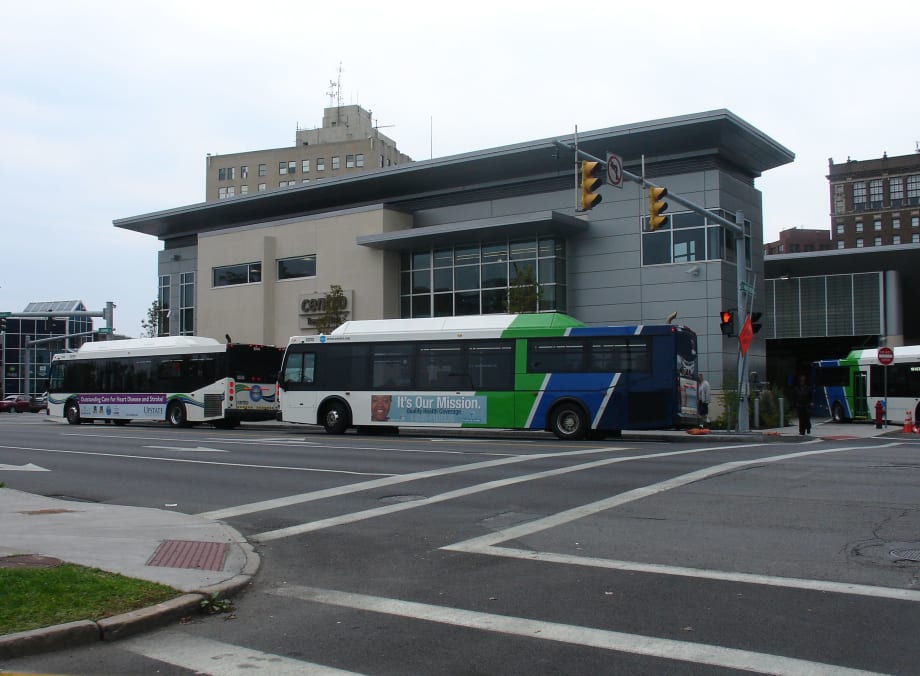
The Central New York Regional Transportation Authority (Centro) has opened its new $18.8M Transit Hub in downtown Syracuse.
Each day, about 8,000 Centro customers travel through the Transit Hub, which serves as the main transfer location for Centro’s bus services in Syracuse and surrounding communities. The new facility replaces a four corners location known as “Common Center” which required customers navigate an array of buses that lined up in all four directions of the intersection and exposed customers to Syracuse’s harsh winters.
“We simply outgrew ‘Common Center’ and smothered that intersection,” said Centro Executive Director Frank Kobliski. “So we moved a couple of blocks south and built the Transit Hub. Now our customers have a refuge from the elements, access to restrooms, and they no longer have to guess where their bus will be. Each bus route departs from a designated bus bay.”
The transit hub also provides customers with access to new ticket vending machine and indoor/outdoor electronic bus information monitors.
Transit customers have been waiting at the former Common Center dating back to the horse-car days. In recent years, the intersection has become increasingly dominated by transit buses and its customers. With the transition to the Transit Hub, developers have taken interest in the former location. A $25M renovation project is already under way — known as Pike Block — which will renovate 130,000 square feet of vacant space into 78 market rate apartments, 25,000 square feet of ground floor retail space and a revitalized city center.
“In the last year we have welcomed 22 new businesses to Downtown. In fact, 38% of Syracuse’s jobs are within 3 miles of the city’s center,” said Robert Simpson, President of CenterState CEO. “Convenient transportation is part of this movement back to the city and Centro’s Transit Hub greatly enhances that experience.”
Construction of the Transit Hub began in July of last year and opened to the public on Sept. 4. The facility includes a 55,000 square foot canopy, 22 sawtooth bus bays and heated sidewalks to help melt the 110 inches of snow that fall in Syracuse during an average winter.
The project was funded through various federal grants, including an $8.5M from the United States Department of Transportation’s Livability Grant program designed specifically to fund projects that improve the quality of public transportations and the communities it serves.
More Bus

New York MTA Plans Largest Bus Fleet Upgrade in More Than a Decade
The agency is seeking manufacturers for 650 new CNG buses to replace aging vehicles, improve reliability, and advance its broader fleet modernization strategy.
Read More →
Building a Flexible Path to Transit Electrification
John Hroncich discusses BAE Systems’ modular and scalable approach, lessons learned from decades of real-world operations, and how agencies can identify electrification strategies that fit their fleets.
Read More →
Bus Tech Talk: Keeping Transit Technicians Ahead of the Technology Curve
LA Metro’s Obed Mejia discusses technician training, evolving maintenance technology, fleet replacement, and strategies for getting the most out of today’s transit fleets.
Read More →
Biz Briefs: RIPTA Unveils New Frontrunners, Clevland RTA Adds New Siemens, and More
In METRO's latest installment, we take a look at recent news from Siemens, Prevost, Dodge, and more partnerships making headlines across the transportation sector.
Read More →
People Movement: Holly Arnold Joins Transdev and More
In this edition, we also cover recent appointments and announcements at Pace, CamTran, MCI, and more, showcasing the individuals helping to shape the future of transportation.
Read More →
The High Cost of Transit Buses: Industry Leaders Look to Procurement Reform
Transit leaders and policymakers examine how standardized bus designs, streamlined procurement, and predictable funding could help agencies stretch budgets and deliver better service.
Read More →
The Business Voice Behind Public Transportation
As chair of APTA’s Business Members Board of Governors, Ray Melleady explains how more than 850 business members are partnering with transit agencies to advance funding, innovation, and industry-wide collaboration.
Read More →
From Surviving to Thriving: Building Stronger Transportation Organizations
Bus Business Consultants founder Brian Dickson shares lessons on leadership, organizational health, and creating options for long-term success in a changing transportation industry.
Read More →
Finding the ‘Happy Medium’: Optimizing Maintenance Without Sacrificing Reliability
The key to maintenance optimization isn’t doing less work—it’s doing the right work at the right time on the right assets.
Read More →
LA Metro, City of West Hollywood, and Partners Advance Smarter Bus Lane Enforcement
The award-winning partnership combines AI-powered detection with human oversight to improve bus reliability, accessibility, and enforcement efficiency.
Read More →