



FMCSA updates Safety Measurement System
The changes, developed over several months with feedback from the public and stakeholders throughout the industry, will enhance the agency’s ability to identify and take action against trucks and buses with safety and compliance concerns.

The U.S. Department of Transportation's Federal Motor Carrier Safety Administration (FMCSA) implemented 11 new improvements to its Safety Measurement System (SMS).
The changes, developed over several months with feedback from the public and stakeholders throughout the industry, will enhance the agency’s ability to identify and take action against trucks and buses with safety and compliance concerns.
The SMS uses all available inspection and crash data to prioritize carriers for interventions. SMS quantifies on-road safety performance of carriers to identify the specific safety problems the carrier exhibits and to monitor whether performance is improving or worsening. SMS helps FMCSA more efficiently apply its resources and bring carriers and drivers into compliance with federal safety regulations in order to prevent crashes and save lives.
"Safety is our number one priority,” said U.S. Transportation Secretary Ray LaHood. “These improvements will enable us to more accurately identify unsafe truck and bus companies and intervene before tragedies occur.”
The SMS improvements will give FMCSA more precise information to assess a company’s on-the-road safety performance. The enhancements implemented today include:
Changing the Cargo-Related BASIC (Behavior Analysis and Safety Improvement Category) to the Hazardous Materials (HM) Compliance BASIC to better identify HM-related safety and compliance problems. Motor carriers and law enforcement can view this new BASIC in December; however FMCSA will conduct further monitoring before the BASIC is made public.
Strengthening the Vehicle Maintenance BASIC by including cargo and load securement violations that were previously in the Cargo-Related BASIC.
Counting intermodal equipment violations found during drivers’ pre-trip inspections.
Aligning speeding violations to be consistent with current speedometer regulations that require speedometers to be accurate within 5 mph. The change applies to the prior 24 months of data used by the SMS and all SMS data moving forward.
Changing the name of the Fatigued Driving BASIC to the Hours-of-Service (HOS) Compliance BASIC to more accurately reflect violations contained within the BASIC.
Aligning the severity weight of paper and electronic logbook violations equally on the SMS for consistency purposes.
FMCSA provided a four-month preview period to give the public and industry ample opportunity to review and comment on the proposed changes to FMCSA's SMS. Overall, more than 19,000 companies and 2,900 law enforcement personnel participated in the public preview.
Motor carriers are encouraged to check their safety data to see how the SMS changes may have affected their SMS results.
More Motorcoach

People Movement: Dan Dipert Coaches Adds Third-Generation Leader, Keolis Names New Valley Metro VP/GM, and More
In this edition, we also cover recent appointments and announcements at the Wabtec, SilverRide, HNTB, and more, showcasing the individuals helping to shape the future of transportation.
Read More →
METRO Opens Submissions for 2026 Motorcoach Awards
Nominations are now being accepted for METRO Magazine’s Operator of the Year and Innovative Operator of the Year awards.
Read More →
Biz Briefs: Alstom Lands Canadian Contract, LYT to Supply California TSP, and More
In METRO's latest installment, we take a look at recent news from Complete Coach Works, Beep, FlixBus, and more partnerships making headlines across the transportation sector.
Read More →
Biz Briefs: RIPTA Unveils New Frontrunners, Clevland RTA Adds New Siemens, and More
In METRO's latest installment, we take a look at recent news from Siemens, Prevost, Dodge, and more partnerships making headlines across the transportation sector.
Read More →
People Movement: Holly Arnold Joins Transdev and More
In this edition, we also cover recent appointments and announcements at Pace, CamTran, MCI, and more, showcasing the individuals helping to shape the future of transportation.
Read More →
ABA Report: Motorcoach Travel Generates $161.6B Economic Impact
The 2025 analysis finds motorcoach travel supported nearly 900,000 jobs and generated $28 billion in federal, state, and local taxes.
Read More →
CharterUP’s Armir Harris on Technology, AI, and the Future of Group Mobility
In a recent episode of METROspectives, CharterUP Founder/CEO Armir Harris discussed the company’s evolution from an online charter bus marketplace into a technology platform supporting public- and private-sector mobility and much more.
Read More →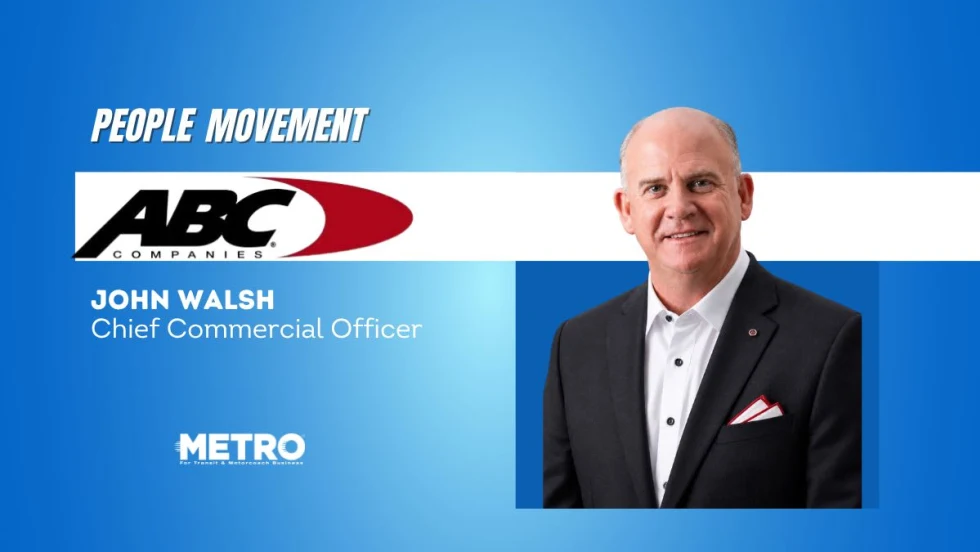
People Movement: ABC Names John Walsh as Chief Commercial Officer
In this edition, METRO also covers recent appointments and announcements at the DART, STV, and more, showcasing the individuals helping to shape the future of transportation.
Read More →
From Surviving to Thriving: Building Stronger Transportation Organizations
Bus Business Consultants founder Brian Dickson shares lessons on leadership, organizational health, and creating options for long-term success in a changing transportation industry.
Read More →
Biz Briefs: Luminator Marks Milestone and More
From manufacturers and suppliers to transit agencies and motorcoach operators, these updates offer a snapshot of the projects, partnerships and business moves driving the industry forward.
Read More →