



Chicago unveils proposed BRT lane configurations
Plans for the Central Loop East-West Transit Corridor include designated bus-priority lanes on two miles of streets The Loop BRT corridor will serve Union Station, Ogilvie Transportation Center, CTA subways and Navy Pier with more than 1,700 buses per day, making it one of the busiest bus routes in the nation. Expected to start service in 2014.

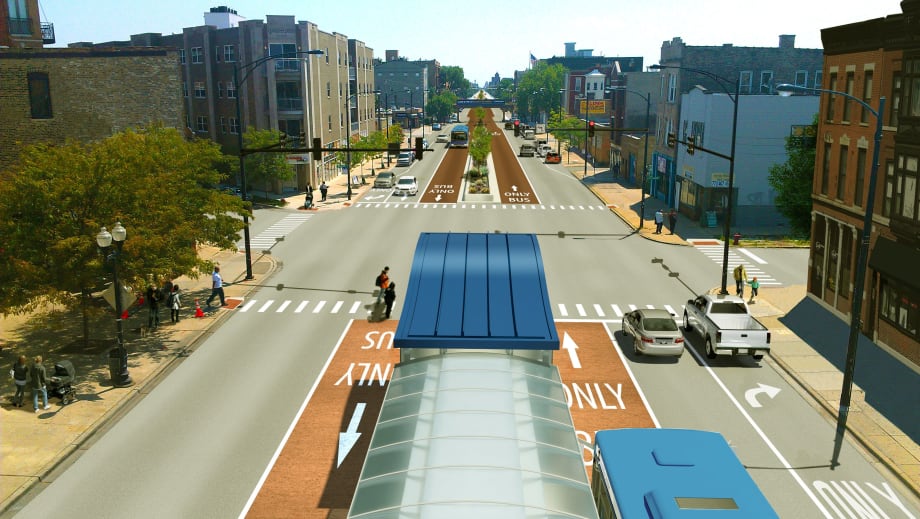
A rendering of the Western Ashland BRT. Photo courtesy Chicago Transit Authority.
A rendering of the Western Ashland BRT. Photo courtesy Chicago Transit Authority.
The Chicago Department of Transportation (CDOT) and the Chicago Transit Authority (CTA) unveiled the proposed lane configurations for the Loop streets to be used by the planned bus rapid transit (BRT) system that is scheduled to start service in 2014. Through careful planning and design, the lanes will provide a balanced separation of bus, bike and regular traffic lanes.
The agencies also unveiled renderings of the design for the new off-street transportation center just south of Union Station, which will provide key connections with other modes of transport to the BRT system.
BRT plans for the Central Loop East-West Transit Corridor include designated bus-priority lanes on two miles of streets: Madison, Washington, Canal and Clinton. The Loop BRT corridor will serve Union Station, Ogilvie Transportation Center, CTA subways and Navy Pier with more than 1,700 buses per day, making it one of the busiest bus routes in the nation.
BRT improvements designed to make bus travel more reliable and appealing to customers include: colored pavement markings and enhanced signage clearly delineating the bus lanes; level-boarding; queue jumps for buses at key intersections; distinct bus shelters; bus tracker digital displays; sidewalk improvements and protected bike lanes.
“By using a balanced approach to configuring the roadways for BRT, we will make cost-effective improvements without dramatically changing the current traffic setup,” said CDOT Commissioner Gabe Klein. “At the same time, we will provide transit connections to downtown businesses and major destinations more reliable, fast and easy.”
Under the proposed lanes configuration, eastbound Washington will feature a colored bus-only lane that will be serviced with island bus-boarding platforms. Two auto lanes will remain for traffic through the Loop. A bike lane against the southern curb would be protected from auto traffic by the bus lane and boarding platforms.
On westbound Madison, the bus-only and auto lanes would be similar to the current configuration with curbside bus-boarding platforms. The westbound protected bike lane would be relocated to Randolph Street.
“Washington and Madison are two of CTA’s most traveled bus corridors with buses arriving every two to three minutes,” said CTA President Forrest Claypool. “The new configuration will speed up six routes on these busy streets and 15 total routes throughout the entire Central Loop BRT corridor, providing more efficient service for those making east-west connections in the Loop.”
CDOT will construct and manage the Central Loop BRT project, which is being financed by a $24.6 million Federal Transit Administration grant and $7.3 million in local Tax Increment Financing funds.
CDOT is in the process of acquiring a surface parking lot located south of Jackson between Canal and Clinton to build the transportation center. It will provide sheltered staging areas for CTA buses and a vertical connection to an existing Amtrak underground passageway, allowing commuters to access Union Station without crossing at street level.
BRT improvements could improve overall bus travel times through the Central Loop corridor by three to nine minutes per trip. While buses are only 4% of the vehicles traveling through the corridor, they carry more than 47% of the commuters making trips in vehicles.
More Bus

New York MTA Plans Largest Bus Fleet Upgrade in More Than a Decade
The agency is seeking manufacturers for 650 new CNG buses to replace aging vehicles, improve reliability, and advance its broader fleet modernization strategy.
Read More →
Building a Flexible Path to Transit Electrification
John Hroncich discusses BAE Systems’ modular and scalable approach, lessons learned from decades of real-world operations, and how agencies can identify electrification strategies that fit their fleets.
Read More →
Bus Tech Talk: Keeping Transit Technicians Ahead of the Technology Curve
LA Metro’s Obed Mejia discusses technician training, evolving maintenance technology, fleet replacement, and strategies for getting the most out of today’s transit fleets.
Read More →
Biz Briefs: RIPTA Unveils New Frontrunners, Clevland RTA Adds New Siemens, and More
In METRO's latest installment, we take a look at recent news from Siemens, Prevost, Dodge, and more partnerships making headlines across the transportation sector.
Read More →
People Movement: Holly Arnold Joins Transdev and More
In this edition, we also cover recent appointments and announcements at Pace, CamTran, MCI, and more, showcasing the individuals helping to shape the future of transportation.
Read More →
The High Cost of Transit Buses: Industry Leaders Look to Procurement Reform
Transit leaders and policymakers examine how standardized bus designs, streamlined procurement, and predictable funding could help agencies stretch budgets and deliver better service.
Read More →
The Business Voice Behind Public Transportation
As chair of APTA’s Business Members Board of Governors, Ray Melleady explains how more than 850 business members are partnering with transit agencies to advance funding, innovation, and industry-wide collaboration.
Read More →
From Surviving to Thriving: Building Stronger Transportation Organizations
Bus Business Consultants founder Brian Dickson shares lessons on leadership, organizational health, and creating options for long-term success in a changing transportation industry.
Read More →
Finding the ‘Happy Medium’: Optimizing Maintenance Without Sacrificing Reliability
The key to maintenance optimization isn’t doing less work—it’s doing the right work at the right time on the right assets.
Read More →
LA Metro, City of West Hollywood, and Partners Advance Smarter Bus Lane Enforcement
The award-winning partnership combines AI-powered detection with human oversight to improve bus reliability, accessibility, and enforcement efficiency.
Read More →