



UT Profile: Student-run Unitrans keeps sustainability in mind
The University of California Davis’ transportation service, launched in 1968, provides service to more than 3.6 million riders each year using iconic double-decker buses, modern buses and all student drivers.

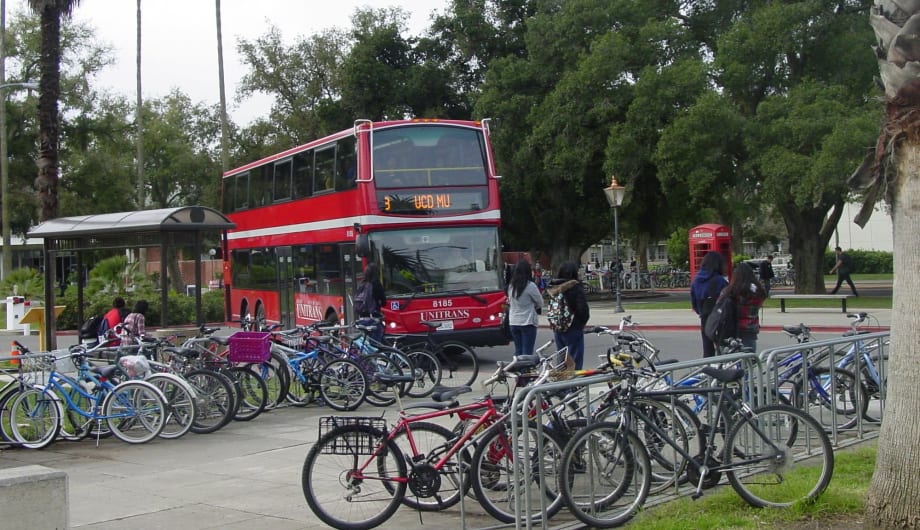
Unitrans began in 1968 with the purchase of two London double decker buses. The service kept the tradition alive by purchasing two modern double decker buses from British manufacturer Alexander Dennis in 2010
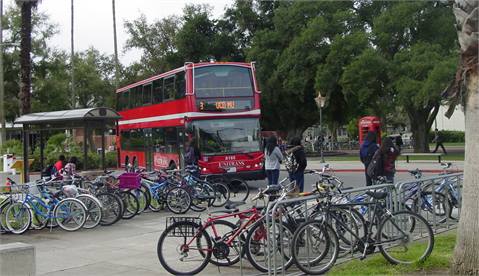
Unitrans began in 1968 with the purchase of two London double decker buses. The service kept the tradition alive by purchasing two modern double decker buses from British manufacturer Alexander Dennis in 2010
The University of California Davis’ Unitrans service, launched in 1968, provides service to more than 3.6 million riders each year using iconic double-decker buses, modern buses and all student drivers. In its original form, the service operated only two vintage London double-decker buses — now it has 49 vehicles and is moving toward an entirely CNG-powered fleet.
Unitrans has 245 student employee positions and 15 full-time positions, according to GM Anthony Palmere. The service’s main challenge, he said, is the training required to keep a fully operating staff, since a large crop of employees is graduated each year.
“We basically graduate about a third of our drivers every year — so we're training 60 to 80 new drivers every year,” he said. “[The students] come in with just a regular driver's license and we provide classroom training, and then, in-vehicle training to get their Class B license, CDL and the passenger endorsement.”
The trainees receive training in both parking lots and simulated courses from their peers who have already completed training and received their licenses. Those students “ride along with [the trainees] to train them in dealing with passengers and all the different procedures necessary to providing the service,” Palmere says.
Students are not just drivers at Unitrans. In fact, many of the service’s mechanics are UC Davis engineering students. Unitrans’ head mechanics — which make up some of the full-time, non-student positions — “are full-time mechanics, but they also act as teachers to the student mechanics.”
Unitrans, which is primarily funded by student fees, serves the campus and its surrounding areas, as well as city residents. All of Davis’ secondary schools, major shopping centers, libraries and medical facilities are served by Unitrans routes. However, 90% of riders are students, according to Palmere.
Since the student fee provides approximately $2.3 million of the service’s $4.5 million annual budget, students with a valid ID ride for free. Other riders can ride for one dollar cash fare, or purchase prepaid discounted tickets and passes. The rest of the budget is covered by Federal Transit Administration funds and a California sales tax.
“The service is focused on the campus because that is the biggest employer and biggest place where people are trying to go,” Palmere explained. “We do run less service in the summer, and [locals] would like to have the high level of service all year. But the students are most of the riders, and without their ridership, it's not nearly as efficient as a system.”
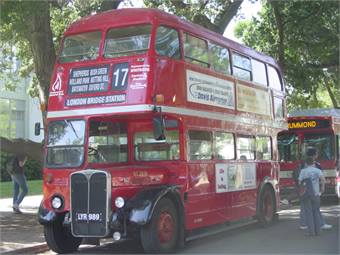
Unitrans’ vintage double decker bus was converted to CNG, and is the only of its kind in North America.
Efficiency is important to the university, which has been recognized for its sustainability efforts, as well as its “cycling culture” — about 50% of students ride a bike to class. Another 25% use Unitrans and about 6% walk.
“About 80% of the students are coming by some alternative mode other than driving. That's something we're very proud of,” Palmere explained.
In that vein, Unitrans is moving toward more sustainable fueling for its vehicles. Most of the service is provided by modern CNG-fueled buses, and the university’s CNG-powered double decker bus is the only of its kind in North America — perhaps in the world.
“[Unitrans] is still running the vintage double-decker buses and we have one that's been converted to natural gas,” Palmere said. “The other two [vintage double-deckers], as well as the two modern double-deckers, are still diesel powered — but we do use bio-diesel for those. Those are our only diesel buses; all of our other buses are natural gas.”
The Unitrans service also connects to other services in the region, including the Yolo County Transportation District’s YoloBus, which takes passengers around Yolo County, Woodland and Sacramento.
Palmere said Unitrans makes UC Davis and the surrounding communities completely accessible to students who don’t have, or don’t want to use, a car.
“That just makes the campus a lot more of a livable community because there's less space required for parking lots and there is more open space and a more compact campus,” he said. “That's something that we've accomplished.”
More Bus

New York MTA Plans Largest Bus Fleet Upgrade in More Than a Decade
The agency is seeking manufacturers for 650 new CNG buses to replace aging vehicles, improve reliability, and advance its broader fleet modernization strategy.
Read More →
Building a Flexible Path to Transit Electrification
John Hroncich discusses BAE Systems’ modular and scalable approach, lessons learned from decades of real-world operations, and how agencies can identify electrification strategies that fit their fleets.
Read More →
Bus Tech Talk: Keeping Transit Technicians Ahead of the Technology Curve
LA Metro’s Obed Mejia discusses technician training, evolving maintenance technology, fleet replacement, and strategies for getting the most out of today’s transit fleets.
Read More →
Biz Briefs: RIPTA Unveils New Frontrunners, Clevland RTA Adds New Siemens, and More
In METRO's latest installment, we take a look at recent news from Siemens, Prevost, Dodge, and more partnerships making headlines across the transportation sector.
Read More →
People Movement: Holly Arnold Joins Transdev and More
In this edition, we also cover recent appointments and announcements at Pace, CamTran, MCI, and more, showcasing the individuals helping to shape the future of transportation.
Read More →
The High Cost of Transit Buses: Industry Leaders Look to Procurement Reform
Transit leaders and policymakers examine how standardized bus designs, streamlined procurement, and predictable funding could help agencies stretch budgets and deliver better service.
Read More →
The Business Voice Behind Public Transportation
As chair of APTA’s Business Members Board of Governors, Ray Melleady explains how more than 850 business members are partnering with transit agencies to advance funding, innovation, and industry-wide collaboration.
Read More →
From Surviving to Thriving: Building Stronger Transportation Organizations
Bus Business Consultants founder Brian Dickson shares lessons on leadership, organizational health, and creating options for long-term success in a changing transportation industry.
Read More →
Finding the ‘Happy Medium’: Optimizing Maintenance Without Sacrificing Reliability
The key to maintenance optimization isn’t doing less work—it’s doing the right work at the right time on the right assets.
Read More →
LA Metro, City of West Hollywood, and Partners Advance Smarter Bus Lane Enforcement
The award-winning partnership combines AI-powered detection with human oversight to improve bus reliability, accessibility, and enforcement efficiency.
Read More →