



UPDATED: President nominates Charlotte Mayor Foxx to head DOT
Anthony Foxx has served as Charlotte, N.C.’s mayor since 2009 where he oversaw several transportation projects including breaking ground on the city’s streetcar project and adding a third runway at Charlotte/Douglas International Airport.

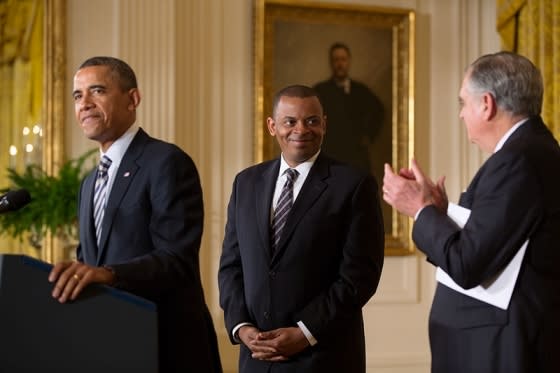
Official White House Photo by Pete Souza
Official White House Photo by Pete Souza
WASHINGTON, D.C. — President Barack Obama nominated Charlotte, N.C. Mayor Anthony Foxx to replace Ray LaHood as secretary of transportation according to several sources, including the New York Times.
When making the announcement, the president also used the opportunity to prod Congress to provide billions of dollars for improving the nation’s transportation infrastructure. He said the Administration’s top priority was strengthening the economy and providing more jobs for people.
Mayor Foxx, the current chair of the Metropolitan Transit Commission, successfully led efforts to advance regional transportation initiatives including breaking ground on the streetcar project and a third runway at Charlotte-Douglas International Airport and securing $1 billion in funding to extend the LYNX Blue Line to the University of North Carolina at Charlotte. For the full story, click here.
Foxx received a law degree from New York University’s School of Law as a Root-Tilden Scholar, the University’s prestigious public service scholarship, and earned a bachelor’s degree in History from Davidson College. He is a member of the Mecklenburg County Bar and a graduate of its Leadership Institute.
Prior to joining the DesignLine Corp. as Deputy General Counsel in 2009, Foxx was an attorney at Hunton & Williams law firm. He also served as a law clerk for the United States Sixth Circuit Court of Appeals, a trial attorney for the Civil Rights Division of the United States Department of Justice, and staff counsel to the United States House of Representatives Committee on the Judiciary.
“Mayor Foxx has been a strong advocate for public transportation in Charlotte, and as a local mayor, he understands the critical role public transit plays in the economic vitality of our communities — and the importance of a strong local, state and federal partnership in infrastructure investment,” said American Public Transportation Association President/CEO Michael Melaniphy.
Upon news of Obama's appointment on Monday, Committee on Transportation and Infrastructure Chairman Bill Shuster (R-PA) released the following statement:
“I am pleased the President has put forward a candidate to lead the U.S. Department of Transportation, and I congratulate Mayor Foxx upon his nomination. Transportation is important for our country. These issues are about jobs, quality of life, and prosperity. I remain committed to building consensus about how to strengthen our infrastructure, promote economic growth, and make the Nation more competitive in the global marketplace. Once he has been confirmed by the Senate, I look forward to working with Mayor Foxx to achieve these goals for our country.
“I also thank Secretary LaHood for his years of service to our country and for his dedication to our Nation’s transportation system. I personally appreciate Ray’s friendship, and I wish him and his family the best in the future.”
More Management

LIT Marks 10-Year Milestone at Annual Summit
Hosted by the COTA from September 10 to 13, the Summit carried the theme “Celebrating 10 Years of Excellence, Leadership, and Impact,” with every part of the program honoring the people, agencies, and partners who built LIT over its first decade.
Read More →
People Movement: Dan Dipert Coaches Adds Third-Generation Leader, Keolis Names New Valley Metro VP/GM, and More
In this edition, we also cover recent appointments and announcements at the Wabtec, SilverRide, HNTB, and more, showcasing the individuals helping to shape the future of transportation.
Read More →
METRO Opens Submissions for 2026 Motorcoach Awards
Nominations are now being accepted for METRO Magazine’s Operator of the Year and Innovative Operator of the Year awards.
Read More →

New York MTA Advances Final Contract for Second Avenue Subway Expansion
Contract Four is the largest in the Second Avenue Subway Phase 2 project and includes construction of station infrastructure, tracks, and signals for the subway expansion, MTA officials said. Work on Contract Four will begin in 2027.
Read More →
Transit Agencies Highlight Safety Gains at National Summit
Leaders from 15 major transit systems shared crime-reduction results and safety initiatives while discussing the role of continued federal support.
Read More →
NITA Names New Leadership, Expands Reduced-Fare Program at First Board Meeting
The new regional transit authority appointed its first board chair and interim executive director while extending reduced fares across CTA, Metra, and Pace for eligible riders.
Read More →
Beyond the Checklist: A Structured Approach to Transit Maintenance
Reliability-Centered Maintenance helps transit agencies move beyond routine checklists to focus limited resources on the assets and failures that have the greatest impact on safety, reliability, and service.
Read More →
APTA 2026 Nominating Committee Selects Leadership Slate, Names Chair and Vice Chair Nominees
Leadership changes will help shape the association’s priorities and its representation of the transportation industry during the 2026–2027 term.
Read More →
DART Launches Major Security, Fare Enforcement Initiative
The 90-day demonstration will deploy coordinated security teams at five light rail stations while testing controlled access and gathering data to guide future investments.
Read More →
Advancing Fare Collection Through Technology and Innovation
Learn about delivering 1300 gates at 91 stations while managing fare evasion. Explore the large scale deployment, solution customization and real-world results that affect the region. Prepare for deployment in your region now.
Read More →