



Transitional program alleviates paratransit demand, cuts costs
Riverside Transit Agency’s travel training program is effectively steering a growing number of customers away from its costly Dial-A-Ride service as well as saving the agency money along the way.

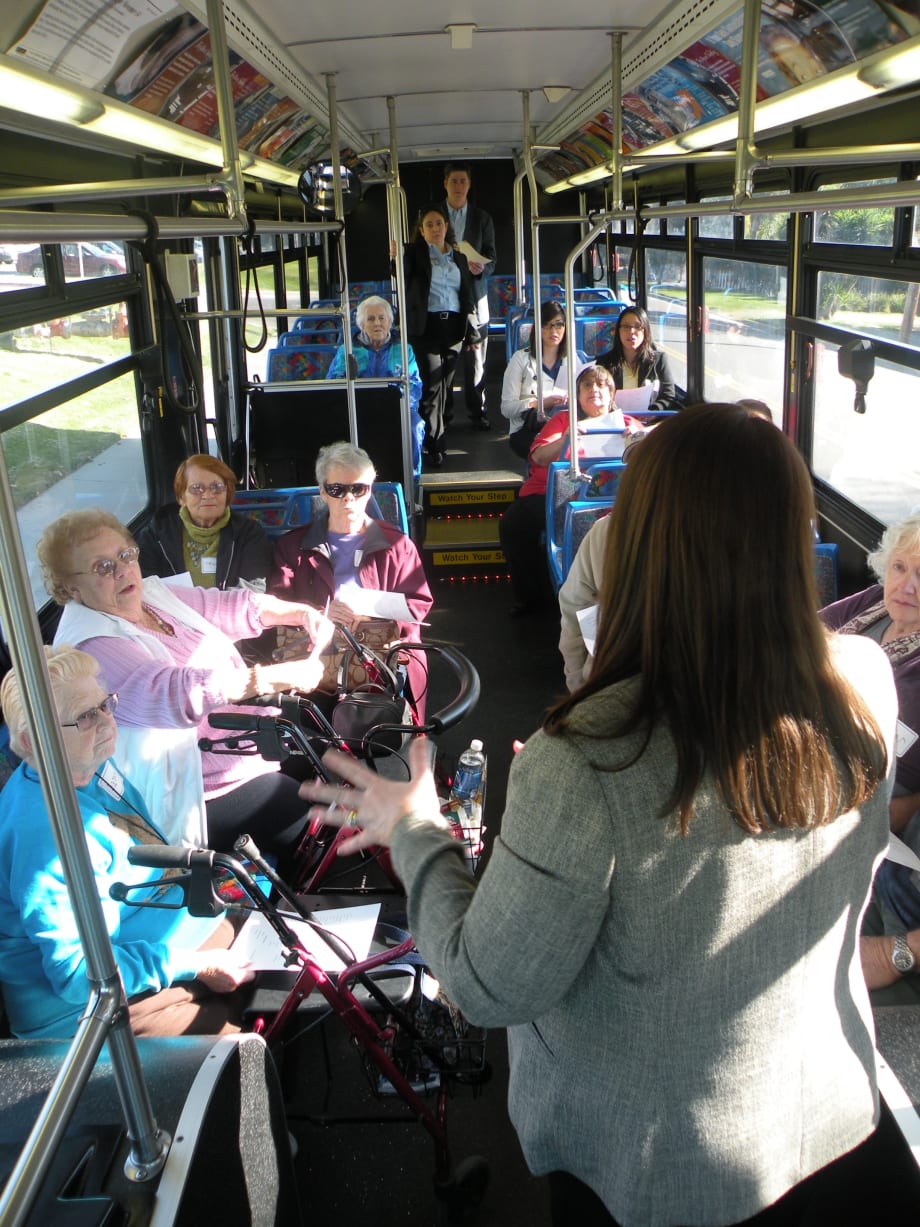
The Riverside Transit Agency’s travel training instructors work individually and in groups until the clients are comfortable using its regular fixed-route services.
The Riverside Transit Agency’s travel training instructors work individually and in groups until the clients are comfortable using its regular fixed-route services.
Launched in November 2011, Calif.-based Riverside Transit Agency’s (RTA) travel training program is effectively steering a growing number of customers away from its costly Dial-A-Ride service as well as saving the agency money along the way.
The program has exceeded our expectations,” explained Bradley Weaver, marketing manager for RTA. “With more people moving away from Dial-A-Ride and using fixed-route buses, this unique program is promoting a variety of travel choices, nurturing community partnerships, embracing sustainable communities, and helping minimize pollution and waste.”
As part of the program to get disabled customers on the bus, RTA develops individualized travel plans for each participant, with a variety of lessons, including how to read bus schedules, pay fares and connect with other routes. Travel trainers also teach seniors the same lessons, but often in group settings, such as at adult day health care centers and senior living communities.
Personal travel trainers customize the learning experience to meet each person’s individual needs. The step-by-step process emphasizes safety, while building confidence and travel skills. Travel training involves a series of steps from initial one-on-one instructor assistance to gradual empowerment of the individual to, ultimately, independent travel.
The total time spent on training is based on the individual’s needs. Instructors spend as much time as necessary to ensure each person is comfortable with traveling on their own.
“[The] customer contacts RTA, or RTA meets customers at a presentation,” said Weaver. “Every client is unique, and barriers are unique, so we don’t have a specific frequency or time spent on each person. It varies. Each trainer sees roughly one to two people a day. We also [work with] groups.”
The program was funded through a federal grant and developed and marketed through multiple partnerships.
“We worked with Easter Seals Project Action and community and senior centers to develop the program,” Weaver explained. “Our community activist group, TNOW, has been instrumental in promoting the program.”
Since its November 2011 launch, approximately 450 people have taken the RTA’s travel training, with another 300 either currently in training or on a waiting list. In about a year-and-a-half, the program has generated 33,678 trips.
Additionally, with the average cost of providing fixed-route service coming in at $5 per passenger compared with $26 per passenger, the RTA has saved approximately $300,000 alone this fiscal year. Furthermore, RTA estimates it saves an estimated $14,000 a year for every five-day-a-week rider who makes the switch from Dial-A-Ride to fixed-route services.
More importantly, the program also saves the RTA’s customers money. The agency estimates that a person riding fixed-route buses five day a week spends less than $300 annually for a disabled/senior bus pass, while that same person would spend at least $1,560 on Dial-A-Ride service.
For all of these reasons, Weaver suggested that implementing a travel training program is a win-win for everybody involved.
“Other agencies looking to implement this program will be pleasantly surprised by the results,” he said. “Not only is it a good way to give customers a new sense of freedom and independence, it’s also a great way to build strong communities and foster partnerships.”
Tips for Developing a Travel Training Program
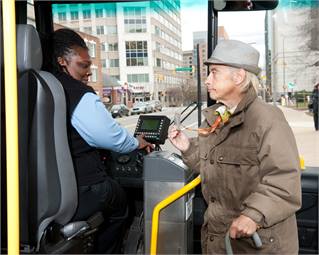
Travel training is intensive, one-to-one instruction designed to teach people with disabilities and older adults how to travel safely and independently using public transportation. Four levels of travel instruction that transit agencies could consider providing include: transit orientation; transit familiarization; travel training for an experienced traveler or new traveler.
Transit agencies may choose to hire a travel trainer themselves or to contract one through a travel training services company or a human services agency. Easter Seals Project ACTION (ESPA) and a national workgroup of travel instruction professionals developed a comprehensive set of competencies for the practice of travel training. Based on those competencies, the following questions are points that transit agencies or contractors may want to consider when hiring a travel trainer:
Does the candidate have a sensitivity to the needs of customers to be taught and an ability to be supportive of those needs?
Has the job candidate completed any structured course or training offered by a recognized vendor?
Has the candidate had experience in all phases of travel instruction?
Is the candidate experienced with the transit system that she will be instructing customers to use?
Does the candidate belong to any professional associations, such as ATI, through which he can participate in ongoing professional development activities?
For additional resources, visit www.projectaction.org.
– Whitney E. Gray, Easter Seals Project ACTION
More Paratransit

Indian River Transit’s Community-Focused Approach Earns National Recognition
Named APTA’s 2026 Outstanding Public Transportation System in its size category, Florida’s Indian River County transit system continues to grow ridership through fare-free service and a focus on evolving community needs.
Read More →
Everett Transit, Community Transit Outline Consolidation Agreement
The proposed agreement calls for a 50% increase in bus service in Everett, a new microtransit zone, continued paratransit service, and the transfer of Everett Transit operations to Community Transit.
Read More →
Driving Smarter Paratransit
John Hanlon shares how AlphaRoute is leveraging AI-powered technology to help paratransit providers optimize operations, support frontline staff, and enhance the rider experience.
Read More →
People Movement: Dan Dipert Coaches Adds Third-Generation Leader, Keolis Names New Valley Metro VP/GM, and More
In this edition, we also cover recent appointments and announcements at the Wabtec, SilverRide, HNTB, and more, showcasing the individuals helping to shape the future of transportation.
Read More →
Biz Briefs: RIPTA Unveils New Frontrunners, Clevland RTA Adds New Siemens, and More
In METRO's latest installment, we take a look at recent news from Siemens, Prevost, Dodge, and more partnerships making headlines across the transportation sector.
Read More →
King County Metro Makes ADA Paratransit Easier to Navigate
METRO's Innovative Solutions Award winner replaces complex service-area descriptions with an accessible, interactive map that puts paratransit information directly in customers’ hands.
Read More →
Jacksonville’s NAVI Project Charts a New Course for Autonomous Public Transportation
Through its NAVI program, JTA is showing how autonomous vehicles, intelligent infrastructure, and coordinated operations can work together to deliver everyday public transportation.
Read More →
Driving Smarter Paratransit
John Hanlon shares how AlphaRoute is leveraging AI-powered technology to help paratransit providers optimize operations, support frontline staff, and enhance the rider experience.
Read More →
METRO Magazine Announces 2026 Innovative Solutions Awards Winners
Projects Recognized for Advancing Mobility Through Technology, Accessibility, Workforce Innovation, and Operational Excellence
Read More →
Biz Briefs: STV teams with Amtrak, Motorcoach Operators Boost Fleet and Land Contracts, and More
From manufacturers and suppliers to transit agencies and motorcoach operators, these updates offer a snapshot of the projects, partnerships and business moves driving the industry forward.
Read More →