



SEPTA sets rail ridership record
Riders took 36,023,000 trips during Fiscal Year 2013. Ridership on SEPTA's 13 regional rail lines increased by 2.2% over the course of the year.

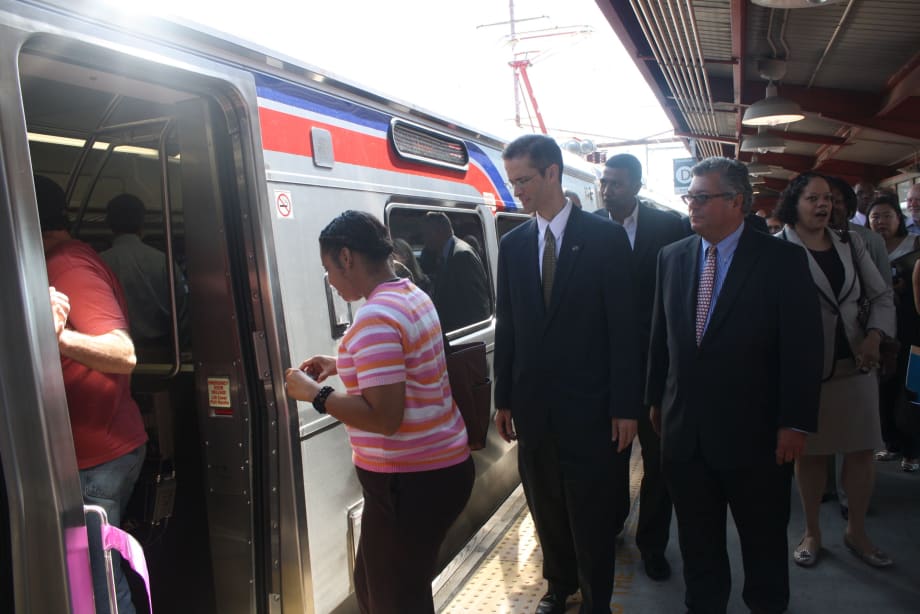
Photo courtesy of Kristin Geiger, SEPTA
Photo courtesy of Kristin Geiger, SEPTA
Southeastern Pennsylvania Transportation Authority (SEPTA) set a new regional rail ridership record, with 36,023,000 trips taken by customers during Fiscal Year (FY) 2013. Fiscal Year 2013 was the 12-month period from July 1, 2012 to June 30, 2013.
Ridership on SEPTA's 13 regional rail lines increased by 2.2% over the course of the year.
System-wide, SEPTA recorded 337.3 million trips during the year on its trains, buses and trolleys. While total ridership was down slightly from the 339.3 million trips in Fiscal Year 2012, the numbers for FY 2013 were impacted by a two-day shutdown due to Hurricane Sandy. SEPTA has an average weekday ridership of approximately one million trips.
Over the last 15 years, regional rail ridership has increased 50%, with annual ridership up from 24 million to 36 million trips. SEPTA's ridership continues on an upward trend on all modes of travel, with average annual increases of 1.9% over the last seven years and total annual trips up by more than 40 million since 2006.
SEPTA GM Joseph M. Casey credits aggressive efforts in recent years to improve SEPTA's aging infrastructure, as well as customer service-focused initiatives, for helping attract and retain new riders. Regional rail service has also been enhanced with the addition of 120 new Silverliner V railcars, which replaced vehicles that dated to the mid-1960s. The Silverliner Vs offer customers state-of-the-art amenities, and have helped improve service reliability.
"SEPTA is thrilled to welcome new riders to the system," Casey said. "We will continue work on efforts to improve the customer experience, which is helping drive this sustained ridership growth."
SEPTA's ridership has grown in recent years despite major funding challenges. SEPTA's capital budget is projected to remain at approximately $300 million for the fourth consecutive year due to reductions in state funding. This represents a 25% decrease compared to Fiscal Year 2010 levels. The capital budget funds critical initiatives, such as infrastructure improvement projects and new vehicle purchases.
Overall, SEPTA's capital budget is at a 15-year low and is less than one-half of similar-sized peer transit agencies nationwide. These funding constraints leave SEPTA without funds for a number of vital projects, such as repairs to 1930s-era electrical substations or upgrades to aging bridges.
More Rail

Chicago Leaders Unveil Plans for O’Hare Airport Express Train
The privately developed project would offer a 15-minute trip between downtown and O’Hare’s Terminal 2, with trains operating every 15 minutes on a dedicated track. The service would use battery-electric trains and three existing freight rail rights-of-way.
Read More →
OCTA Maps Out 30-Year Strategy to Protect Coastal Rail Corridor
The draft feasibility report identifies strategies to protect the coastal rail line for decades as the agency continues near-term stabilization and sand placement efforts.
Read More →
The Business Voice Behind Public Transportation
As chair of APTA’s Business Members Board of Governors, Ray Melleady explains how more than 850 business members are partnering with transit agencies to advance funding, innovation, and industry-wide collaboration.
Read More →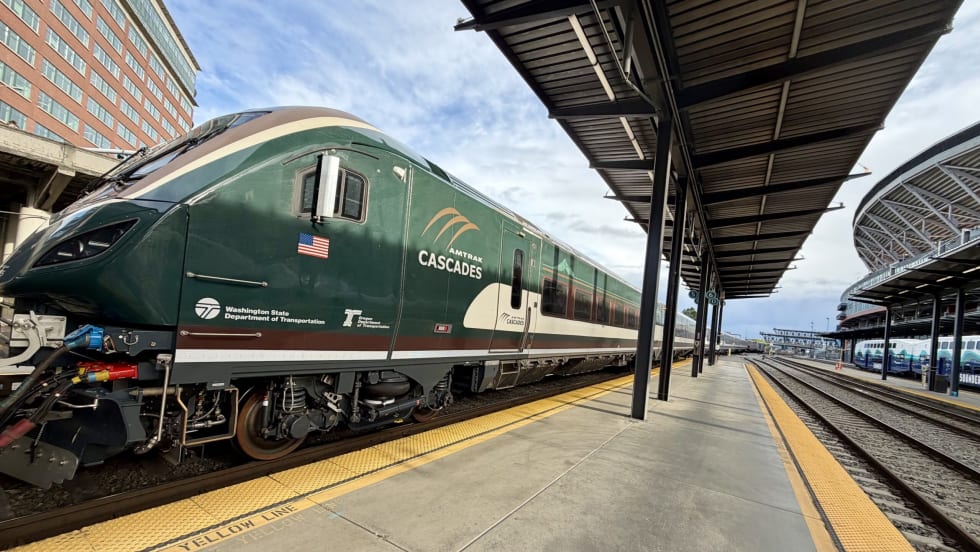
FRA Announces $5.3B in Rail Investments, Including $2B for Amtrak
Funding will support grade-crossing improvements, infrastructure upgrades, and new Amtrak equipment in 23 states.
Read More →
Finding the ‘Happy Medium’: Optimizing Maintenance Without Sacrificing Reliability
The key to maintenance optimization isn’t doing less work—it’s doing the right work at the right time on the right assets.
Read More →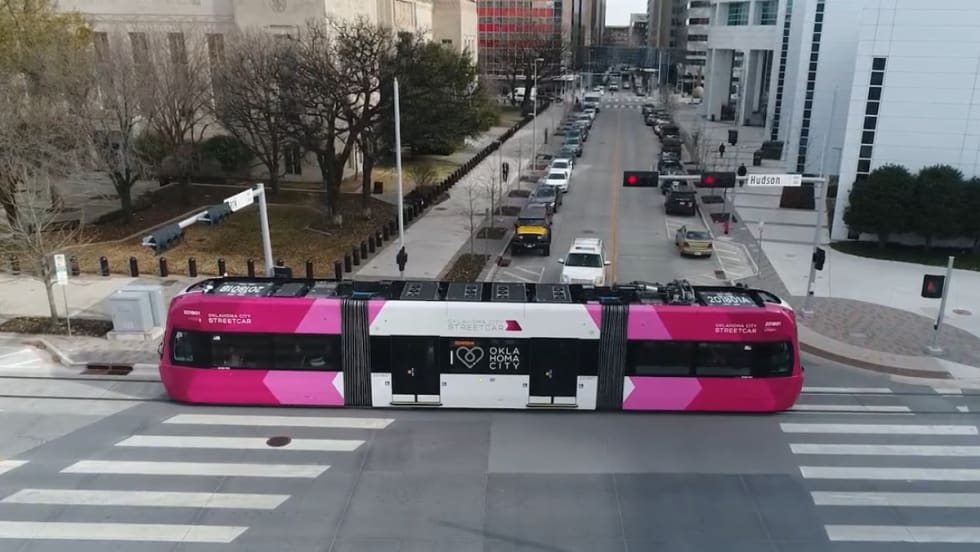
OKC Streetcar Makes Zero-Fare Service Permanent
Ridership increased an average of 71% compared with the same period a year earlier during the fare-free pilot.
Read More →
DART Customer Satisfaction Reaches Six-Year High
Overall satisfaction rose to 74.9%, while the agency’s Net Promoter Score reached a record 33.7.
Read More →
How DART's GoPass Is Redefining Regional Mobility
Serving 14 transit agencies, GoPass simplifies multimodal travel by allowing riders to plan, pay for, and manage an entire trip through one app.
Read More →
Amtrak Board Advances Plan to Restructure Organization, Seeks Public Input
The proposal, developed by Amtrak management and approved by the board for further consideration, is intended to modernize the organization's structure while improving accountability, operational efficiency, and customer service.
Read More →
Biz Briefs: STV teams with Amtrak, Motorcoach Operators Boost Fleet and Land Contracts, and More
From manufacturers and suppliers to transit agencies and motorcoach operators, these updates offer a snapshot of the projects, partnerships and business moves driving the industry forward.
Read More →