



RTC Southern Nevada opens university transit center
The agency also launched a new student transit pass program and the pilot for a contactless fare payment system.

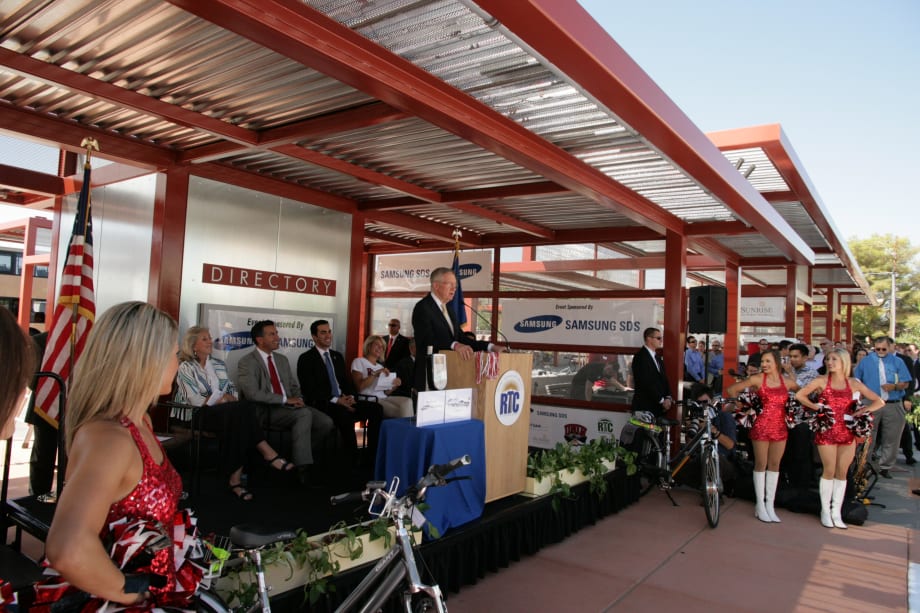
U.S. Senator Harry Reid (at podium), Governor Brian Sandoval, Samsung SDS, University of Nevada, Las Vegas (UNLV) and local, state and federal leaders joined RTC Southern Nevada officials to mark the grand opening of a new transit center located on the UNLV campus. Photo courtesy RTC Southern Nevada
U.S. Senator Harry Reid (at podium), Governor Brian Sandoval, Samsung SDS, University of Nevada, Las Vegas (UNLV) and local, state and federal leaders joined RTC Southern Nevada officials to mark the grand opening of a new transit center located on the UNLV campus. Photo courtesy RTC Southern Nevada
The Regional Transportation Commission of Southern Nevada (RTC) marked the grand opening of a new transit center located on the UNLV campus and rolled out a new transit pass program for valley university students.
The UNLV Transit Center is a 6,460-square-foot facility located south of Maryland Parkway and University Road, within walking distance of key UNLV facilities, including the Thomas & Mack Center, Cox Pavilion, and various UNLV academic and administrative buildings. The open-air facility offers a large number of bicycle racks and an outdoor waiting area with shelter canopies.
The RTC’s Centennial Express (CX) route will be the first route directly servicing the UNLV Transit Center, making campus access easier for students, faculty and staff. The 24-mile route currently carries approximately 25,000 passengers per month, providing connections to downtown Las Vegas, the Premium Outlet Mall/Clark County Government Center, the Las Vegas Strip at Spring Mountain and the Howard Hughes office park.
The RTC also launched a new student transit pass program, UPASS, tailored just for college students and faculty at all three of Southern Nevada’s major higher education institutions: UNLV, College of Southern Nevada and Nevada State College. The transit pass will offer students a 50% discount on a 30-day monthly pass for $32.50 or more than a 60% discount for an entire semester transit pass for $104. Passes can be used for any transit route and to any destination.
The UPASS program was established to improve access to the transit system among Southern Nevada college students and will help the RTC to better understand college students’ transit usage and behavior and the needs and demands for transit services.
“This has been an amazing partnership working with UNLV in creating transit opportunities and solutions for our community,” said Tina Quigley, GM of the RTC. “The combination of improved campus access and a fare program targeted specifically to valley students will not only make transit a more economical transportation alternative, but more convenient and appealing as well.”
The RTC built the new UNLV Transit Center at a cost of $3.45 million, 80% of which was federally funded by the Federal Transit Administration Bus and Bus Facilities Livability Initiative Grant, and 20% funded by a local match made by the RTC.
The grand opening event also announced a new technology program called “TransitTap,” which the RTC and Samsung SDS will begin piloting along the CX route. “TransitTap” will allow customers to use an open payment system to pay for transit fares, simply by tapping a MasterCard PayPass contactless credit or prepaid debit card or by using a NFC- (Near Field Communication) enabled smart phone to the card reader when boarding transit vehicles.
The pilot program will explore new and emerging technologies that will improve customer convenience and speed of boarding, which will enhance the transit experience in the valley. Samsung SDS, the developer of the “TransitTap” technology, is a global provider of information and communications technology.
More Bus

New York MTA Plans Largest Bus Fleet Upgrade in More Than a Decade
The agency is seeking manufacturers for 650 new CNG buses to replace aging vehicles, improve reliability, and advance its broader fleet modernization strategy.
Read More →
Building a Flexible Path to Transit Electrification
John Hroncich discusses BAE Systems’ modular and scalable approach, lessons learned from decades of real-world operations, and how agencies can identify electrification strategies that fit their fleets.
Read More →
Bus Tech Talk: Keeping Transit Technicians Ahead of the Technology Curve
LA Metro’s Obed Mejia discusses technician training, evolving maintenance technology, fleet replacement, and strategies for getting the most out of today’s transit fleets.
Read More →
Biz Briefs: RIPTA Unveils New Frontrunners, Clevland RTA Adds New Siemens, and More
In METRO's latest installment, we take a look at recent news from Siemens, Prevost, Dodge, and more partnerships making headlines across the transportation sector.
Read More →
People Movement: Holly Arnold Joins Transdev and More
In this edition, we also cover recent appointments and announcements at Pace, CamTran, MCI, and more, showcasing the individuals helping to shape the future of transportation.
Read More →
The High Cost of Transit Buses: Industry Leaders Look to Procurement Reform
Transit leaders and policymakers examine how standardized bus designs, streamlined procurement, and predictable funding could help agencies stretch budgets and deliver better service.
Read More →
The Business Voice Behind Public Transportation
As chair of APTA’s Business Members Board of Governors, Ray Melleady explains how more than 850 business members are partnering with transit agencies to advance funding, innovation, and industry-wide collaboration.
Read More →
From Surviving to Thriving: Building Stronger Transportation Organizations
Bus Business Consultants founder Brian Dickson shares lessons on leadership, organizational health, and creating options for long-term success in a changing transportation industry.
Read More →
Finding the ‘Happy Medium’: Optimizing Maintenance Without Sacrificing Reliability
The key to maintenance optimization isn’t doing less work—it’s doing the right work at the right time on the right assets.
Read More →
LA Metro, City of West Hollywood, and Partners Advance Smarter Bus Lane Enforcement
The award-winning partnership combines AI-powered detection with human oversight to improve bus reliability, accessibility, and enforcement efficiency.
Read More →