



FRA issues Emergency Order to Metro-North following crash
In response, the Metro-North signal crews have installed new protections at the Spuyten Duyvil curve, which will warn train engineers of the approaching speed reduction and automatically apply the train's emergency brakes if speed is not lowered to the 30 mph maximum in the curve.

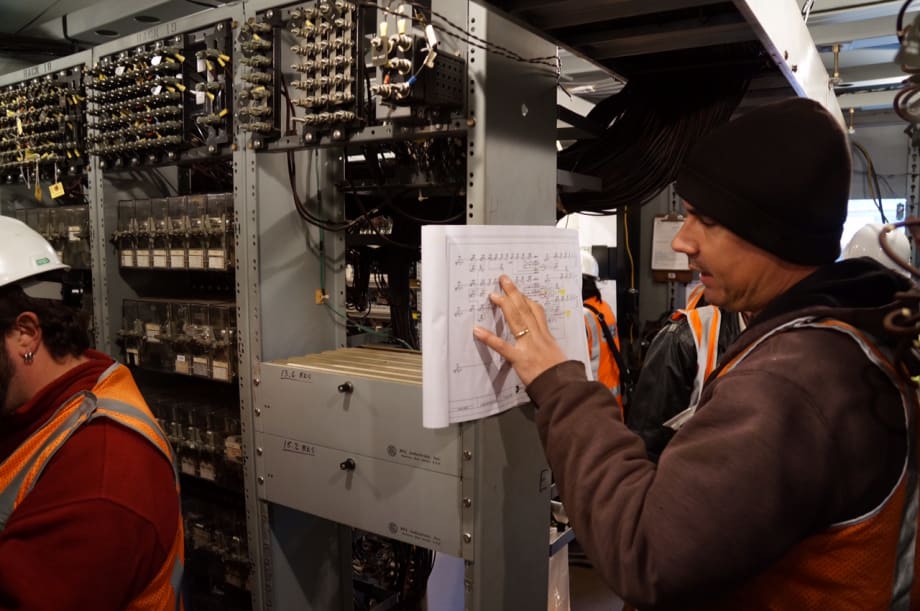
Metro-North Signal Department workers consult circuit diagrams, make signal changes and test the system at Spuyten Duyvil. Photo: Metropolitan Transportation Authority / J. P. Chan.
Metro-North Signal Department workers consult circuit diagrams, make signal changes and test the system at Spuyten Duyvil. Photo: Metropolitan Transportation Authority / J. P. Chan.
The Federal Railroad Administration (FRA) issued an Emergency Order (EO 29) to the New York Metropolitan Transportation Authority’s (MTA) Metro-North Railroad to take specific, immediate steps to ensure its train crews do not exceed speed limitations.
The EO requires Metro-North to modify its existing signal system to ensure speed limits are obeyed and to provide two qualified railroad employees to operate trains where major speed restrictions are in place until the signal system is updated.
EO 29 requires Metro-North to provide the FRA with a list of main track locations where there is a reduction of more than 20 mph in the maximum authorized passenger train speed by Dec. 10, 2013. Further, Metro-North is ordered to identify appropriate modifications to its existing automatic train control system or other signal systems to enable adequate advance warning of and adherence to such speed restrictions.
The modifications will help prevent another over-the-speed-limit event if a locomotive engineer fails to take actions to appropriately slow or stop a passenger train.
In the meantime, Metro-North is ordered to operate trains with two qualified train crew members in the controlling locomotive cab or passenger car control compartment at the locations where speed limits change by 20 mph or more until the signal work at these locations is complete. Additionally, the railroad must submit to the FRA for approval an Action Plan that ensures the safety of its operations for passengers and employees by December 31. The plan must contain target dates and milestones for implementing necessary signal system modifications.
The EO is a mandatory directive to the railroad, and failure to comply with its requirements will result in enforcement actions against the railroad or individuals who violate it.
In response, the MTA announced that Metro-North signal crews have installed new protections at the Spuyten Duyvil curve, the site of last week's fatal derailment, which will warn train engineers of the approaching speed reduction and automatically apply the train's emergency brakes if speed is not lowered to the 30 mph maximum in the curve.
The signal improvement at Spuyten Duyvil was done simultaneously and in coordination with work to restore track, power and signal systems there after the derailment. Those protections were set to begin operating on all trains by Monday morning.
“Metro-North is taking important steps to improve safety for its customers and employees, and I expect the railroad will continue searching for ways to improve its operations and fully restore its commuters' confidence,” said MTA Chairman and CEO Thomas F. Prendergast.
By Tuesday morning, all Metro-North trains will enhance communication between train engineers and conductors to ensure trains are operated at safe speeds at four other critical curves as well as at five movable bridges. Conductors will stand with engineers at each train's control cab through the critical curves to verbally confirm that speed limits are adhered to. Where the train layout prohibits the conductor from reaching the engineer in a locomotive, they will communicate by radio. They will also communicate by radio at the five movable bridges.
Metro-North engineers are developing new signal protections to automatically enforce speed restrictions at the other four critical curves by March and at the five movable bridges by September. The four critical curves are at Yonkers on the Hudson Line, White Plains on the Harlem Line, and Port Chester and Bridgeport on the New Haven Line. All five movable bridges are on the New Haven Line.
Metro-North has also surveyed its tracks and will reduce the maximum authorized speed at 26 locations to eliminate all locations where the speed limit drops by more than 20 mph. Signs will be posted along the right-of-way to alert engineers of reductions in maximum authorized speed at the four curves by December 16.
In addition, Metro-North has committed to enhance its monitoring of compliance with speed restrictions. This monitoring is accomplished by reviewing the event data recorders from randomly selected trains, by sending supervisors to ride trains and observe speeds and by operating radar gun enforcement at locations throughout the Metro-North network.
Two-thirds of Metro-North's operating fleet is equipped with alerter devices in the engineer's position to ensure engineers remain attentive, and the remaining one-third is equipped with dead man's controls. Within the next year, all equipment without alerters will be either retrofitted to include them or replaced with new equipment that includes alerters.
At the FRA's direction, Metro-North has also committed to implementing a confidential close call reporting system, a measure which will allow employees to anonymously report safety concerns without fear of reprisal in order to identify potential problems before they can cause an accident or injury.
More Rail

New York MTA Advances Final Contract for Second Avenue Subway Expansion
Contract Four is the largest in the Second Avenue Subway Phase 2 project and includes construction of station infrastructure, tracks, and signals for the subway expansion, MTA officials said. Work on Contract Four will begin in 2027.
Read More →
San Diego MTS Breaks Monthly Trolley Ridership Record
Agency officials said July’s ridership indicates MTS’s continued recovery from the pandemic.
Read More →
Report Examines NJ TRANSIT Reliability, Funding Challenges
The Garden State Initiative analysis examines the roles of Amtrak infrastructure, fleet management, and agency operations while recommending a more performance-based approach to improving reliability.
Read More →
Stadler, CapMetro Sign Long-Term Rail Fleet Support Agreement
Beginning in 2027, Stadler will provide on-site technical expertise, spare parts support, training, and obsolescence management to help extend the reliability and longevity of CapMetro’s GTW fleet.
Read More →
Biz Briefs: Alstom Lands Canadian Contract, LYT to Supply California TSP, and More
In METRO's latest installment, we take a look at recent news from Complete Coach Works, Beep, FlixBus, and more partnerships making headlines across the transportation sector.
Read More →
CATS Gold Line Marks 5 Years of Service, 2.8M Passenger Trips
With a six-mile expansion planned, the Charlotte streetcar is positioned to connect more neighborhoods and major transit hubs across the region.
Read More →
Why Simulating Pedestrian Movement Has Become Essential for Modern Rail Stations
Pedestrian microsimulation is helping rail planners identify bottlenecks, test station designs, and prepare complex transit hubs for growing passenger volumes.
Read More →
Amtrak Begins Major Construction at New York’s Sunnyside Yard
The new maintenance facility will support Amtrak’s Airo trainsets while improving maintenance efficiency and turnaround times in New York.
Read More →
Chicago Leaders Unveil Plans for O’Hare Airport Express Train
The privately developed project would offer a 15-minute trip between downtown and O’Hare’s Terminal 2, with trains operating every 15 minutes on a dedicated track. The service would use battery-electric trains and three existing freight rail rights-of-way.
Read More →
OCTA Maps Out 30-Year Strategy to Protect Coastal Rail Corridor
The draft feasibility report identifies strategies to protect the coastal rail line for decades as the agency continues near-term stabilization and sand placement efforts.
Read More →