



Feds find no problems with N.Y. train brakes, kick union out of probe
The general chairman of ACRE conducted a press conference and a series of media interviews during which he discussed and interpreted information related to the ongoing investigation.

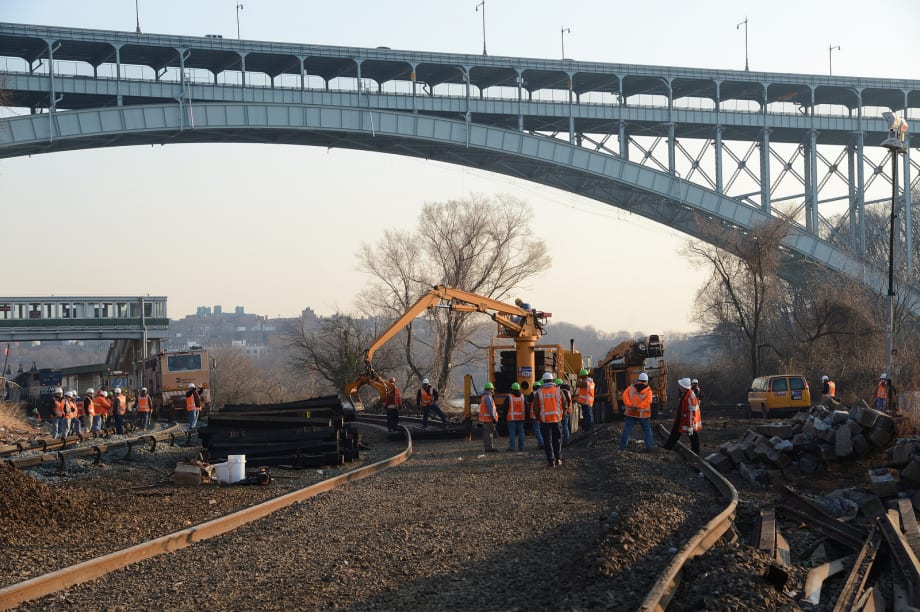
Metro-North Railroad crews at work repairing a damaged section of track near the Spuyten-Duyvil station on Tue., December 3, 2013 where a derailment occurred on Sunday, in preparation for limited restoration of service on the Hudson Line the following morning. Photo: Marc A. Hermann / MTA New York City Transit
Metro-North Railroad crews at work repairing a damaged section of track near the Spuyten-Duyvil station on Tue., December 3, 2013 where a derailment occurred on Sunday, in preparation for limited restoration of service on the Hudson Line the following morning. Photo: Marc A. Hermann / MTA New York City Transit
NEW YORK — AP is reporting that National Safety Transportation Board (NTSB) investigators looking into the derailment of a Metro-North train on Sunday found no problems with the brake system or track signals along its route, while the engineer was being questioned again.
The Metro-North Railroad commuter train was traveling at 82 mph as it approached a 30 mph zone and jumped the tracks along a sharp curve, killing four passengers. For the full AP report, click here.
Meanwhile, two law enforcement officials told NBC 4 New York that the train’s engineer said he zoned out just before the crash and was not able to recall specifics about the moments before the accident.
The NTSB said at a Tuesday briefing that authorities could not yet describe the engineer's condition just before the crash. Investigators are still probing whether human or mechanical error was responsible for the train speeding. For the full story, click here.
Additionally, the NTSB removed the Association of Commuter Rail Employees, or ACRE, as a participant in its investigation into the derailment.
Under the NTSB's procedures, organizations and agencies are invited to provide technical expertise in support of the NTSB's investigation. The organizations designated as parties sign an agreement to abide by NTSB rules for the duration of the investigation. Maintaining confidentiality of investigative information is one of the rules that parties agree to, further, they agree that their organizations will neither reveal nor comment on investigative information.
On Tuesday, Anthony Bottalico, general chairman of ACRE, conducted a press conference and a series of media interviews during which he discussed and interpreted information related to the ongoing investigation. As a result of this violation of the party agreement, the organization was advised it was removed from the investigation.
"While we value the technical expertise that groups like ACRE can provide during the course of an investigation, it is counterproductive when an organization breaches the party agreement and publically interprets or comments on investigation information," said NTSB Chairman Deborah A.P. Hersman. "Our rules exist to avoid the prospect of any party to an NTSB investigation offering its slant on the circumstances of the accident."
More Rail

New York MTA Advances Final Contract for Second Avenue Subway Expansion
Contract Four is the largest in the Second Avenue Subway Phase 2 project and includes construction of station infrastructure, tracks, and signals for the subway expansion, MTA officials said. Work on Contract Four will begin in 2027.
Read More →
San Diego MTS Breaks Monthly Trolley Ridership Record
Agency officials said July’s ridership indicates MTS’s continued recovery from the pandemic.
Read More →
Report Examines NJ TRANSIT Reliability, Funding Challenges
The Garden State Initiative analysis examines the roles of Amtrak infrastructure, fleet management, and agency operations while recommending a more performance-based approach to improving reliability.
Read More →
Stadler, CapMetro Sign Long-Term Rail Fleet Support Agreement
Beginning in 2027, Stadler will provide on-site technical expertise, spare parts support, training, and obsolescence management to help extend the reliability and longevity of CapMetro’s GTW fleet.
Read More →
Biz Briefs: Alstom Lands Canadian Contract, LYT to Supply California TSP, and More
In METRO's latest installment, we take a look at recent news from Complete Coach Works, Beep, FlixBus, and more partnerships making headlines across the transportation sector.
Read More →
CATS Gold Line Marks 5 Years of Service, 2.8M Passenger Trips
With a six-mile expansion planned, the Charlotte streetcar is positioned to connect more neighborhoods and major transit hubs across the region.
Read More →
Why Simulating Pedestrian Movement Has Become Essential for Modern Rail Stations
Pedestrian microsimulation is helping rail planners identify bottlenecks, test station designs, and prepare complex transit hubs for growing passenger volumes.
Read More →
Amtrak Begins Major Construction at New York’s Sunnyside Yard
The new maintenance facility will support Amtrak’s Airo trainsets while improving maintenance efficiency and turnaround times in New York.
Read More →
Chicago Leaders Unveil Plans for O’Hare Airport Express Train
The privately developed project would offer a 15-minute trip between downtown and O’Hare’s Terminal 2, with trains operating every 15 minutes on a dedicated track. The service would use battery-electric trains and three existing freight rail rights-of-way.
Read More →
OCTA Maps Out 30-Year Strategy to Protect Coastal Rail Corridor
The draft feasibility report identifies strategies to protect the coastal rail line for decades as the agency continues near-term stabilization and sand placement efforts.
Read More →