



MCI delivers 25 J4500s, announces staffing changes
Roberts Hawaii’s newest J4500 coaches feature a redesign, which includes stylish LED headlights and a heightened presence for more curb appeal on the outside, while on the inside, passengers still enjoy the easy-to-board spiral entryway and tiered theater seating.

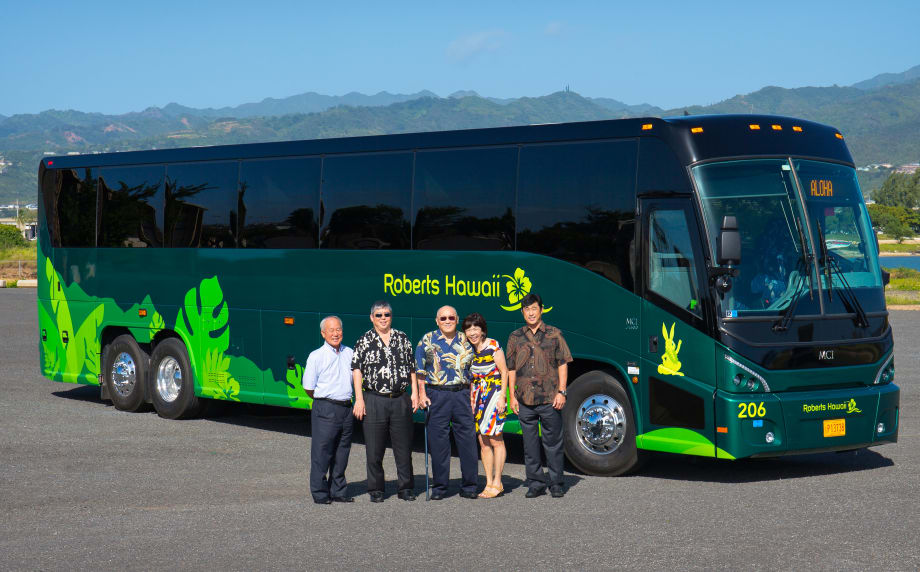
Roberts Hawaii founder Robert Iwamoto (center) and his wife, Arlene, mark the delivery of 25 new MCI J4500 coaches with his sons Scott (second from left) and Chad (far right), along with company president and COO Percy Higashi.
Roberts Hawaii's (left to right) Percy Higashi, Scott Iwamoto, Robert Iwamoto, Arlene Iwamoto and Chad Iwamoto with one of the company's 25 new MCI J4500 coaches.
The purchase represents a return to the J4500 model for the company, which has been an MCI customer for three decades.
Roberts Hawaii’s newest J4500 coaches feature a redesign, which includes stylish LED headlights and a heightened presence for more curb appeal on the outside, while on the inside, passengers still enjoy the easy-to-board spiral entryway and tiered theater seating for exceptional views from every seat.
The model comes equipped with new clean-diesel engine technology for lower emissions and better fuel economy, along with MCI’s MDSS suspension system for greater maneuverability and a smoother ride. Standard safety features include three-point passenger seatbelts, electronic stability control, and tire pressure and fire-suppression systems.
MCI also announced it is promoting four people to VP positions and adding new roles to marketing, following a solid year of “sales and marketing triumphs.”
The new VPs are Mitch Guralnick, VP, pre-owned coach sales; Tom Wagner, VP, public sector sales; Louis Quaglia, VP, regional public sector sales; and Darill King, VP, Setra sales specialist.
Meanwhile, Brent Danielson, based at MCI’s Winnipeg plant, moves into director, sales engineering and product planning, where he will work with sales, engineering, and production to improve information flow and customer satisfaction, while Brad Noeske has been promoted to manager, product planning and analysis.
Last year, MCI won several large orders from Public Sector accounts including a 31-coach order from MASS DOT for its Bus Plus+ program and a NJ Transit order for 84 CNG Commuter Coaches.
The company also rolled out its highly popular Re-energized pre-owned coach program that allows operators to outfit their existing or purchased MCI pre-owned coaches with features to achieve like-new condition.
More Management

METRO Opens Submissions for 2026 Motorcoach Awards
Nominations are now being accepted for METRO Magazine’s Operator of the Year and Innovative Operator of the Year awards.
Read More →
New York MTA Advances Final Contract for Second Avenue Subway Expansion
Contract Four is the largest in the Second Avenue Subway Phase 2 project and includes construction of station infrastructure, tracks, and signals for the subway expansion, MTA officials said. Work on Contract Four will begin in 2027.
Read More →
Transit Agencies Highlight Safety Gains at National Summit
Leaders from 15 major transit systems shared crime-reduction results and safety initiatives while discussing the role of continued federal support.
Read More →

NITA Names New Leadership, Expands Reduced-Fare Program at First Board Meeting
The new regional transit authority appointed its first board chair and interim executive director while extending reduced fares across CTA, Metra, and Pace for eligible riders.
Read More →
Beyond the Checklist: A Structured Approach to Transit Maintenance
Reliability-Centered Maintenance helps transit agencies move beyond routine checklists to focus limited resources on the assets and failures that have the greatest impact on safety, reliability, and service.
Read More →
APTA 2026 Nominating Committee Selects Leadership Slate, Names Chair and Vice Chair Nominees
Leadership changes will help shape the association’s priorities and its representation of the transportation industry during the 2026–2027 term.
Read More →
DART Launches Major Security, Fare Enforcement Initiative
The 90-day demonstration will deploy coordinated security teams at five light rail stations while testing controlled access and gathering data to guide future investments.
Read More →
Advancing Fare Collection Through Technology and Innovation
Learn about delivering 1300 gates at 91 stations while managing fare evasion. Explore the large scale deployment, solution customization and real-world results that affect the region. Prepare for deployment in your region now.
Read More →
Game Day in Motion: Moving Millions During the 2026 World Cup
Between packed transit stations and team motorcoaches, see how agencies and operators across North America tackled the transportation demands of the 2026 FIFA World Cup.
Read More →
Surface Transportation Extension Averts Shutdown, Leaves Transit Funding Gap
The stopgap keeps federal transportation programs moving, but missing advance funding could complicate the transit and rail projects agencies are planning next.
Read More →