



WMATA introduces first of 7000-series railcars
FTA provided $44.8 million in funding specifically to help fund the replacement of the 1000-series railcars. In addition, the agency has committed $58.3 million for 64 new railcars through a grant program.

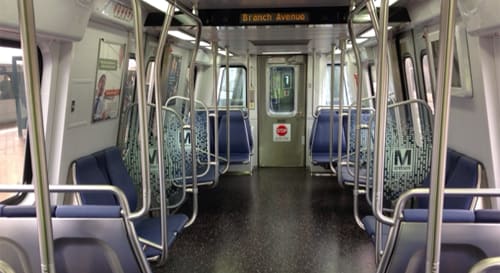
The Federal Transit Administration (FTA) celebrated the arrival of the first new state-of-the-art railcar prototypes for the Washington Metropolitan Area Transit Authority’s (WMATA) Metrorail system.
The four new cars will belong to a fleet of more than 500 new railcars, all made in the U.S., which are designed to provide a safer, more comfortable ride for millions of passengers and expand the Metrorail system’s capacity overall. FTA provided more than $100 million toward the purchase.
The new 7000-series railcars will be deployed throughout Metrorail’s entire fleet, including on the new Silver Line as it expands to serve Dulles International Airport.
The railcars will replace all 300 of the Metrorail 1000-series cars that have been in service for 40 years — fulfilling a key safety recommendation from the National Transportation Safety Board (NTSB) following the fatal Metrorail accident at Fort Totten Station in June 2009, which involved some of these cars. The WMATA accident, following other incidents in Chicago, Boston and elsewhere, spurred the Obama Administration to seek and ultimately secure new federal safety oversight authority.
The U.S. Department of Transportation estimates that WMATA faces an estimated $4.2 billion backlog in capital investments needed to bring its entire system, including rail and transit buses, into a state of good repair. WMATA has embarked on an ambitious six-year, $5 billion capital improvement program to modernize its entire system.
FTA has provided $44.8 million in funding specifically to help fund the replacement of the 1000-series railcars. In addition, FTA has committed $58.3 million for 64 new railcars through the Capital Investment Grant Program (New Starts), as part of a $900 million construction grant agreement with the Metropolitan Washington Airports Authority for Phase 1 of the Metrorail Silver Line extension project.
The new cars must still undergo operational testing on local tracks and the initial batch is expected to begin serving riders in late 2014.
More Management

METRO Opens Submissions for 2026 Motorcoach Awards
Nominations are now being accepted for METRO Magazine’s Operator of the Year and Innovative Operator of the Year awards.
Read More →
New York MTA Advances Final Contract for Second Avenue Subway Expansion
Contract Four is the largest in the Second Avenue Subway Phase 2 project and includes construction of station infrastructure, tracks, and signals for the subway expansion, MTA officials said. Work on Contract Four will begin in 2027.
Read More →
Transit Agencies Highlight Safety Gains at National Summit
Leaders from 15 major transit systems shared crime-reduction results and safety initiatives while discussing the role of continued federal support.
Read More →

NITA Names New Leadership, Expands Reduced-Fare Program at First Board Meeting
The new regional transit authority appointed its first board chair and interim executive director while extending reduced fares across CTA, Metra, and Pace for eligible riders.
Read More →
Beyond the Checklist: A Structured Approach to Transit Maintenance
Reliability-Centered Maintenance helps transit agencies move beyond routine checklists to focus limited resources on the assets and failures that have the greatest impact on safety, reliability, and service.
Read More →
APTA 2026 Nominating Committee Selects Leadership Slate, Names Chair and Vice Chair Nominees
Leadership changes will help shape the association’s priorities and its representation of the transportation industry during the 2026–2027 term.
Read More →
DART Launches Major Security, Fare Enforcement Initiative
The 90-day demonstration will deploy coordinated security teams at five light rail stations while testing controlled access and gathering data to guide future investments.
Read More →
Advancing Fare Collection Through Technology and Innovation
Learn about delivering 1300 gates at 91 stations while managing fare evasion. Explore the large scale deployment, solution customization and real-world results that affect the region. Prepare for deployment in your region now.
Read More →
Game Day in Motion: Moving Millions During the 2026 World Cup
Between packed transit stations and team motorcoaches, see how agencies and operators across North America tackled the transportation demands of the 2026 FIFA World Cup.
Read More →
Surface Transportation Extension Averts Shutdown, Leaves Transit Funding Gap
The stopgap keeps federal transportation programs moving, but missing advance funding could complicate the transit and rail projects agencies are planning next.
Read More →