



Slow adoption of modern tech hampers NYC subway, study says
Reliance on antiquated signaling system adds to delays, inefficiency and safety risks, according to a regional research and advocacy group.


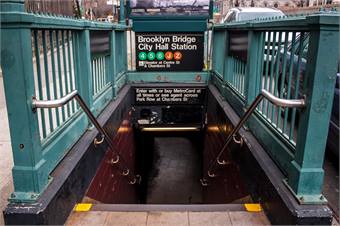
Brooklyn Bridge Station subway entrance photo by drpavloff via Flickr
The New York City subway system has moved too slowly to adopt modern signaling technology, adding to train delays, heightening safety risks and reducing efficiency in operations and maintenance, according to a new study.
While New York is in the early stages of converting to communications-based train control, the modern, computerized system on which many cities’ metro systems rely today, the pace of change has been slow, according to the report conducted by the Regional Plan Association, an independent urban research and advocacy organization. At the current rate, a full transformation wouldn’t occur for more than 50 years, the study shows, putting New York decades behind its peers around the world.
The New York City subway system has made substantial strides in recent years in upgrading stations, service, subway cars and passengers’ experience. But the subway continues to rely largely on early 20th century technology to space and operate trains in 97% of the system. CBTC technology has been fully implemented on only one subway line, the Canarsie (L) line, while conversion work is under way on the 7 line.
The remainder of the system uses a fixed-block system, much of which was installed in the first half of the 20th century. Fixed-block controls, which tell train drivers via wayside signals when it is safe to move trains forward, prevent system engineers from determining the precise location of trains. For safety reasons, extra buffers are needed between trains. With CBTC, the distance between trains could be narrowed, allowing operators to run more trains per hour.
“Ridership on New York City’s subway has risen 17% in the last decade, and is projected to climb 5% over the next four years. It will be incredibly difficult for the metropolitan region to meet growing demand using outdated technology,” said Rich Barone, RPA’s director of transportation programs and the lead author of the study. “Other cities, including London and Paris, whose underground systems date from the same era as New York’s subway, are much further along in adopting CBTC.”
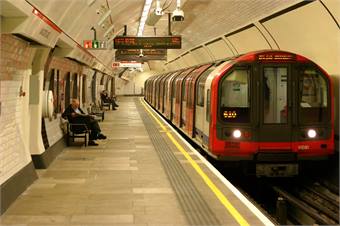
London Underground photo by Tom Page via Flickr
The reliance on outmoded technology increases operating and maintenance costs. Replacement parts must be custom-ordered or salvaged from old components. Repairs to signals along tracks need to be carried out by hand instead of remotely, as computerized CBTC technology allows. CBTC systems also reduce energy use by smoothing rates of acceleration and deceleration in and out of stations.
CBTC’s computerized technology enhances subway safety, automatically slowing and braking trains that attempt to exceed allowable speeds.
The growing threat of climate change and severe weather augments the need to accelerate the transition to CBTC, the study shows. Old fixed-block signals, unlike their modern digital counterparts, can’t be easily removed prior to storms and are vulnerable to saltwater damage. Extensive flooding of New York City’s subway tunnels during Hurricane Sandy corroded older components, contributing to the need to shut down several tunnels for repairs for extended periods of time.
The conversion of the subway system to CBTC has been slowed by limited resources, the study says. While CBTC will save money in the long run, its full implementation would require an estimated upfront investment of $13.8 billion in new systems and equipment. Equipping subway cars would cost an additional $5.4 billion.
CBTC’s successful implementation also depends on establishing a full implementation strategy by the Metropolitan Transportation Authority, retraining the transit workforce and shifting longstanding operational practices in consultation with labor unions.
“New York City’s subway system is the lifeblood of the region’s economy,” said RPA’s Barone. “When it doesn’t function reliably and efficiently, the impact is felt acutely by residents, businesses and visitors. While the MTA has worked hard to begin implementing CBTC in New York, the agency needs both more resources and a more contemporary approach to operations to support a 21st century subway system.”
View the complete report, Moving Forward: Accelerating the Transition to Communications-Based Train Control for New York City’s Subways
More Management

METRO Opens Submissions for 2026 Motorcoach Awards
Nominations are now being accepted for METRO Magazine’s Operator of the Year and Innovative Operator of the Year awards.
Read More →
New York MTA Advances Final Contract for Second Avenue Subway Expansion
Contract Four is the largest in the Second Avenue Subway Phase 2 project and includes construction of station infrastructure, tracks, and signals for the subway expansion, MTA officials said. Work on Contract Four will begin in 2027.
Read More →
Transit Agencies Highlight Safety Gains at National Summit
Leaders from 15 major transit systems shared crime-reduction results and safety initiatives while discussing the role of continued federal support.
Read More →

NITA Names New Leadership, Expands Reduced-Fare Program at First Board Meeting
The new regional transit authority appointed its first board chair and interim executive director while extending reduced fares across CTA, Metra, and Pace for eligible riders.
Read More →
Beyond the Checklist: A Structured Approach to Transit Maintenance
Reliability-Centered Maintenance helps transit agencies move beyond routine checklists to focus limited resources on the assets and failures that have the greatest impact on safety, reliability, and service.
Read More →
APTA 2026 Nominating Committee Selects Leadership Slate, Names Chair and Vice Chair Nominees
Leadership changes will help shape the association’s priorities and its representation of the transportation industry during the 2026–2027 term.
Read More →
DART Launches Major Security, Fare Enforcement Initiative
The 90-day demonstration will deploy coordinated security teams at five light rail stations while testing controlled access and gathering data to guide future investments.
Read More →
Advancing Fare Collection Through Technology and Innovation
Learn about delivering 1300 gates at 91 stations while managing fare evasion. Explore the large scale deployment, solution customization and real-world results that affect the region. Prepare for deployment in your region now.
Read More →
Game Day in Motion: Moving Millions During the 2026 World Cup
Between packed transit stations and team motorcoaches, see how agencies and operators across North America tackled the transportation demands of the 2026 FIFA World Cup.
Read More →
Surface Transportation Extension Averts Shutdown, Leaves Transit Funding Gap
The stopgap keeps federal transportation programs moving, but missing advance funding could complicate the transit and rail projects agencies are planning next.
Read More →