



Alstom’s Light Rail Advances Ripe for North American Market
President of Alstom Transportation in North America Guillaume Mehlman cites vehicle accessibility, increased speed and catenary-free capabilities developed for projects in the international market as foreseeable trends in the U.S.
While Europe, most notably France, was the proving ground for Alstom’s light rail product platform, the company has since expanded internationally to cities in North Africa, South America and the Middle East as well as throughout Europe.
Evolution of light rail
When discussing the evolution of these products, Guillaume Mehlman, president of Alstom Transportation in North America says, the European market very quickly became partial to city center-type circulator services with short lines of a few miles running through densely populated historical city centers. These smaller gauge vehicles were more comparable to what the American market calls the “streetcar,” he says.
The need for full low-floor vehicles for accessibility was also recognized early on in this market, as was the need to connect to residential areas in the suburbs, which led to the evolution of the product range from a streetcar to a light rail vehicle with increasing speed.
“So the speed, size and capacity of the vehicle increased,” says Mehlman. “The most recent models that have been delivered in the last five years have bridged the gap between intercity type service and a commuter type service.”
Trend forecast
Full low-floor accessibility and increasing speed are standout trends from global light rail projects that Mehlman foresees coming to the North American market.
“The transit service has to be for diverse users, particularly people with disabilities, or senior or younger riders,” Mehlman says. The development of full low-floor light rail vehicles, of which Alstom has sold more than 1,500 units, is a growing trend, which he believes will soon come to the U.S.
Speed is another crucial factor for light rail applications. “To be successful, light rail services need to achieve a certain level of speed to get out of the city center to go to the suburbs,” says Mehlman. “So, you’ve got to reach 65 miles per hour.”
With this type of service, he adds, cities can find the best compromise between ridership and level of service and capital dollars.
In addition to accessibility and speed, the third trend in light rail technology is off-wire or wireless capabilities. This technology utilizes ground-level power supply systems, doing away with overhead catenary lines. Alstom’s APS (Alimentation Par le Sol) — as the off-wire system is known — allows the light rail vehicle to operate “wire free” over journeys of any distance.
“These types of systems are pretty widespread throughout the world,” says Mehlman. “We see it in historical city centers, where the city governments or planners find that it’s important to preserve the historical character and the aesthetics of those landmark type areas.”
Partial or full off-wire applications are also used in light rail planning to help navigate complicated routes, which may include intersections with overpasses, viaducts or power utilities. “For such areas, often an off-wire solution will be much cheaper to implement rather than to relocate utilities or get around massive structures,” he says.
The French city of Bordeaux (Communauté Urbaine de Bordeaux) was the first in the world to have opted for this completely new technology on nine miles of its 27-mile-long tram network, which has been in service since 2003.
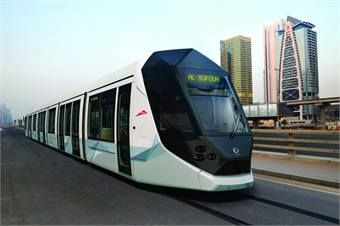
Alstom’s Dubai tramway project in the United Arab Emirates, currently under construction, is another example of a wireless project featuring a ground-level power supply system.
Sustainable aspects of the light rail applications are also a growing factor. With more and more transit systems placing greater emphasis on sustainable policies, Mehlman says the company is seeing many current procurements where the one key criterion for an award is the level of energy consumption. [PAGEBREAK]
An Alstom Citadis Dualis Tram/Train operated by SNCF (Société Nationale des Chemins de fer français), France’s national state-owned railway company.
LRV vs. BRT
Recent economic struggles have pushed some U.S. transit systems to rethink project plans, or look to bus rapid transit (BRT) service over light rail. When asked to comment on this, Mehlman says that while “upfront investment costs are lower for BRT systems, from an overall lifecycle cost perspective and sustainable development perspective, clearly light rail stands out as the better solution.”
He cites the recovery of braking energy and efficient electronic technology resulting in low energy consumption levels as a key benefit. “From the standpoint of lifecycle costs, energy consumption, low maintenance costs, light rail is the superior option, he says.
Alternative financing is also key in project development. “Streetcar systems costing $200 million or short line LRVs can be implemented with private financing or full concessions,” Mehlman says. “We’ve done it 12 times for projects in cities like Barcelona and elsewhere.”
“When these systems are well planned, they are hugely successful and they pay for themselves,” Mehlman says. Contrary to mass transit or mainline rail systems, which do not pay for themselves because the cost of the infrastructure is so high.
“We should look at the price gap between BRT and LRV in those terms, and in fact, it’s a very limited price gap, with huge lifecycle benefits afterwards,” he says.
Mehlman sees the company’s Dualis product platform as a good fit for the U.S. market. “This is an evolution of our Citadis product range, which is typically a high-capacity, broad gauge light rail vehicle with full low-floor design enabled to meet all the requirements of the U.S. market in terms of acceleration, braking, crash resistance, ADA compliance, and smoke and toxicity standards,” he says.
Transit agencies could start with a very limited network, allowing for those with a limited budget to start with a short line. The networks can then evolve and expand like the systems in Phoenix, Los Angeles and Dallas, and get people out to the suburbs at quicker speeds, Mehlman explains. “It’s a nice platform because it allows city planners to develop their network progressively with mixed service,” he says.
Innovative projects
Two recent projects that showcase Alstom’s innovative light rail technology include the system in Reims, France, which opened in spring 2011, and the aforementioned project in Dubai.
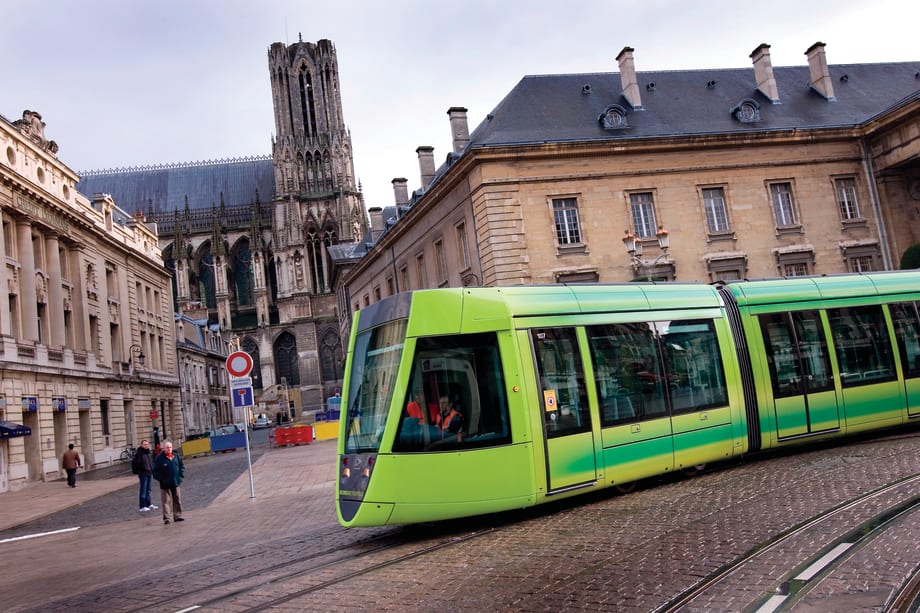
The project in Reims is a full low-floor Citadis streetcar with off-wire capabilities. It was delivered as a concession — partially financed by Alstom and its partners. The two-line, nearly seven-mile system features 23 stations. “You have all the innovations packed into this system and an alternate delivery scheme with limited financing for the city,” Mehlman says.
With commercial service slated for the end of 2014, Dubai will become the first city in the Gulf region to operate a tram system. Phase one of the project, known as the Al Sufouh tramway, includes the supply of 11 Citadis tramsets, 6.2 miles of track, 13 stations and other equipment, including electrification, signaling and ticketing systems. The APS technology selected for use on the Dubai tramway is a catenary-free system, which helps to preserve the urban environment.
Alstom recently was awarded an $88 million dollar 13-year maintenance contract, which includes preventive and corrective routine maintenance and equipment renewal.
Phase 2 of the Dubai tramway project provides for 14 additional Citadis tramsets, as well as 2.5 miles of track and six stations.
More Rail

New York MTA Advances Final Contract for Second Avenue Subway Expansion
Contract Four is the largest in the Second Avenue Subway Phase 2 project and includes construction of station infrastructure, tracks, and signals for the subway expansion, MTA officials said. Work on Contract Four will begin in 2027.
Read More →
San Diego MTS Breaks Monthly Trolley Ridership Record
Agency officials said July’s ridership indicates MTS’s continued recovery from the pandemic.
Read More →
Report Examines NJ TRANSIT Reliability, Funding Challenges
The Garden State Initiative analysis examines the roles of Amtrak infrastructure, fleet management, and agency operations while recommending a more performance-based approach to improving reliability.
Read More →
Stadler, CapMetro Sign Long-Term Rail Fleet Support Agreement
Beginning in 2027, Stadler will provide on-site technical expertise, spare parts support, training, and obsolescence management to help extend the reliability and longevity of CapMetro’s GTW fleet.
Read More →
Biz Briefs: Alstom Lands Canadian Contract, LYT to Supply California TSP, and More
In METRO's latest installment, we take a look at recent news from Complete Coach Works, Beep, FlixBus, and more partnerships making headlines across the transportation sector.
Read More →
CATS Gold Line Marks 5 Years of Service, 2.8M Passenger Trips
With a six-mile expansion planned, the Charlotte streetcar is positioned to connect more neighborhoods and major transit hubs across the region.
Read More →
Why Simulating Pedestrian Movement Has Become Essential for Modern Rail Stations
Pedestrian microsimulation is helping rail planners identify bottlenecks, test station designs, and prepare complex transit hubs for growing passenger volumes.
Read More →
Amtrak Begins Major Construction at New York’s Sunnyside Yard
The new maintenance facility will support Amtrak’s Airo trainsets while improving maintenance efficiency and turnaround times in New York.
Read More →
Chicago Leaders Unveil Plans for O’Hare Airport Express Train
The privately developed project would offer a 15-minute trip between downtown and O’Hare’s Terminal 2, with trains operating every 15 minutes on a dedicated track. The service would use battery-electric trains and three existing freight rail rights-of-way.
Read More →
OCTA Maps Out 30-Year Strategy to Protect Coastal Rail Corridor
The draft feasibility report identifies strategies to protect the coastal rail line for decades as the agency continues near-term stabilization and sand placement efforts.
Read More →