



Excavation begins for 3,000 skeletons unearthed in London tunneling
A team of 60 archaeologists will work in shifts, six days a week to remove skeletons and carefully record evidence for what may prove to be, in archaeology terms, London’s most valuable 16th and 17th-century cemetery site.


Photo: Crossrail

Photo: Crossrail
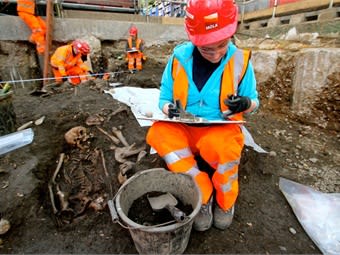
Archaeologists have started excavating around 3,000 skeletons from the Bedlam burial ground at Liverpool Street in London.
The excavation will allow construction of the eastern entrance of the new Liverpool Street Crossrail station. A team of 60 archaeologists will work in shifts, six days a week to remove skeletons and carefully record evidence for what may prove to be, in archaeology terms, London’s most valuable 16th and 17th-century cemetery site. The excavation is being undertaken by MOLA (Museum of London Archaeology) on behalf of Crossrail.
The Bedlam burial ground was in use from 1569 to at least 1738, spanning the start of the British Empire, civil wars, the Restoration, Shakespeare’s plays, the Great Fire of London and numerous plague outbreaks. This year marks the 350th anniversary of London’s last Great Plague in 1665 and archaeologists hope that tests on excavated plague victims will help understand the evolution of the plague bacteria strain.
Jay Carver, Crossrail Lead Archaeologist said: “This excavation presents a unique opportunity to understand the lives and deaths of 16th and 17th century Londoners. The Bedlam burial ground spans a fascinating phase of London’s history, including the transition from the Tudor-period City into cosmopolitan early-modern London. This is probably the first time a sample of this size from this time period has been available for archaeologists to study in London. The Bedlam burial ground was used by a hugely diverse population from right across the social spectrum and from different areas of the City.”
Archaeologists begin main excavation of Broadgate ticket hall_ March 2015. Photo: Crossrail
Nick Elsden, Project Manager from MOLA said: “Construction for Crossrail is providing rare and exciting opportunities for archaeologists to excavate and study areas of London that would ordinarily be inaccessible, such as under established road-systems. There are up to six metres of archaeology on site, in what is one of the oldest areas of the city, so we stand to learn a great deal.”
The research also aims to shed light on migration patterns, diet, lifestyle and demography of those living in London at the time. Excavated skeletons will be taken to MOLA for testing by osteologists (bone specialists) before being reburied in a consecrated burial ground.
The skeletons will be excavated over the next four weeks, after which archaeologists will dig through medieval marsh deposits and Roman remains. A Roman road runs under the site, which has already yielded several interesting Roman artefacts such as horseshoes and cremation urns. Archaeologists are expected to finish onsite in September, after which construction will proceed on the new eastern ticket hall by contractor Laing O’Rourke.
Bedlam is London’s first municipal burial ground and was located just outside the original City Wall. It was used by people from around London who could not afford a church burial, or who chose to be buried there for religious or political reasons. It was also used as an ‘overflow’ cemetery when existing sites were full, including in times of plague. Famous 17th century political ‘Levellers’ such as John Lilburne and Robert Lockyer are believed to be buried there.
To date Crossrail has found more than 10,000 artifacts spanning 55 million years of London’s past across over 40 construction sites. It is the UK’s largest archaeology project. Preliminary excavations at the Liverpool Street site in 2013 and 2014 uncovered more than 400 skeletons and numerous artifacts.
More Rail

New York MTA Advances Final Contract for Second Avenue Subway Expansion
Contract Four is the largest in the Second Avenue Subway Phase 2 project and includes construction of station infrastructure, tracks, and signals for the subway expansion, MTA officials said. Work on Contract Four will begin in 2027.
Read More →
San Diego MTS Breaks Monthly Trolley Ridership Record
Agency officials said July’s ridership indicates MTS’s continued recovery from the pandemic.
Read More →
Report Examines NJ TRANSIT Reliability, Funding Challenges
The Garden State Initiative analysis examines the roles of Amtrak infrastructure, fleet management, and agency operations while recommending a more performance-based approach to improving reliability.
Read More →
Stadler, CapMetro Sign Long-Term Rail Fleet Support Agreement
Beginning in 2027, Stadler will provide on-site technical expertise, spare parts support, training, and obsolescence management to help extend the reliability and longevity of CapMetro’s GTW fleet.
Read More →
Biz Briefs: Alstom Lands Canadian Contract, LYT to Supply California TSP, and More
In METRO's latest installment, we take a look at recent news from Complete Coach Works, Beep, FlixBus, and more partnerships making headlines across the transportation sector.
Read More →
CATS Gold Line Marks 5 Years of Service, 2.8M Passenger Trips
With a six-mile expansion planned, the Charlotte streetcar is positioned to connect more neighborhoods and major transit hubs across the region.
Read More →
Why Simulating Pedestrian Movement Has Become Essential for Modern Rail Stations
Pedestrian microsimulation is helping rail planners identify bottlenecks, test station designs, and prepare complex transit hubs for growing passenger volumes.
Read More →
Amtrak Begins Major Construction at New York’s Sunnyside Yard
The new maintenance facility will support Amtrak’s Airo trainsets while improving maintenance efficiency and turnaround times in New York.
Read More →
Chicago Leaders Unveil Plans for O’Hare Airport Express Train
The privately developed project would offer a 15-minute trip between downtown and O’Hare’s Terminal 2, with trains operating every 15 minutes on a dedicated track. The service would use battery-electric trains and three existing freight rail rights-of-way.
Read More →
OCTA Maps Out 30-Year Strategy to Protect Coastal Rail Corridor
The draft feasibility report identifies strategies to protect the coastal rail line for decades as the agency continues near-term stabilization and sand placement efforts.
Read More →