




Related: Alstom launches Attractic and SRS at UITP World Congress
How transportation played key role in transformation of Milan
The Brussels based UITP’s World Congress is the major global gathering of the world’s public transport industry to network, review progress and innovation, understand trends from suppliers as well as focus on the challenges that public transport faces in delivering a viable, sustainable future for the world.
July 1, 2015
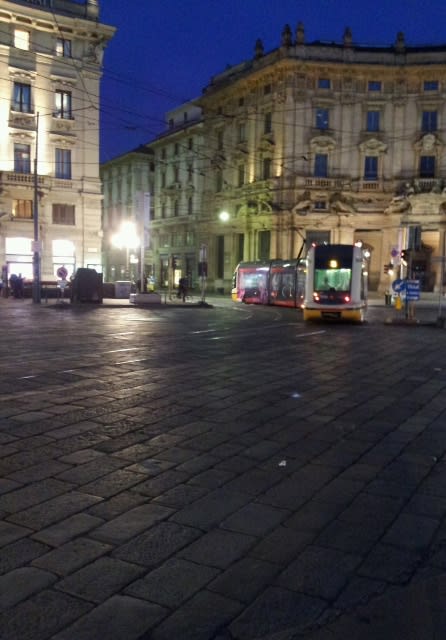
Tram in central Milan
9 min to read
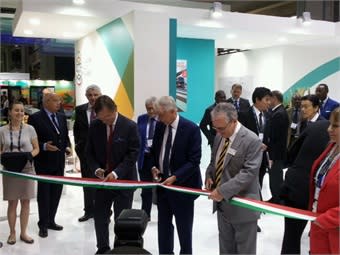
UITP Conference Exhibition Opening
The International Public Transport Association (UITP) held its biennial World Congress in Milan, Italy from June 8 to 10, featuring 250 journalists, 82 countries, 284 exhibitors, 300,000 square feet of exhibition space and over 2,000 delegates. The Brussels based UITP’s World Congress is the major global gathering of the world’s public transport industry to network, review progress and innovation, understand trends from suppliers as well as focus on the challenges that public transport faces in delivering a viable, sustainable future for the world. The Congress has been occurring for over 100 years and the last two were in Geneva (2013) and Dubai (2011).
The Congress was held in Italy’s commercial hub — Milan. According to Alain Flausch, Secretary General of UITP, “… it is not an accident that UITP choose to have its Congress in Milan...but a choice based on great practice and integration…[in this city and region].” The city has been “…working on supply side and demand site initiatives to grow its economy.” It is a good example of transport innovation “…like London, Stockholm or Oslo.” The Congress was introduced by the Mayor of Milan and key officials from the Region and transport operators.
Several days in Milan and the surrounding region of Lombardy provides some insights into the state of the local public transport network.
Milan is the largest city in Italy, and while not as famous or classically picturesque as Rome, Florence or Venice, it is an over 2,000-year-old city that is the undisputed economic powerhouse of the country and one of the most dynamic business centers of Europe. Milan's population is approximately 1.2 million and the wider Region of Lombardy, which covers 24,000 square kms and includes various neighbouring suburbs, cities and towns spreading from the foothills of the Alps to the Po River contains over 10 million people. Over 900 million public transport trips are made each year in the region.
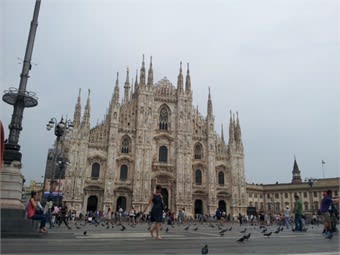
Milan Duomo (cathedral)
Lombardy remains Italy’s most populous and richest region. Milan has historically been a center of heavy industry, but has refocussed as a city of design, fashion, culture, higher education and tourism, as well as some residual manufacturing. Like many former industrial cities, particularly in Europe, that boomed in the 60’s and 70’s, Milan faced a steep challenge in maintaining prosperity in the 80’s and 90’s during structural adjustments as well as political challenges in Italy. It has also suffered from years of low economic growth in Italy in the new millennium. Historically, a city of immigration from the rest of Italy, neighboring Europe and now the wider world, its challenges had made it somewhat run down, polluted and dirty, chaotic and hard to govern.
This is now being addressed in a range of initiatives, which are evidenced by the new construction and office districts in the central area, the investment in infrastructure and the growth of the design culture. Prada, Canali and Versace, as well as eyewear manufacturer Luxottica, amongst many fashion houses, are all based in Milan. The 2015 World’s Fair is also being hosted in the city.
Transport has been a key component in this transformation. This has improved the mobility of workers across the wider region, attempted to deal with severe air pollution issues in the central city as well as one of the highest rates of car ownership in the world. The Milanese love their cars and even in the historic center, where numerous sustainable transport options exist, residential areas are severely impacted by high car ownership and the extensive numbers of double parked vehicles trying to find space.
Milan, like many European cities attempted to focus on delivering mobility for the “car” age shortly after World War II. This meant more parking, motorways and reducing the presence of street running trams — which were historically very extensive in the city.
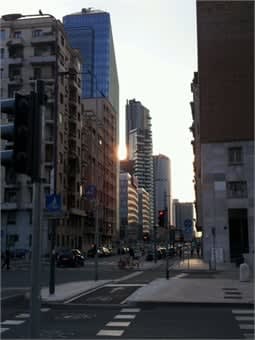
New office district in central Milan
However, at an early stage plans for a Metro system to replace parts of the tram network were put in place in 1950’s. The first line entered service in 1964, the second in 1969 and expansions have continued over the decades leading to four lines today (96 km) and plans for another line. The Metro has undoubtedly led to reductions in the tram network and within the inner city it is common to still see former tram tracks and junctions in the roadway. The prevalence of the tram is still very common, though, and remains a major means of mobility. There are 18 tram lines over 171 km utilizing 480 vehicles. The trams represent a remarkable mix of historic, yet very effective vehicles albeit a bit noisy, vehicles from the 1980’s, to very contemporary low-floor units from the start of the millennium. Buses within the city centre clearly play a smaller role in public transport mobility versus the trams and Metro although across the entire city over 1,400 buses are in use. To complete the service mix, ATM also operates four trolleybus routes around the historic inner city covering 40 km.
Milan faced a choice in terms of significantly improving a contemporary mix of public transport and championing some of the emerging trends that have made cities much cleaner, more liveable and encouraged investment and new residents. The city decided to focus on this mix of transport investment to regenerate the city, and economy and the progress has been substantial. This alludes back to the decision of the UITP to award the prestigious World Congress to the city.
Today, ATM (Azienda Transporti Milanesi) runs the metro, bus, trolley and tram system in the City of Milan, as well as cycle and car hire schemes and the “Area C” congestion charging service. Over 750 million trips per year are made on its services. Cost recovery is 50%.
ATM has just introduced an extension of Metro line 5 with service to the station adjacent to the Congress Centre opening a few days before the UITP event. The line is unlike the other lines in the city and uses shorter trains (50 meters), platforms with edge doors and automated vehicle operation. An intensive service is possible through this automation, which allows for the smaller scale of the station infrastructure. The system, developed in Italy by AnsaldoBreda — which is now part of Hitachi’s growing European business — is also used in the highly praised Copenhagen Metro in the Danish capital. In fact, ATM operates the Danish system under contract as an extension of its local businesses. The new line is impressive, but is in the very early stages of its deployment with many stations not yet complete and various tests still underway.
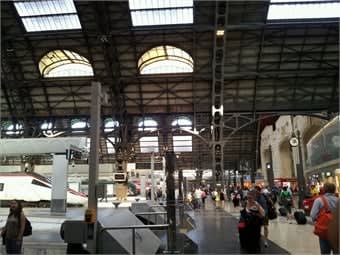
Milan Centrale Rail Station
In 2012, ATM started to manage the “Area C” congestion charging scheme in inner Milan which was a replacement for an earlier penalty scheme for highly polluting vehicles. The scheme was introduced following a public referendum. Vehicles entering the central zone between 7:30 a.m. and 7:30 p.m., via 43 road entry points need to have purchased an access ticket or face a penalty charge. Discounts exist for residents within the zone. The scheme reinvests its operating surplus in sustainable transport schemes. The Area C scheme won a Transport Achievement Award from the OECD (Organisation for Economic Cooperation and Development) and is the kind of innovation that has led to Milan’s increasing profile as a leader in urban transport and directly tackles issues of congestion and pollution in a very space constrained inner city.
ATM also runs bike (201 stations, 3,600 bikes) and car sharing (141 vehicles) schemes in the city. Thus, they are able to take an integrated view of multi-modal mobility services.
Further investments have been made in: a centralized control center for the older three Metro lines; new trains for lines 1 and 2 — some of the existing rolling stock is extremely old and not consistent with contemporary expectations of public transport users; Metro extensions; a new Metro line (4); a mix of customer service points including Web, app, social media, phone and staffed service points at key stations. Ticketing on the system has been largely moved to self-service machines with staff on hand to assist customers.
FNM (Ferrovie Nord Milano) runs the heavy rail network in the Lombardy region under its operating brand TrenNord as well as rural buses and offers car sharing services. The service covers 11 core suburban and 42 regional rail lines and is focused on terminals Porta Garibaldi and Cadorna stations for regional commuters and a cross city tunnel (Passante) very similar to the Paris RER. The city center rail tunnel was completed in stages between 1997 and 2008. The cross city services are frequent and high capacity.
The very busy and large Centrale station seems primarily used by inter-regional and high-speed services. Over 300,000 people use this station daily. While connected directly via a heavy rail link to Porta Garibaldi, it is unusual to see, but perhaps useful, to have such a separation in commuter and interregional services in the city’s rail system. The regional rail service has clearly seen significant investment over the recent years. New double deck trains are common — the average age of the rail fleet is now 10 years — as well as bright and modern stations. FNM also offers a frequent express service to Milan’s main airport from three of the main central area terminals.
The rail system has also had to deal with the phenomenon of the recent recession leading to many Milanese leaving the central parts of the urban area for lower cost lifestyles in the countryside and then commuting back to the city which is adding additional demand to the network.
Both ATP and FNM have been given the challenge of making transport to the 2015 Milan World’s Fair, just outside the city center, work well for most of the expected 20 million visitors. The focus on transport to such an event, classically, is a means of accelerating service improvements in transport infrastructure as seen in London for the Olympics in 2012. As a visitor rail services and the available information seem to work very well.
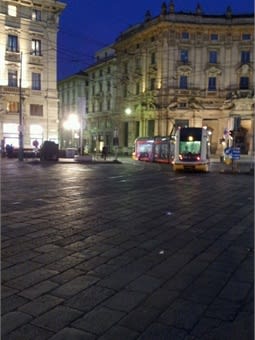
Tram in central Milan
However, it was interesting as a visitor to note how an expected 20-minute return journey from the Expo site one evening degenerated into a 2.5 hour ordeal, and even a modernizing system can be quite poor at providing comprehensive information or updates to on-system users or providing any information on alternative travel options during the delay.
Milan as a city works quite well and sustainable transport seems to be comprehensive, efficient and effective. It presents a good example of the modern European city presenting the latest thinking in sustainable transport choices and using investment to improve service quality and comprehensiveness. More can be done and many challenges remain. These include: a more customer focussed culture during delays; continuing investment in older assets — tram, metro vehicles and stations, bus, on-street infrastructure; battling a car culture that congests local inner city streets with parked vehicles; and establishing the role of cycling. However, the city does show the role of a renewed focus in transport making mobility an enabler, rather than blockage in presenting the contemporary, liveable and large urban metropolis.
The UITP “World Congress” will become the “Global Public Transport Congress” and comes to Montreal, Canada in May 2017.
More Rail

New York MTA Advances Final Contract for Second Avenue Subway Expansion
Contract Four is the largest in the Second Avenue Subway Phase 2 project and includes construction of station infrastructure, tracks, and signals for the subway expansion, MTA officials said. Work on Contract Four will begin in 2027.
Read More →
San Diego MTS Breaks Monthly Trolley Ridership Record
Agency officials said July’s ridership indicates MTS’s continued recovery from the pandemic.
Read More →
Report Examines NJ TRANSIT Reliability, Funding Challenges
The Garden State Initiative analysis examines the roles of Amtrak infrastructure, fleet management, and agency operations while recommending a more performance-based approach to improving reliability.
Read More →
Stadler, CapMetro Sign Long-Term Rail Fleet Support Agreement
Beginning in 2027, Stadler will provide on-site technical expertise, spare parts support, training, and obsolescence management to help extend the reliability and longevity of CapMetro’s GTW fleet.
Read More →
Biz Briefs: Alstom Lands Canadian Contract, LYT to Supply California TSP, and More
In METRO's latest installment, we take a look at recent news from Complete Coach Works, Beep, FlixBus, and more partnerships making headlines across the transportation sector.
Read More →
CATS Gold Line Marks 5 Years of Service, 2.8M Passenger Trips
With a six-mile expansion planned, the Charlotte streetcar is positioned to connect more neighborhoods and major transit hubs across the region.
Read More →
Why Simulating Pedestrian Movement Has Become Essential for Modern Rail Stations
Pedestrian microsimulation is helping rail planners identify bottlenecks, test station designs, and prepare complex transit hubs for growing passenger volumes.
Read More →
Amtrak Begins Major Construction at New York’s Sunnyside Yard
The new maintenance facility will support Amtrak’s Airo trainsets while improving maintenance efficiency and turnaround times in New York.
Read More →
Chicago Leaders Unveil Plans for O’Hare Airport Express Train
The privately developed project would offer a 15-minute trip between downtown and O’Hare’s Terminal 2, with trains operating every 15 minutes on a dedicated track. The service would use battery-electric trains and three existing freight rail rights-of-way.
Read More →
OCTA Maps Out 30-Year Strategy to Protect Coastal Rail Corridor
The draft feasibility report identifies strategies to protect the coastal rail line for decades as the agency continues near-term stabilization and sand placement efforts.
Read More →