



$3 billion Penn Station transformation proposed
The project, known as the Empire Station Complex, will feature increased train capacity, decreased congestion and improved signage. It will be expedited by a public-private partnership to break ground this year and complete substantial construction within the next three years.

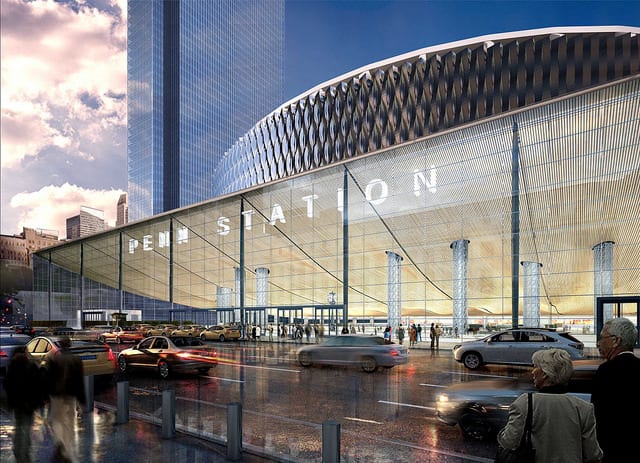
Rendering courtesy: Office Gov. Cuomo
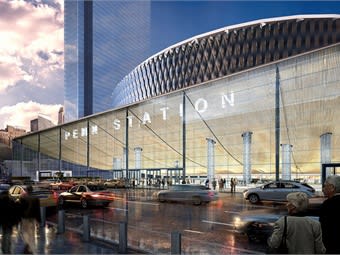
Rendering courtesy: Office Gov. Cuomo
New York Gov. Andrew Cuomo unveiled the sixth signature proposal of his 2016 agenda: transform Penn Station and the historic James A. Farley Post Office into a world-class transportation hub. The project, known as the Empire Station Complex, will feature significant passenger improvements, including first-class amenities, natural light, increased train capacity and decreased congestion, and improved signage to dramatically enhance the travel experience. The project — which is anticipated to cost $3 billion — will be expedited by a public-private partnership in order to break ground this year and complete substantial construction within the next three years.
View Governor Cuomo's Presentation
The original Penn Station first opened in 1910, and its underground areas have remained in continual use since then. In its current form, the station is designed to accommodate 200,000 daily passengers. In practice, it is the busiest train station in North America, serving more than 650,000 passengers every day and is plagued by widespread pedestrian congestion and outdated facilities. Gov. Cuomo's proposal will address these current shortcomings and transform the facility into a modern, iconic gateway to New York that is capable of meeting the demands of increased ridership in the 21st century.
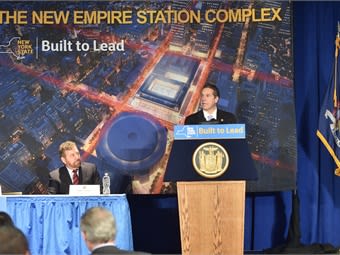
The Governor outlined his initiatives at an event Jan. 6, 2016 in Madison Square Garden, where he was joined by Madison Square Garden President James Dolan (seated), Amtrak President and CEO Joseph H. Boardman, and Empire Development Corporation President and CEO Howard Zemsky.(Kevin P. Coughlin/Office of the Governor)
“Penn Station is the heart of New York’s economy and transportation network, but it has been outdated, overcrowded, and unworthy of the Empire State for far too long,” said Gov. Cuomo. “We want to build Penn Station to be better than it ever was, and that is exactly what we are going to do. This proposal will fundamentally transform Penn Station for the 21st century, and we are excited to move forward with the project in the days to come.”
The Governor discussed the Empire Station proposal at an event in Madison Square Garden. The proposal is described below.
Penn Station Redevelopment: The existing Penn Station facility, which lies beneath Madison Square Garden and between 7th and 8th Avenues, will be dramatically renovated. The project will widen existing corridors, reconfiguring ticketing and waiting areas, improve connectivity between the lower levels and street level, bring natural light into the facility, improve signage, simplify navigation and reduce congestion, and expand and upgrade the retail offerings and passenger amenities on all levels of the station. The new station will include Wi-Fi, modernized train information displays and streamlined ticketing.
Several design alternatives will be considered, including major exterior renovations involving 33rd street, 7th avenue, 8th avenue, and/or Madison Square Garden Theater. Renderings of all of these options are available in the Governor’s presentation here.
Farley Post Office Redevelopment: As part of the Governor’s proposal, the Farley Post Office, which sits across 8th Avenue from Penn Station, will be redeveloped into a state-of-the-art train hall for Amtrak, the new train hall, with services for passengers of the Long Island Rail Road, New Jersey Transit and the new Air Train to LaGuardia Airport. The train hall will be connected to Penn Station via an underground pedestrian concourse, and increase the station’s size by 50%. At 210,000 square feet, the train hall will be roughly equivalent in size to the main room at Grand Central Terminal. The new facility will offer more concourse and circulation space, include retail space and modern amenities such as Wi-Fi and digital ticketing, and feature 30 new escalators, elevators and stairs to speed passenger flow. The Governor’s proposal also calls for an iconic yet energy-efficient architectural design.
Public-Private Partnership: The simultaneous redevelopments will be advanced by a public-private partnership on an unprecedented scale, resulting in one holistic and interconnected world-class station. Solicitations to developers will be issued by the state (which owns the Farley Post Office) and Amtrak (which owns Penn Station) this week. Responses are due in 90 days.
The construction cost is expected to be in excess of $3 billion, including $2 billion to redevelop Farley and Penn into a world-class transportation hub and at least $1 billion for ancillary retail and commercial developments between 7th and 9th avenues. $325 million of this will come from government sources, including U.S. DOT, Port Authority and Amtrak. Nearly all of the work will be funded by private investment, in exchange for an interest in the long-term revenue stream generated by the retail and commercial rents.
The Empire Station Complex will feature significant passenger improvements, including first-class amenities, natural light, increased train capacity and decreased congestion, and improved signage to dramatically enhance the travel experience.
Concept rendering for renovated Long Island Rail Road at 33rd Street Concourse
The Farley Post Office, which sits across 8th Avenue from Penn Station, will be redeveloped into a state-of-the-art train hall for Amtrak.
In light of years the public has waited for this important infrastructure upgrade, work will be expedited, with completion expected in the next three years, and Farley opening before Penn Station’s redevelopment is finished. State and federal environmental review has already been completed on redevelopment plans for the Farley Building, clearing a major hurdle and lining the project up for work to begin.
The redevelopment builds on work already underway beneath the Farley Building, in which construction of the lower concourse and underground connections to the subway and Penn Station is on budget and on schedule, for completion in the fall of 2016. With the structural steel completed in January 2015, more than 300 workers are now on site each day fitting out the new commuter concourse west of 8th Avenue in preparation for its opening next fall. Renovations to Penn Station and redevelopment of the Farley building are expected to begin after that work is completed.
The new complex will also lay the foundation for a further expansion south, connecting to the Gateway Project.
More Rail
Amtrak, CN Reach Agreements to Strengthen Passenger Rail Service, Safety
The agreement resolves a more than decade-long proceeding before the Surface Transportation Board concerning the terms and conditions for Amtrak services, such as the City of New Orleans, Illini/Saluki, and Wolverine.
Read More →
New York MTA Advances Final Contract for Second Avenue Subway Expansion
Contract Four is the largest in the Second Avenue Subway Phase 2 project and includes construction of station infrastructure, tracks, and signals for the subway expansion, MTA officials said. Work on Contract Four will begin in 2027.
Read More →
San Diego MTS Breaks Monthly Trolley Ridership Record
Agency officials said July’s ridership indicates MTS’s continued recovery from the pandemic.
Read More →
Report Examines NJ TRANSIT Reliability, Funding Challenges
The Garden State Initiative analysis examines the roles of Amtrak infrastructure, fleet management, and agency operations while recommending a more performance-based approach to improving reliability.
Read More →
Stadler, CapMetro Sign Long-Term Rail Fleet Support Agreement
Beginning in 2027, Stadler will provide on-site technical expertise, spare parts support, training, and obsolescence management to help extend the reliability and longevity of CapMetro’s GTW fleet.
Read More →
Biz Briefs: Alstom Lands Canadian Contract, LYT to Supply California TSP, and More
In METRO's latest installment, we take a look at recent news from Complete Coach Works, Beep, FlixBus, and more partnerships making headlines across the transportation sector.
Read More →
CATS Gold Line Marks 5 Years of Service, 2.8M Passenger Trips
With a six-mile expansion planned, the Charlotte streetcar is positioned to connect more neighborhoods and major transit hubs across the region.
Read More →
Why Simulating Pedestrian Movement Has Become Essential for Modern Rail Stations
Pedestrian microsimulation is helping rail planners identify bottlenecks, test station designs, and prepare complex transit hubs for growing passenger volumes.
Read More →
Amtrak Begins Major Construction at New York’s Sunnyside Yard
The new maintenance facility will support Amtrak’s Airo trainsets while improving maintenance efficiency and turnaround times in New York.
Read More →
Chicago Leaders Unveil Plans for O’Hare Airport Express Train
The privately developed project would offer a 15-minute trip between downtown and O’Hare’s Terminal 2, with trains operating every 15 minutes on a dedicated track. The service would use battery-electric trains and three existing freight rail rights-of-way.
Read More →