



Bombardier, Alstom consortium celebrates new Montreal railcars
The project generates important economic benefits for Québec: more than 150 Canadian suppliers, including over a hundred long-standing Québec companies, participate in the project, whose Canadian content exceeds 60%.

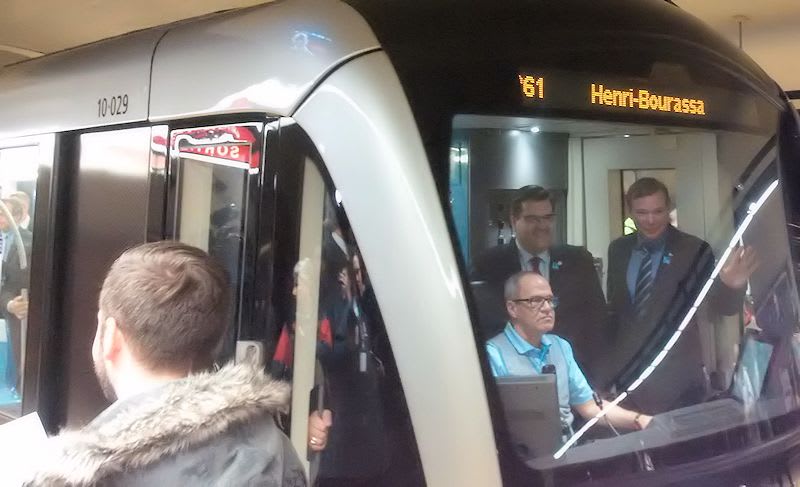
The Bombardier-Alstom Consortium, manufacturers of the new generation of metro cars for Montréal, celebrated the service launch of the Société de Transport de Montréal's (STM) new AZUR metro cars.
“We wish to congratulate our customer, the Société de Transport de Montréal, with whom we inaugurated today the AZUR metro cars," said Raymond Bachant, president of Bombardier Transportation – Americas. "We have spared no efforts in carrying out this project and helping shape the city’s vision: offering Montrealers cutting-edge metro cars that will provide STM passengers with the reliable, comfortable and rapid service to meet the high expectations of Québec’s metropolis.”
“AZUR has undergone strict and extensive qualification testing on the STM network, validating the metro trainset in its operating environment and confirming its performance,” said Angelo Guercioni, President of Alstom Canada. “With today’s entry into service, passengers can be assured of comfortable, enjoyable and safe journeys.”
Combining Québec know-how and international experience, Bombardier leads the project with responsibility for design and engineering at its St. Bruno, Québec, site, and production and final assembly at its La Pocatière manufacturing facility.
This project generates important economic benefits for Québec: more than 150 Canadian suppliers, including over a hundred long-standing Québec companies, participate in the project, whose Canadian content exceeds 60%.
Alstom’s scope of work for this contract is the supply of more than 900 bogies for the new metro cars, the automatic train control system, as well as communications and passenger information and video-surveillance systems.
The bogie is the unit that supports the metro car and supplies the acceleration, braking, guidance and suspension of the trains. Compared to the bogies of the older fleet, the new Alstom bogie features a pneumatic suspension, providing riders a much greater comfort level by minimizing the shaking and vibrating sensations sometimes felt. These new bogies, produced at Alstom’s plant in Sorel-Tracy, Québec, also feature efficient electric traction and regenerative braking systems that feed energy back into the network to energize other trains that may be accelerating at the same time.
The automatic train control system supplied by Alstom, adapted to the operational mode, constraints and infrastructure of the STM network, ensures passenger safety and maximum fluidity. AZUR’s on-board, integrated and fully customizable information system keeps passengers informed, safe and entertained throughout their journey, and allows for real-time monitoring to improve network operations.
More Rail

New York MTA Advances Final Contract for Second Avenue Subway Expansion
Contract Four is the largest in the Second Avenue Subway Phase 2 project and includes construction of station infrastructure, tracks, and signals for the subway expansion, MTA officials said. Work on Contract Four will begin in 2027.
Read More →
San Diego MTS Breaks Monthly Trolley Ridership Record
Agency officials said July’s ridership indicates MTS’s continued recovery from the pandemic.
Read More →
Report Examines NJ TRANSIT Reliability, Funding Challenges
The Garden State Initiative analysis examines the roles of Amtrak infrastructure, fleet management, and agency operations while recommending a more performance-based approach to improving reliability.
Read More →
Stadler, CapMetro Sign Long-Term Rail Fleet Support Agreement
Beginning in 2027, Stadler will provide on-site technical expertise, spare parts support, training, and obsolescence management to help extend the reliability and longevity of CapMetro’s GTW fleet.
Read More →
Biz Briefs: Alstom Lands Canadian Contract, LYT to Supply California TSP, and More
In METRO's latest installment, we take a look at recent news from Complete Coach Works, Beep, FlixBus, and more partnerships making headlines across the transportation sector.
Read More →
CATS Gold Line Marks 5 Years of Service, 2.8M Passenger Trips
With a six-mile expansion planned, the Charlotte streetcar is positioned to connect more neighborhoods and major transit hubs across the region.
Read More →
Why Simulating Pedestrian Movement Has Become Essential for Modern Rail Stations
Pedestrian microsimulation is helping rail planners identify bottlenecks, test station designs, and prepare complex transit hubs for growing passenger volumes.
Read More →
Amtrak Begins Major Construction at New York’s Sunnyside Yard
The new maintenance facility will support Amtrak’s Airo trainsets while improving maintenance efficiency and turnaround times in New York.
Read More →
Chicago Leaders Unveil Plans for O’Hare Airport Express Train
The privately developed project would offer a 15-minute trip between downtown and O’Hare’s Terminal 2, with trains operating every 15 minutes on a dedicated track. The service would use battery-electric trains and three existing freight rail rights-of-way.
Read More →
OCTA Maps Out 30-Year Strategy to Protect Coastal Rail Corridor
The draft feasibility report identifies strategies to protect the coastal rail line for decades as the agency continues near-term stabilization and sand placement efforts.
Read More →