




Built in 1907, Union Station is a critical transportation center in the Mid-Atlantic region. It is one of the most visited tourist attractions in the nation’s capital and serves as a hub for VRE, MARC and Amtrak plus Metrorail and Metrobus. Many tour bus and intercity bus services also use Union Station’s bus facilities. With approximately 37 million people passing through the station annually, planning for the station’s future remains at the forefront for station partners. Separate from the Concourse Modernization Project, FRA is currently leading an Environmental Impact Statement (EIS) for the Union Station Expansion Project to review long-term redevelopment alternatives.
Amtrak renovation of D.C.'s Union Station to double capacity
The result will be a vastly reconfigured, modernized and unified concourse that will improve the passenger experience by providing better accessibility, circulation, wayfinding and multimodal connectivity.
March 31, 2016
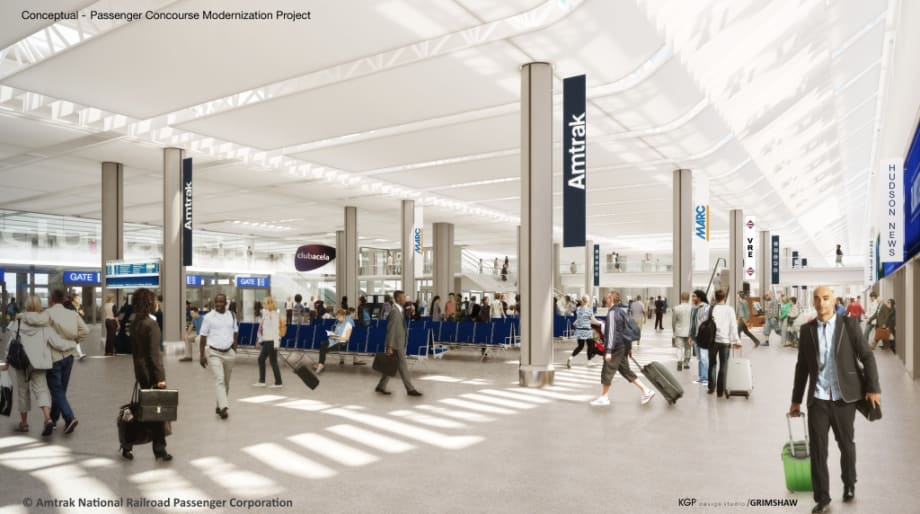
Rendering of Washington Union Station’s modernized intercity and commuter rail concourse.
Credit: KGP design studio/Grimshaw)
2 min to read
Rendering of Washington Union Station’s modernized intercity and commuter rail concourse.
KGP design studio/Grimshaw)
Amtrak is advancing a near-term comprehensive renovation of Washington Union Station’s intercity and commuter rail concourse, which will add approximately 20,000 square feet of new passenger space — nearly doubling the concourse’s current capacity.
Design is underway to upgrade passenger amenities including new restrooms, boarding gates, seating and a ClubAcela lounge. The design will also include new architectural features and natural light elements to enliven the space for travelers. The result will be a vastly reconfigured, modernized and unified concourse that will improve the passenger experience by providing better accessibility, circulation, wayfinding and multimodal connectivity.
While Union Station has served the region well for over a century, it is now operating beyond its capacity, particularly during rush hours and peak travel times, according to Amtrak officials. As such, implementing near-term solutions to gain capacity and alleviate congestion is imperative to maintaining safe and efficient station operations.
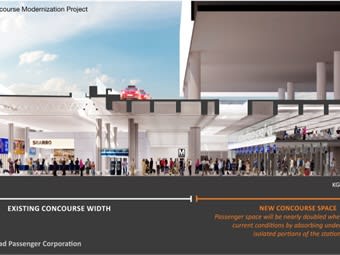
Courtesy: Amtrak
The Concourse Modernization project will be the first set of improvements to come to life as part of Washington Union Station’s 2nd Century plan, a comprehensive improvement initiative comprised of multiple projects — in coordination with the Union Station Redevelopment Corporation (USRC), the Federal Railroad Administration (FRA) and private real estate developer Akridge — which seeks to triple passenger capacity and double train capacity over the next 20 years.
In addition to the modernization of the concourse, planned improvements by Washington Metropolitan Area Transit Authority (WMATA) for a new Metrorail staircase and new First Street entrance will bring a consolidated set of passenger improvements to the western portion of the concourse.
Early action construction for Amtrak’s Concourse Modernization project will start spring 2016, including the relocation of heating and ventilation units. Phased construction is anticipated to start in 2017 and will seek to minimize impacts to all station users.
More Rail

New York MTA Advances Final Contract for Second Avenue Subway Expansion
Contract Four is the largest in the Second Avenue Subway Phase 2 project and includes construction of station infrastructure, tracks, and signals for the subway expansion, MTA officials said. Work on Contract Four will begin in 2027.
Read More →
San Diego MTS Breaks Monthly Trolley Ridership Record
Agency officials said July’s ridership indicates MTS’s continued recovery from the pandemic.
Read More →
Report Examines NJ TRANSIT Reliability, Funding Challenges
The Garden State Initiative analysis examines the roles of Amtrak infrastructure, fleet management, and agency operations while recommending a more performance-based approach to improving reliability.
Read More →
Stadler, CapMetro Sign Long-Term Rail Fleet Support Agreement
Beginning in 2027, Stadler will provide on-site technical expertise, spare parts support, training, and obsolescence management to help extend the reliability and longevity of CapMetro’s GTW fleet.
Read More →
Biz Briefs: Alstom Lands Canadian Contract, LYT to Supply California TSP, and More
In METRO's latest installment, we take a look at recent news from Complete Coach Works, Beep, FlixBus, and more partnerships making headlines across the transportation sector.
Read More →
CATS Gold Line Marks 5 Years of Service, 2.8M Passenger Trips
With a six-mile expansion planned, the Charlotte streetcar is positioned to connect more neighborhoods and major transit hubs across the region.
Read More →
Why Simulating Pedestrian Movement Has Become Essential for Modern Rail Stations
Pedestrian microsimulation is helping rail planners identify bottlenecks, test station designs, and prepare complex transit hubs for growing passenger volumes.
Read More →
Amtrak Begins Major Construction at New York’s Sunnyside Yard
The new maintenance facility will support Amtrak’s Airo trainsets while improving maintenance efficiency and turnaround times in New York.
Read More →
Chicago Leaders Unveil Plans for O’Hare Airport Express Train
The privately developed project would offer a 15-minute trip between downtown and O’Hare’s Terminal 2, with trains operating every 15 minutes on a dedicated track. The service would use battery-electric trains and three existing freight rail rights-of-way.
Read More →
OCTA Maps Out 30-Year Strategy to Protect Coastal Rail Corridor
The draft feasibility report identifies strategies to protect the coastal rail line for decades as the agency continues near-term stabilization and sand placement efforts.
Read More →