




The cost to complete the entire 500-kilometer Sweden-Finland network is projected to be $21 billion dollars, or $42 million dollars per kilometer on average.
Hyperloop trip would link Helsinki to Stockholm in under 30 minutes
A study of a full-scale system connecting the two capitals would save three hours compared to flying or an overnight ferry. The value of time saved by the network is estimated to be $355 million per year.
July 6, 2016
Hyperloop One
2 min to read
Hyperloop One
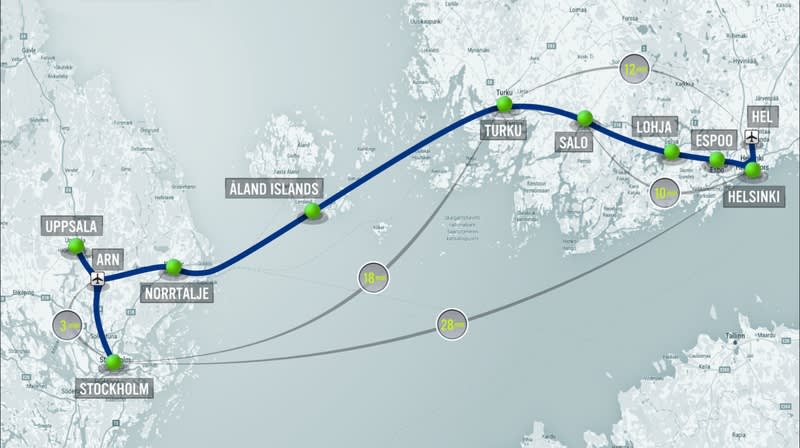
Passengers of a proposed Hyperloop network linking Helsinki to Stockholm would be able to make the trip in 28 minutes compared to a 3.5-hour flight or overnight ferry, according to a new study.
Results from the world's first study of a full-scale Hyperloop system was presented by Hyperloop One, FS Links and KPMG at the Northern Light business summit in Helsinki, Finland. The data reinforces the transformational economic and social case for building the proposed 500-kilometer Hyperloop network linking the metro areas and airports of the two capitals, according to the companies.
The value of time saved by the network is an $355 million dollars per year. Revenue for the complete system is estimated to be $1.1 billion dollars per year, with an operating profit of $886 million dollars based on a forecast of 43 million passenger trips a year.
"Our findings confirm what we have been saying all along: Hyperloop is a time-saver for commuters and an incredible generator of economic benefits for cities and regions along the route," said Rob Lloyd, CEO, Hyperloop One. "Hyperloop One is ready to take the next step and start construction. The Scandinavian region is a perfect location because of its strong economy, mobile population and global leadership as tech innovators. From the early stages, the region has been at the forefront of exploring Hyperloop as a transportation solution."
The Hyperloop network would unlock new economic development in the region, too. Stockholm, for example, has a 13-year waiting list for new rental apartments. Plans by the Swedish government to add 210,000 new commuter homes in the Greater Stockholm can be incorporated into the route, building real estate values around Hyperloop stations that can whisk people to downtown Stockholm in less than 10 minutes.
Based on the strength of the study's findings, the city of Salo, Finland, has signed a Letter of Intent with Hyperloop One to become the first Hyperloop city along the proposed Helsinki-Stockholm route. Salo has a strong population of talented engineers eager to fill open tech jobs across the region that a Hyperloop would knit together with on-demand transport.
More Rail

New York MTA Advances Final Contract for Second Avenue Subway Expansion
Contract Four is the largest in the Second Avenue Subway Phase 2 project and includes construction of station infrastructure, tracks, and signals for the subway expansion, MTA officials said. Work on Contract Four will begin in 2027.
Read More →
San Diego MTS Breaks Monthly Trolley Ridership Record
Agency officials said July’s ridership indicates MTS’s continued recovery from the pandemic.
Read More →
Report Examines NJ TRANSIT Reliability, Funding Challenges
The Garden State Initiative analysis examines the roles of Amtrak infrastructure, fleet management, and agency operations while recommending a more performance-based approach to improving reliability.
Read More →
Stadler, CapMetro Sign Long-Term Rail Fleet Support Agreement
Beginning in 2027, Stadler will provide on-site technical expertise, spare parts support, training, and obsolescence management to help extend the reliability and longevity of CapMetro’s GTW fleet.
Read More →
Biz Briefs: Alstom Lands Canadian Contract, LYT to Supply California TSP, and More
In METRO's latest installment, we take a look at recent news from Complete Coach Works, Beep, FlixBus, and more partnerships making headlines across the transportation sector.
Read More →
CATS Gold Line Marks 5 Years of Service, 2.8M Passenger Trips
With a six-mile expansion planned, the Charlotte streetcar is positioned to connect more neighborhoods and major transit hubs across the region.
Read More →
Why Simulating Pedestrian Movement Has Become Essential for Modern Rail Stations
Pedestrian microsimulation is helping rail planners identify bottlenecks, test station designs, and prepare complex transit hubs for growing passenger volumes.
Read More →
Amtrak Begins Major Construction at New York’s Sunnyside Yard
The new maintenance facility will support Amtrak’s Airo trainsets while improving maintenance efficiency and turnaround times in New York.
Read More →
Chicago Leaders Unveil Plans for O’Hare Airport Express Train
The privately developed project would offer a 15-minute trip between downtown and O’Hare’s Terminal 2, with trains operating every 15 minutes on a dedicated track. The service would use battery-electric trains and three existing freight rail rights-of-way.
Read More →
OCTA Maps Out 30-Year Strategy to Protect Coastal Rail Corridor
The draft feasibility report identifies strategies to protect the coastal rail line for decades as the agency continues near-term stabilization and sand placement efforts.
Read More →