



Student studies pros, cons of Denver's P3 commuter rail partnership
The Eagle P3 serves as a case study for a University of Denver doctoral student's dissertation, which includes assessing the project’s unique public-private aspect from both a financial and social perspective.

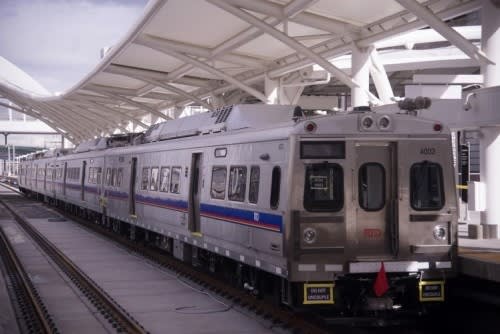
RTD commuter rail line. Photo: University of Denver
RTD commuter rail line. Photo: University of Denver
When commuters first stepped aboard Denver Regional Transportation District's new commuter rail line between Denver International Airport and downtown’s Union Station last April, they probably weren’t aware of the groundbreaking nature of those 23 miles of track.
Not only did the project break ground literally, but the new line is part of the nation’s very first public-private partnership (P3) for commuter rail. Known as the Eagle P3, the project also includes the new B Line to Westminster and the G Line to Arvada scheduled to begin service in 2017.
For Sylvia Brady, a doctoral student in University of Denver’s Department of Geography and the Environment, the Eagle P3 serves as a case study for her dissertation. With Professor Andrew Goetz as her advisor, she’s assessing the project’s unique public-private aspect from both a financial and social perspective.
“One of my questions is whether the Eagle P3 could serve as a model for transit agencies in other locations,” Brady says. “What are the benefits and shortcomings of Denver’s approach?”
With population and traffic congestion growing in urban areas throughout the U.S., the demand for transportation infrastructure is increasing. Funding to expand and repair infrastructure has fallen, however, due to local revenue shortfalls, lack of federal funds and the economic crisis associated with the Great Recession. As a result, state and local agencies increasingly are turning to the private sector to fill funding gaps.
“Most of the research out there on P3s in the U.S. has focused on roads, bridges and tunnels,” Brady says. “We need more research on the emerging trend of using P3s for transit infrastructure.”
The Eagle P3 is a component of the Denver Regional Transportation District’s multibillion-dollar FasTracks program, the nation’s largest voter-approved mass transit expansion. Under the partnership, a private consortium called Denver Transit Partners holds a 34-year agreement with RTD that includes five years to design and build the three new lines followed by 29 years to operate and maintain them.
The main benefit of the partnership is that the private sector assumes some of the risks associated with the new lines, which reduces overall costs and expedites the project. According to Brady, the estimated cost of designing and constructing the lines was $300 million lower than if RTD had undertaken the project itself.
“With these savings, RTD has been able to open additional rail lines and build more infrastructure faster and cheaper,” she says.
She points out that while design and construction costs were less with the P3, the project’s long-term operational costs could ultimately end up costing more than if RTD had built the lines itself. The P3 does, however, offer cost certainty to RTD.
One disadvantage of the P3 approach is the complication that arises from formulating and navigating a public-private contract, which can increase exploratory and legal expenses. “In addition, the public sector cedes some control of the project to the private sector,” Brady explains. “Some people don't think that public assets should be privately managed.”
Brady’s work in public transportation grows out of her interest in sustainability. “My real passion for this comes from how more people can benefit from public transportation, and how it can help reduce pollution and increase sustainability,” she says. “Denver, in particular, is in a position where the city needs to balance growth with policies to help reduce negative impacts of that growth.”
When she finishes her dissertation, Brady plans to share her results with RTD. Her research methods have involved numerous interviews with project stakeholders.
“I've gotten a good look at the inner workings of public transport through this research and have been pleasantly surprised with how transparent everyone has been,” she says. “The project leaders have been excellent at sharing information with me.”
More Rail

New York MTA Advances Final Contract for Second Avenue Subway Expansion
Contract Four is the largest in the Second Avenue Subway Phase 2 project and includes construction of station infrastructure, tracks, and signals for the subway expansion, MTA officials said. Work on Contract Four will begin in 2027.
Read More →
San Diego MTS Breaks Monthly Trolley Ridership Record
Agency officials said July’s ridership indicates MTS’s continued recovery from the pandemic.
Read More →
Report Examines NJ TRANSIT Reliability, Funding Challenges
The Garden State Initiative analysis examines the roles of Amtrak infrastructure, fleet management, and agency operations while recommending a more performance-based approach to improving reliability.
Read More →
Stadler, CapMetro Sign Long-Term Rail Fleet Support Agreement
Beginning in 2027, Stadler will provide on-site technical expertise, spare parts support, training, and obsolescence management to help extend the reliability and longevity of CapMetro’s GTW fleet.
Read More →
Biz Briefs: Alstom Lands Canadian Contract, LYT to Supply California TSP, and More
In METRO's latest installment, we take a look at recent news from Complete Coach Works, Beep, FlixBus, and more partnerships making headlines across the transportation sector.
Read More →
CATS Gold Line Marks 5 Years of Service, 2.8M Passenger Trips
With a six-mile expansion planned, the Charlotte streetcar is positioned to connect more neighborhoods and major transit hubs across the region.
Read More →
Why Simulating Pedestrian Movement Has Become Essential for Modern Rail Stations
Pedestrian microsimulation is helping rail planners identify bottlenecks, test station designs, and prepare complex transit hubs for growing passenger volumes.
Read More →
Amtrak Begins Major Construction at New York’s Sunnyside Yard
The new maintenance facility will support Amtrak’s Airo trainsets while improving maintenance efficiency and turnaround times in New York.
Read More →
Chicago Leaders Unveil Plans for O’Hare Airport Express Train
The privately developed project would offer a 15-minute trip between downtown and O’Hare’s Terminal 2, with trains operating every 15 minutes on a dedicated track. The service would use battery-electric trains and three existing freight rail rights-of-way.
Read More →
OCTA Maps Out 30-Year Strategy to Protect Coastal Rail Corridor
The draft feasibility report identifies strategies to protect the coastal rail line for decades as the agency continues near-term stabilization and sand placement efforts.
Read More →