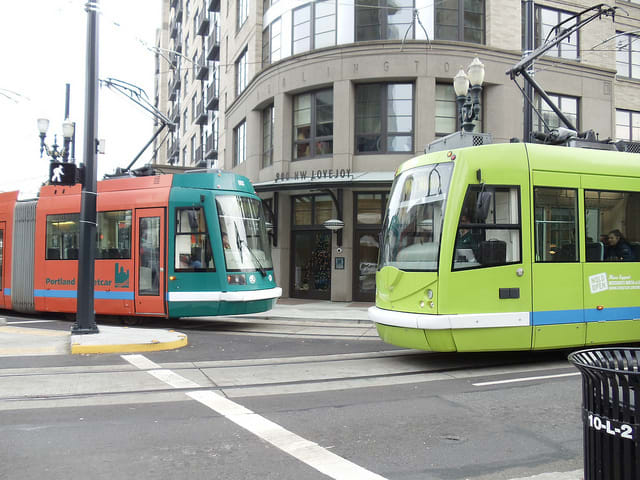
"Development outcomes along streetcar corridors cannot be entirely attributed to the presence of the streetcar," said Joel Mendez, assistant professor of urban planning in the School of Public Affairs & Administration. Photo: Portland Streetcar
3 min to read
"Development outcomes along streetcar corridors cannot be entirely attributed to the presence of the streetcar," said Joel Mendez, assistant professor of urban planning in the School of Public Affairs & Administration. Photo: Portland Streetcar
Cities considering investing in streetcar systems in an effort to bolster economic development should take caution, according to a study conducted by a University of Kansas urban planning researcher.
"Development outcomes along streetcar corridors cannot be entirely attributed to the presence of the streetcar," said Joel Mendez, assistant professor of urban planning in the School of Public Affairs & Administration. "There are many elements at play which are contributing to observed development activity. Streetcar investment is commonly accompanied with a healthy incentive package. The streetcar is not a one-tool solution."
Ad Loading...
Study excerpt
The lesson from Portland’s experience seems to be that the more effective a streetcar is as a transportation service, and the more it is used by patrons, the more likely it is to have development effects.
Simultaneously, a streetcar alone is not a guarantee of positive outcomes, as other factors such as a healthy real estate market, land availability, development-supportive zoning and other policies also need to be present.
Cities that are operating streetcars or contemplating making a streetcar investment would be best served by keeping these issues in mind when making their own decisions.
Mendez and co-author Jeffrey Brown, professor and chair in the Department of Urban & Regional Planning at Florida State University, recently published their findings in the Transportation Research Record and as a report for the Mineta Transportation Institute.
In the study, the researchers examined development activity in Portland and Seattle from 2000-2017. Both urban metropolitan areas invested heavily in streetcars and have experienced significant success in stimulating development within their urban cores and along streetcar corridors. This has encouraged many U.S. cities to follow suit in hopes of experiencing similar development outcomes.
This can be problematic as there is minimal research out there that explores the development impact of streetcar investment, Mendez said.
"The purpose of this study was to better inform cities who were considering investing hundreds of millions of dollars on a streetcar specifically to achieve economic development outcomes," Mendez said. "We want to provide insight into the complicated relationship between streetcar investment and development outcomes. They see Portland, and they see all these new buildings, but not all of this came because of the streetcar. Many other elements are in play."
Development activity was compared between areas receiving development incentives located near streetcar stations and areas receiving incentives that were not.
Ad Loading...
“We did this to test whether the presence of the streetcar had a unique impact on stimulating development activity or if it was the development incentives doing most of the work,” Mendez said.
Photo: Portland Streetcar
Outcomes were inconsistent within and between cities. Some areas near streetcar stations were observed to experience greater development activity than areas receiving similar incentives and located in non-streetcar service areas, and vice versa.
“What this tells us is that the presence of the streetcar does not guarantee the attainment of heightened development activity," Mendez said. "If the achievement of development outcomes is driving the pursuit of streetcar investment, the sole implementation of development incentives should be considered. The employment of such incentives can potentially aid in the attainment of desired outcomes while requiring significantly lower capital costs in their implementation.”
Variation in outcomes between cities also showed that the association between streetcars and development activity is very context- and place-specific.
“The success experienced in one city may not be transferable to another. Cities contemplating making a streetcar investment would be best served by keeping this in in mind,” Mendez said.
As chair of APTA’s Business Members Board of Governors, Ray Melleady explains how more than 850 business members are partnering with transit agencies to advance funding, innovation, and industry-wide collaboration.
The proposal, developed by Amtrak management and approved by the board for further consideration, is intended to modernize the organization's structure while improving accountability, operational efficiency, and customer service.
From manufacturers and suppliers to transit agencies and motorcoach operators, these updates offer a snapshot of the projects, partnerships and business moves driving the industry forward.
The event was also a celebration of recent reforms to public transportation in the Chicago area, changes that could be as transformative in the future as the major civic achievement a century ago, said officials.
Incoming LA Metro Board Chair and Los Angeles Mayor Karen Bass joined outgoing Board Chair Fernando Dutra and LA Metro CEO Stephanie Wiggins to review accomplishments from fiscal year 2026, which included the opening of new rail extensions, advancement of major transit projects, expanded safety programs, and new rider amenities.