



Valley Metro to tap solar power for rail ops facility
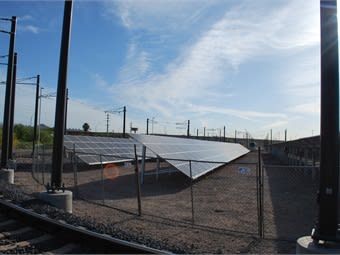
The new solar plant, which comprises 2,800 solar voltaic panels spanning 1.15 acres, is mounted at ground-level and on parking lot shade canopies. It’s capable of generating 1.3 million Kilowatt-hours (kWh) of energy savings annually, or enough electricity to power 123 homes.

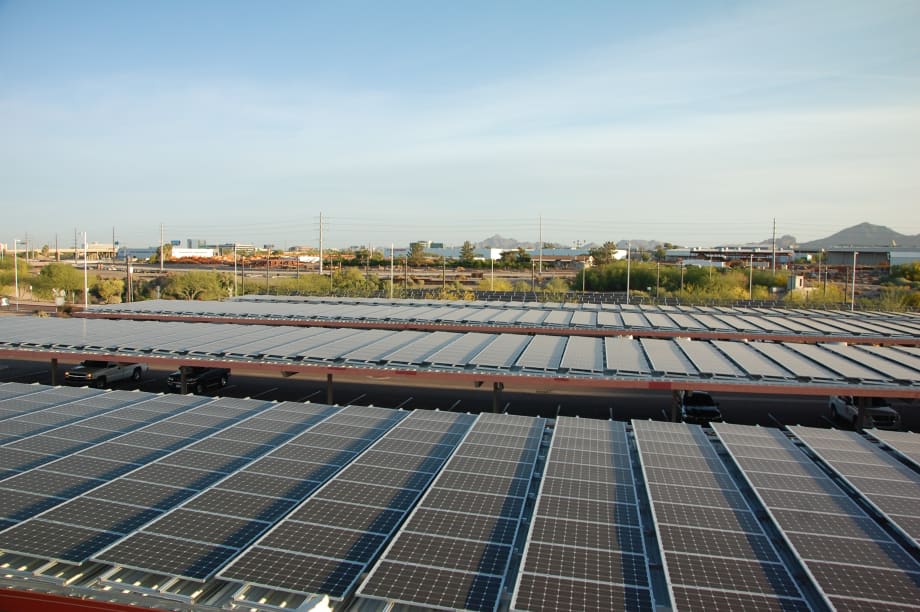
Solar panels installed at Valley Metro Rail Operations & Maintenance Center in Phoenix.
Solar panels installed at Valley Metro Rail Operations & Maintenance Center in Phoenix.
Valley Metro announced plans to begin powering its Rail Operations & Maintenance Center using solar power beginning on Earth Day, April 22. The new solar plant, which comprises 2,800 solar voltaic panels spanning 1.15 acres, is mounted at ground-level and on parking lot shade canopies. It’s capable of generating 1.3 million Kilowatt-hours (kWh) of energy savings annually, or enough electricity to power 123 homes.
RELATED:New park-and-ride structure touts Calif. agency's sustainability commitment
“From reducing greenhouse gases to improving fuel usage, we are proud to be involved in a variety of initiatives to protect and preserve our environment,” said Steve Banta, Valley Metro CEO. “Solar energy is a principal addition to our growing sustainability efforts.” Solar power is added to a menu of existing sustainable programs that Valley Metro practices each day including a large fleet of alternatively fueled bus and trains.
Valley Metro received a Tran
Courtesy Valley Metro
sit Investments for Greenhouse Gas & Emissions Reduction (TIGGER) federal grant to help fund construction and installation of the solar photovoltaic system. Additional funding was received through the APS Schools and Government Incentive program. To date, the APS program has helped more than 32 government agencies, 300 schools and 70 school districts install solar energy.
RELATED:SoCal transit center incorporates innovation, sustainability in design
“This innovative project represents a dynamic way to bring sustainable, emission free energy solutions that will benefit Valley Metro’s customers and the greater Phoenix community,” said Rex Stepp, Renewable Energy Program Leader for APS. “Working with Valley Metro will enable everyone to continue to work together as we collectively build a sustainable energy future for Arizona and advance Arizona’s solar leadership.”
Last week, Valley Metro received Bronze level status in the American Public Transportation Authority’s (APTA) Sustainability Commitment on the basis of making sustainability a part of the agency’s strategic objectives, developing an awareness program and establishing a sustainability inventory. The new solar facility is a vital part of the agency’s overall commitment to sustainability. Valley Metro is one of eight systems across the country to earn this esteemed distinction.
“Congratulations to Valley Metro for receiving Bronze status in the APTA Sustainability Commitment Program,” said APTA President/CEO Michael Melaniphy. “Valley Metro is being recognized for its strong organizational commitment to improving sustainability, for significant progress in water reduction efforts in an arid environment, and for its innovation that led to saving energy in air conditioning on buses.”
More Technology

From Hardware to Digital Partner: Luminator Charts Its Next Chapter
CEO Magnus Friberg discusses Luminator’s shift toward becoming a digital partner, the growing importance of software and interoperability, and how AI can help agencies improve operations and passenger experience.
Read More →
Beyond the Checklist: A Structured Approach to Transit Maintenance
Reliability-Centered Maintenance helps transit agencies move beyond routine checklists to focus limited resources on the assets and failures that have the greatest impact on safety, reliability, and service.
Read More →
NJ TRANSIT Advances Bus Technology Upgrades Across Statewide Fleet
More than 1,500 buses now feature upgraded technology designed to improve arrival predictions and provide free Wi-Fi, with deployment expected to reach nearly 2,000 buses by the end of 2026.
Read More →

Building a Flexible Path to Transit Electrification
John Hroncich discusses BAE Systems’ modular and scalable approach, lessons learned from decades of real-world operations, and how agencies can identify electrification strategies that fit their fleets.
Read More →
Biz Briefs: Alstom Lands Canadian Contract, LYT to Supply California TSP, and More
In METRO's latest installment, we take a look at recent news from Complete Coach Works, Beep, FlixBus, and more partnerships making headlines across the transportation sector.
Read More →
From Legacy Silos to Conversational Intelligence
What if transit leaders could ask any operational question and get a trusted answer in seconds? Conversational AI is transforming how agencies use their data.
Read More →
USDOT Announces Rail Vehicle Replacement Grants, Chattanooga AV Shuttle Funding
More than $191 million in federal funding will help three transit agencies replace aging rail vehicles and support a new autonomous shuttle service in Chattanooga.
Read More →
Bus Tech Talk: Keeping Transit Technicians Ahead of the Technology Curve
LA Metro’s Obed Mejia discusses technician training, evolving maintenance technology, fleet replacement, and strategies for getting the most out of today’s transit fleets.
Read More →
Biz Briefs: RIPTA Unveils New Frontrunners, Clevland RTA Adds New Siemens, and More
In METRO's latest installment, we take a look at recent news from Siemens, Prevost, Dodge, and more partnerships making headlines across the transportation sector.
Read More →
Why Simulating Pedestrian Movement Has Become Essential for Modern Rail Stations
Pedestrian microsimulation is helping rail planners identify bottlenecks, test station designs, and prepare complex transit hubs for growing passenger volumes.
Read More →