




Related: Proterra Catalyst bus travels 258 miles on single charge
Proterra adds 35-foot Catalyst to vehicle lineup
Dallas Area Rapid Transit will be the first customer to receive seven, 35-foot Catalyst FC buses and two overhead semi-autonomous fast chargers. The seven buses will reduce DART’s emissions footprint while providing a clean, quiet ride for the agency’s 250,000 daily riders.
October 5, 2015
3 min to read
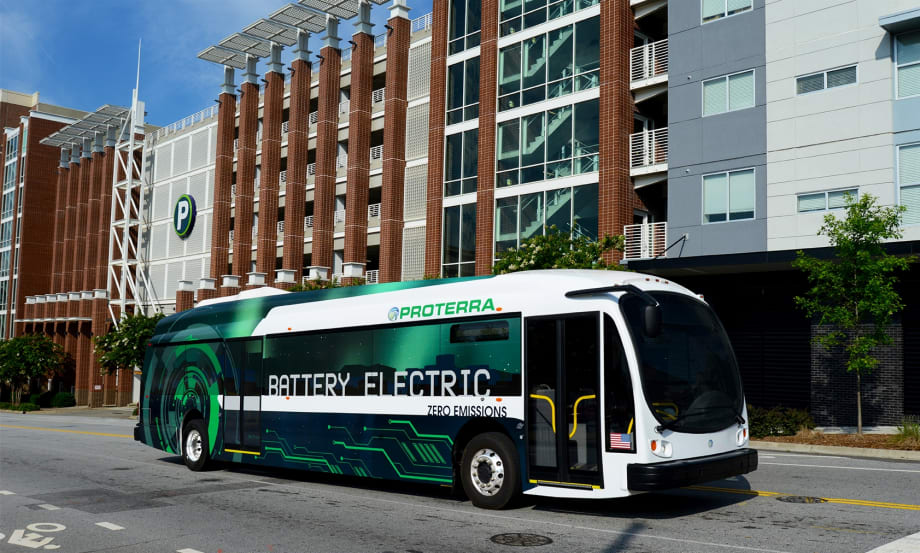
Proterra has expanded its Catalyst platform to accommodate increased customer demand for advanced mass transit buses, by introducing a new 35-foot vehicle based on the same technology platform as its current 40-foot Catalyst vehicle.
Closely tracking the broader transportation trend towards advanced safety systems, the new 35-foot Catalyst electric bus provides customers with nimble maneuvering and enhanced automated features, including collision avoidance and traction control in a smaller model for dense urban areas, building on the performance of the 40-foot Catalyst vehicle.
Proterra is also announcing that Dallas Area Rapid Transit will be the first customer to receive seven, 35-foot Catalyst FC buses and two overhead semi-autonomous fast chargers. The seven buses will reduce DART’s emissions footprint while providing a clean, quiet ride for the agency’s 250,000 daily riders.
“We believe in staying at the forefront of transit, so Proterra’s high performance zero-emission electric buses were an easy decision for us to make. These buses will give our riders and drivers the most modern bus transit experience on the road,” said DART President/Executive Director Gary Thomas.
Built from the ground-up to be completely optimized as an EV, the Catalyst is the only purpose-built bus in its class, recently proving its industry-leading performance by breaking four national records with the 40-foot vehicle in efficiency, gradeability, weight and acceleration at the Altoona Bus Research and Testing Center.
“The modular approach we have taken with the Catalyst design enables us to stay at the forefront of innovation and enable our customers to optimize their fleets over the average 12-year life of the bus,” said John Sleconich, chief engineer at Proterra. “Road safety is paramount to our design, so we’ve integrated a collision avoidance system that offers both safety benefits as well as potential customer savings.”
The modular configuration is a part of Proterra’s tech-centric approach to electrifying mass transit routes across the U.S. It offers customers the flexibility to change or upgrade the energy storage and charging systems as their transit needs evolve. By choosing from two base vehicle sizes, then configuring each bus with the right type of energy storage and charging systems, transit agencies can meet each route’s daily range requirements, remain adaptable to future changes, eliminate fossil fuel emissions in their communities and ultimately save money over the lifetime of their vehicles.
“The overwhelming success of our 40-foot Catalyst bus continues to drive new demand. We’re pleased to have Dallas as our first customer as they redefine their urban core and invest in a Smart City vision, prioritizing infrastructure, mobility and connected living,” said Ryan Popple, CEO of Proterra. “With Texas’ growing wind capacity, we’re pleased to provide a complementary clean mobility solution that will help Dallas improve its local air quality and reduce greenhouse gas emissions.”
More Technology

From Hardware to Digital Partner: Luminator Charts Its Next Chapter
CEO Magnus Friberg discusses Luminator’s shift toward becoming a digital partner, the growing importance of software and interoperability, and how AI can help agencies improve operations and passenger experience.
Read More →
Beyond the Checklist: A Structured Approach to Transit Maintenance
Reliability-Centered Maintenance helps transit agencies move beyond routine checklists to focus limited resources on the assets and failures that have the greatest impact on safety, reliability, and service.
Read More →
NJ TRANSIT Advances Bus Technology Upgrades Across Statewide Fleet
More than 1,500 buses now feature upgraded technology designed to improve arrival predictions and provide free Wi-Fi, with deployment expected to reach nearly 2,000 buses by the end of 2026.
Read More →

Building a Flexible Path to Transit Electrification
John Hroncich discusses BAE Systems’ modular and scalable approach, lessons learned from decades of real-world operations, and how agencies can identify electrification strategies that fit their fleets.
Read More →
Biz Briefs: Alstom Lands Canadian Contract, LYT to Supply California TSP, and More
In METRO's latest installment, we take a look at recent news from Complete Coach Works, Beep, FlixBus, and more partnerships making headlines across the transportation sector.
Read More →
Sponsored•September 8, 2026
From Legacy Silos to Conversational Intelligence
What if transit leaders could ask any operational question and get a trusted answer in seconds? Conversational AI is transforming how agencies use their data.
Read More →
USDOT Announces Rail Vehicle Replacement Grants, Chattanooga AV Shuttle Funding
More than $191 million in federal funding will help three transit agencies replace aging rail vehicles and support a new autonomous shuttle service in Chattanooga.
Read More →
Bus Tech Talk: Keeping Transit Technicians Ahead of the Technology Curve
LA Metro’s Obed Mejia discusses technician training, evolving maintenance technology, fleet replacement, and strategies for getting the most out of today’s transit fleets.
Read More →
Biz Briefs: RIPTA Unveils New Frontrunners, Clevland RTA Adds New Siemens, and More
In METRO's latest installment, we take a look at recent news from Siemens, Prevost, Dodge, and more partnerships making headlines across the transportation sector.
Read More →
Why Simulating Pedestrian Movement Has Become Essential for Modern Rail Stations
Pedestrian microsimulation is helping rail planners identify bottlenecks, test station designs, and prepare complex transit hubs for growing passenger volumes.
Read More →