



Calif.'s SolTrans adds 2 BYD electric buses
The new buses are decorated with mural-style art depicting the local community, newly commissioned by Vallejo artist Miro del Salazar.

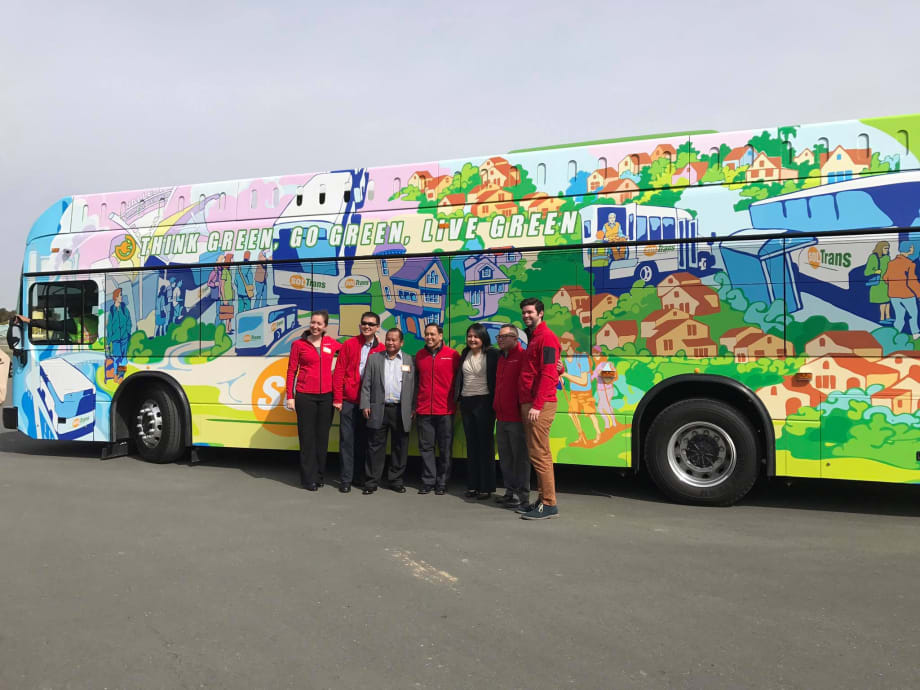
Mona Babauta, former director of SolTrans (third from right), with artist Miro del Salazar (third from left) and SolTrans staff members. BYD’s K9 Electric Bus is the longest range 40-foot electric transit bus available in North America.
Photo Credit: Vallejo Together
Mona Babauta, former director of SolTrans (third from right), with artist Miro del Salazar (third from left) and SolTrans staff members. BYD’s K9 Electric Bus is the longest range 40-foot electric transit bus available in North America.
Photo
Vallejo Together
BYD announced a delivery of two 40-foot K9 electric buses to SolTrans, which serves the cities of Benicia and Vallejo, Calif.
Both buses were manufactured at BYD’s factory in Lancaster, Calif.
“SolTrans is taking an important step today, moving towards sustainability and cleaner air while saving money on fuel, infrastructure, and maintenance,” said Macy Neshati, sr. VP, sales and marketing, at BYD America. “As a California company, we’re thrilled to be working with SolTrans, and looking forward to seeing these buses on the road.”
The new buses are decorated with mural-style art depicting the local community, newly commissioned by Vallejo artist Miro del Salazar.
The BYD K9 40-foot bus has a range of 161 miles on a single charge, the largest for an electric bus of its size available in North America, according to BYD. It is rated for up to an 18% gradient, making it an ideal choice for any route in the hilly San Francisco Bay Area.
The BYD factory in Lancaster currently employs more than 500 people, and with a planned expansion nearly complete, that number is expected to triple over the next three years. Earlier this year, BYD employees in Lancaster completed a “card-check” vote, one major step towards unionization.
More Technology
Almaviva Looks to Open Architecture to Advance Transit Technology
Eric Reese discusses how interoperability, open architecture, and modular design can help transit agencies control costs, reduce vendor lock-in, and upgrade technology without starting over.
Read More →
Driving Smarter Paratransit
John Hanlon shares how AlphaRoute is leveraging AI-powered technology to help paratransit providers optimize operations, support frontline staff, and enhance the rider experience.
Read More →
From Hardware to Digital Partner: Luminator Charts Its Next Chapter
CEO Magnus Friberg discusses Luminator’s shift toward becoming a digital partner, the growing importance of software and interoperability, and how AI can help agencies improve operations and passenger experience.
Read More →

Beyond the Checklist: A Structured Approach to Transit Maintenance
Reliability-Centered Maintenance helps transit agencies move beyond routine checklists to focus limited resources on the assets and failures that have the greatest impact on safety, reliability, and service.
Read More →
NJ TRANSIT Advances Bus Technology Upgrades Across Statewide Fleet
More than 1,500 buses now feature upgraded technology designed to improve arrival predictions and provide free Wi-Fi, with deployment expected to reach nearly 2,000 buses by the end of 2026.
Read More →
Building a Flexible Path to Transit Electrification
John Hroncich discusses BAE Systems’ modular and scalable approach, lessons learned from decades of real-world operations, and how agencies can identify electrification strategies that fit their fleets.
Read More →
Biz Briefs: Alstom Lands Canadian Contract, LYT to Supply California TSP, and More
In METRO's latest installment, we take a look at recent news from Complete Coach Works, Beep, FlixBus, and more partnerships making headlines across the transportation sector.
Read More →
From Legacy Silos to Conversational Intelligence
What if transit leaders could ask any operational question and get a trusted answer in seconds? Conversational AI is transforming how agencies use their data.
Read More →
USDOT Announces Rail Vehicle Replacement Grants, Chattanooga AV Shuttle Funding
More than $191 million in federal funding will help three transit agencies replace aging rail vehicles and support a new autonomous shuttle service in Chattanooga.
Read More →
Bus Tech Talk: Keeping Transit Technicians Ahead of the Technology Curve
LA Metro’s Obed Mejia discusses technician training, evolving maintenance technology, fleet replacement, and strategies for getting the most out of today’s transit fleets.
Read More →