




RELATED: BYD commits to hiring from communities facing significant barriers to employment
BYD unveils North America's largest electric bus factory
The grand opening celebration commemorated the addition of a new wing to the current BYD Coach and Bus space, bringing the total manufacturing facility to nearly 450,000 sq. ft.
October 9, 2017
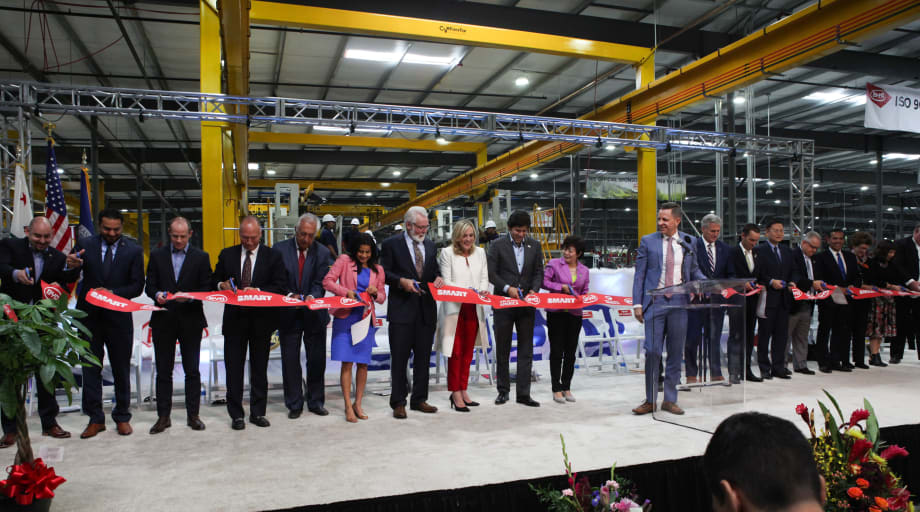
Dignitaries on hand included House Majority Leader Kevin McCarthy (R-Bakersfield); California Senate President Pro Tem Kevin de Leon; Congress members Steve Knight (R-Palmdale) and Nanette Diaz Barragan (D-San Pedro); former mayor of Los Angeles Antonio Villaraigosa; California Assemblyman Tom Lackey (R-Lancaster); Los Angeles County Supervisor Kathryn Barger; City of Lancaster Mayor R. Rex Parris and BYD leadership including Chairman Wang Chuanfu, President Stella Li and Senior Vice President Macy Neshati.
3 min to read
Dignitaries on hand included House Majority Leader Kevin McCarthy (R-Bakersfield); California Senate President Pro Tem Kevin de Leon; Congress members Steve Knight (R-Palmdale) and Nanette Diaz Barragan (D-San Pedro); former mayor of Los Angeles Antonio Villaraigosa; California Assemblyman Tom Lackey (R-Lancaster); Los Angeles County Supervisor Kathryn Barger; City of Lancaster Mayor R.Rex Parris and BYD leadership including Chairman Wang Chuanfu, President Stella Li and Senior Vice President Macy Neshati.
BYD unveiled its expanded battery-electric bus manufacturing facility—North America’s largest — with bipartisan support from elected officials on Friday. BYD’s nearly 800 employees in California were also on hand to help commemorate the new expansion for the coach and bus factory.
The grand opening celebration commemorated the addition of a new wing to the current BYD Coach and Bus space, bringing the total manufacturing facility to nearly 450,000 sq. ft. This expansion nearly quadruples BYD’s facility from its initial 2013 footprint.
The growth of BYD Coach and Bus reflects a rapid transition to electric transportation and will allow BYD to build up to 1,500 battery-electric buses annually. Since BYD established its U.S. electric bus manufacturing capabilities in Los Angeles County, the company has created nearly 800 full-time jobs throughout the state. This manufacturing facility expansion will enable BYD to hire up to 1,200 full-time workers at top production-line capacity. This manufacturing facility is powered 100% by renewable energy, which is provided by the City of Lancaster’s energy company, Lancaster Choice Energy.
BYD’s buses operate in transit agencies, universities, and airports across North America, with more than 40 customers including LA Metro, Los Angeles Department of Transportation, Stanford University, UCLA, UC San Francisco, UC Irvine, Anaheim Resort Transportation, Long Beach Transit, Denver Regional Transportation District, City of Albuquerque, SolTrans, SunLine Transit, Link Transit, COMO Connect, Antelope Valley Transit Authority, and many others.
BYD’s buses operate in transit agencies, universities, and airports across North America, with more than 40 customers including LA Metro, Long Beach Transit, and Antelope Valley Transit Authority.
The BYD Coach and Bus facility also supports R&D and assembly for BYD’s battery-electric medium- and heavy-duty trucks, including delivery, drayage, refuse, and yard trucks, among other product lines. These trucks incorporate the same proven core components that are used in BYD’s commercialized buses and vehicles with several hundred million service-proven miles. By the end of 2017, BYD will have delivered 70 all-electric trucks to 15 customers in North America, with orders for more than 140 trucks to-date.
The bipartisan group of officials on hand for the factory expansion unveiling praised BYD for its local job creation and impact on the community as an employer that provides a pathway to career growth in the burgeoning clean energy sector.
“The City of Lancaster is proud to have paired our progressive efforts with an equally bold and visionary partner — Build Your Dreams,” said Lancaster Mayor R. Rex Parris. “Our many successful achievements together, have contributed to the City’s steady rise as a frontrunner in the alternative energy arena. This expansion of BYD’s electric vehicle manufacturing facility is a true testament to the commitment of BYD to the southern California region; California; and indeed this nation. We are proud to be home to this great company.”
BYD’s products form a complete clean-energy ecosystem. BYD’s photovoltaic panels capture power from the sun, store it in BYD’s energy storage systems, and then use it in BYD’s electric vehicles without ever touching fossil fuels. This model has made BYD a global clean technology powerhouse that is changing what’s possible in electrified transportation. In each of its 33 global locations, BYD promotes economic development by creating good local jobs, training its work force, and ensuring that local communities have access to affordable clean energy.
More Technology
Almaviva Looks to Open Architecture to Advance Transit Technology
Eric Reese discusses how interoperability, open architecture, and modular design can help transit agencies control costs, reduce vendor lock-in, and upgrade technology without starting over.
Read More →
Driving Smarter Paratransit
John Hanlon shares how AlphaRoute is leveraging AI-powered technology to help paratransit providers optimize operations, support frontline staff, and enhance the rider experience.
Read More →
From Hardware to Digital Partner: Luminator Charts Its Next Chapter
CEO Magnus Friberg discusses Luminator’s shift toward becoming a digital partner, the growing importance of software and interoperability, and how AI can help agencies improve operations and passenger experience.
Read More →

Beyond the Checklist: A Structured Approach to Transit Maintenance
Reliability-Centered Maintenance helps transit agencies move beyond routine checklists to focus limited resources on the assets and failures that have the greatest impact on safety, reliability, and service.
Read More →
NJ TRANSIT Advances Bus Technology Upgrades Across Statewide Fleet
More than 1,500 buses now feature upgraded technology designed to improve arrival predictions and provide free Wi-Fi, with deployment expected to reach nearly 2,000 buses by the end of 2026.
Read More →
Building a Flexible Path to Transit Electrification
John Hroncich discusses BAE Systems’ modular and scalable approach, lessons learned from decades of real-world operations, and how agencies can identify electrification strategies that fit their fleets.
Read More →
Biz Briefs: Alstom Lands Canadian Contract, LYT to Supply California TSP, and More
In METRO's latest installment, we take a look at recent news from Complete Coach Works, Beep, FlixBus, and more partnerships making headlines across the transportation sector.
Read More →
Sponsored•September 8, 2026
From Legacy Silos to Conversational Intelligence
What if transit leaders could ask any operational question and get a trusted answer in seconds? Conversational AI is transforming how agencies use their data.
Read More →
USDOT Announces Rail Vehicle Replacement Grants, Chattanooga AV Shuttle Funding
More than $191 million in federal funding will help three transit agencies replace aging rail vehicles and support a new autonomous shuttle service in Chattanooga.
Read More →
Bus Tech Talk: Keeping Transit Technicians Ahead of the Technology Curve
LA Metro’s Obed Mejia discusses technician training, evolving maintenance technology, fleet replacement, and strategies for getting the most out of today’s transit fleets.
Read More →