




RELATED: Zonar expands fleet management tech to public transit
Zonar launches new ridership management app
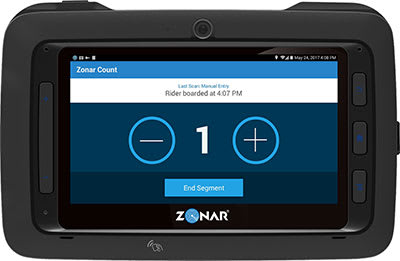
Developed for safety and ease-of-use, Zonar Count can only be used when the vehicle is not in motion and a driver “wakes up” their tablet to conduct a count.
June 29, 2017
2 min to read
Zonar introduced Zonar Count, an app designed for Zonar tablets that enables users to accurately count passengers that get on and off a vehicle, track average travel time, average passenger trip length, and operating costs per passenger trip. This data allows fleet managers to ensure safer vehicle operations, balance ridership, and streamline federal reporting — including Medicaid reimbursement.
“We built Zonar Count to help managers better understand how their fleets perform so they could make their vehicles safer and routes more efficient for drivers and passengers,” said H. Kevin Mest, sr. VP/GM, passenger services, at Zonar. “Operations managers would know how many students were actually riding a route in comparison to how many were assigned, providing a key productivity metric to right size fleets to actual load counts and accurately capturing state ridership information for state reporting.”
Developed for safety and ease-of-use, Zonar Count can only be used when the vehicle is not in motion and a driver “wakes up” their tablet to conduct a count. This ensures that a driver will not be distracted while operating their vehicle. With the touch of the screen, drivers can easily conduct a rider count and quickly transmit that data to a secure database for immediate access through with Zonar's Ground Traffic Control®. When paired with Zonar's Z Pass™, an RFID reader, which with passive Zonar RFID cards logs each entry and exit from the bus, the Zonar solution enables fleet managers visibility into exactly when and where riders got on and off a bus.
In additional to providing schools and mass transit organizations with increased access to ridership data, Zonar Count's data collection eliminates the complexity and paperwork involved tracking and submitting ridership information of special need students. With an accurate digitally recorded count of these students, school administrators can easily submit the information to receive Medicaid reimbursements.
More Technology

From Hardware to Digital Partner: Luminator Charts Its Next Chapter
CEO Magnus Friberg discusses Luminator’s shift toward becoming a digital partner, the growing importance of software and interoperability, and how AI can help agencies improve operations and passenger experience.
Read More →
Beyond the Checklist: A Structured Approach to Transit Maintenance
Reliability-Centered Maintenance helps transit agencies move beyond routine checklists to focus limited resources on the assets and failures that have the greatest impact on safety, reliability, and service.
Read More →
NJ TRANSIT Advances Bus Technology Upgrades Across Statewide Fleet
More than 1,500 buses now feature upgraded technology designed to improve arrival predictions and provide free Wi-Fi, with deployment expected to reach nearly 2,000 buses by the end of 2026.
Read More →

Building a Flexible Path to Transit Electrification
John Hroncich discusses BAE Systems’ modular and scalable approach, lessons learned from decades of real-world operations, and how agencies can identify electrification strategies that fit their fleets.
Read More →
Biz Briefs: Alstom Lands Canadian Contract, LYT to Supply California TSP, and More
In METRO's latest installment, we take a look at recent news from Complete Coach Works, Beep, FlixBus, and more partnerships making headlines across the transportation sector.
Read More →
Sponsored•September 8, 2026
From Legacy Silos to Conversational Intelligence
What if transit leaders could ask any operational question and get a trusted answer in seconds? Conversational AI is transforming how agencies use their data.
Read More →
USDOT Announces Rail Vehicle Replacement Grants, Chattanooga AV Shuttle Funding
More than $191 million in federal funding will help three transit agencies replace aging rail vehicles and support a new autonomous shuttle service in Chattanooga.
Read More →
Bus Tech Talk: Keeping Transit Technicians Ahead of the Technology Curve
LA Metro’s Obed Mejia discusses technician training, evolving maintenance technology, fleet replacement, and strategies for getting the most out of today’s transit fleets.
Read More →
Biz Briefs: RIPTA Unveils New Frontrunners, Clevland RTA Adds New Siemens, and More
In METRO's latest installment, we take a look at recent news from Siemens, Prevost, Dodge, and more partnerships making headlines across the transportation sector.
Read More →
Why Simulating Pedestrian Movement Has Become Essential for Modern Rail Stations
Pedestrian microsimulation is helping rail planners identify bottlenecks, test station designs, and prepare complex transit hubs for growing passenger volumes.
Read More →