



Stertil-Koni unveils SKYLIFT Wash Bay
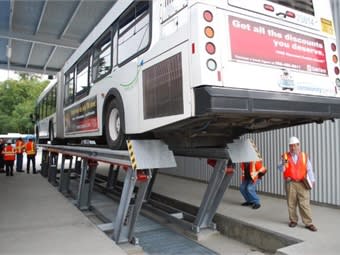
Flush mounting permits heavy-duty vehicles with particularly low ground clearance to easily drive directly onto the SKYLIFT, thus facilitating quick and easy access to a vehicle’s undercarriage.


Stertil-Koni
Stertil-Koni
The combination of extreme weather conditions and new engines that tend to run hotter, has increased the demand across North America for vehicle lifts that are specifically engineered for wash bay conditions — this according to a new industry overview from Stertil-Koni.
“When road grime accumulates on the undercarriage of work trucks, buses, and new hybrid/electric vehicles, heat builds up and can decrease engine efficiency. That in turn necessitates more frequent washings to keep battery and engine systems cool and free from mud, salt, and other contaminates,” noted Peter Bowers, Stertil-Koni technical sales support manager.
Cleanliness is the answer. And, that’s why municipalities, state agencies, corporate fleets, the U.S. Military, school bus fleets, transit agencies, and corporate trucking groups are increasingly seeking a solution to keep the undercarriages of their vehicles free of debris.
One option that has gained strong recognition and usage is the Stertil-Koni SKYLIFT Wash Bay model. This heavy duty platform lift is water-resistant and features hot-dip galvanized platforms; three-layer mono-pox coated lift supports; and a stainless steel, water-resistant, lockable control box to provide superior protection for the electronic controls.
The product’s design includes two independent runways, no crossbeams, overhang, or base frame and its modular design allows for flush or surface mounted. Flush mounting permits heavy-duty vehicles with particularly low ground clearance to easily drive directly onto the SKYLIFT, thus facilitating quick and easy access to a vehicle’s undercarriage.
Space is another consideration for facilities. The SKYLIFT, a true vertical rise lift, generally takes up less room than a parallelogram lift and also has reduced foundation requirements, according to the company. “What’s more,” added Bowers, “it’s relatively easy to install, offers greater maneuverability for shop technicians from all angles of the vehicle, and requires minimal maintenance.”
The SKYLIFT’s platform lengths are available from 23 feet up to 48 feet and, depending on the model, can lift up to 78,000 lbs. in a standard version or up to 156,000 lbs. in a tandem configuration.
It’s an approach we call ‘Freedom of Choice’ and illustrates our ability to respond to customer needs with the very best in heavy duty lifting systems to meet their specific requirements,” concluded Dr. Jean DellAmore, president of Stertil-Koni, “We pride ourselves in delivering the broadest range of safe, durable, ALI-certified heavy duty vehicle lifting systems for our customers.” “In the instance of ALI-certified, water-resistant vehicle lifts, our customers can rest assured that with the Stertil-Koni Skylift Washbay version, they have a safe, long-lasting solution to ensure that their vehicles can be serviced and cleaned efficiently and safely.”
More Technology

From Hardware to Digital Partner: Luminator Charts Its Next Chapter
CEO Magnus Friberg discusses Luminator’s shift toward becoming a digital partner, the growing importance of software and interoperability, and how AI can help agencies improve operations and passenger experience.
Read More →
Beyond the Checklist: A Structured Approach to Transit Maintenance
Reliability-Centered Maintenance helps transit agencies move beyond routine checklists to focus limited resources on the assets and failures that have the greatest impact on safety, reliability, and service.
Read More →
NJ TRANSIT Advances Bus Technology Upgrades Across Statewide Fleet
More than 1,500 buses now feature upgraded technology designed to improve arrival predictions and provide free Wi-Fi, with deployment expected to reach nearly 2,000 buses by the end of 2026.
Read More →

Building a Flexible Path to Transit Electrification
John Hroncich discusses BAE Systems’ modular and scalable approach, lessons learned from decades of real-world operations, and how agencies can identify electrification strategies that fit their fleets.
Read More →
Biz Briefs: Alstom Lands Canadian Contract, LYT to Supply California TSP, and More
In METRO's latest installment, we take a look at recent news from Complete Coach Works, Beep, FlixBus, and more partnerships making headlines across the transportation sector.
Read More →
From Legacy Silos to Conversational Intelligence
What if transit leaders could ask any operational question and get a trusted answer in seconds? Conversational AI is transforming how agencies use their data.
Read More →
USDOT Announces Rail Vehicle Replacement Grants, Chattanooga AV Shuttle Funding
More than $191 million in federal funding will help three transit agencies replace aging rail vehicles and support a new autonomous shuttle service in Chattanooga.
Read More →
Bus Tech Talk: Keeping Transit Technicians Ahead of the Technology Curve
LA Metro’s Obed Mejia discusses technician training, evolving maintenance technology, fleet replacement, and strategies for getting the most out of today’s transit fleets.
Read More →
Biz Briefs: RIPTA Unveils New Frontrunners, Clevland RTA Adds New Siemens, and More
In METRO's latest installment, we take a look at recent news from Siemens, Prevost, Dodge, and more partnerships making headlines across the transportation sector.
Read More →
Why Simulating Pedestrian Movement Has Become Essential for Modern Rail Stations
Pedestrian microsimulation is helping rail planners identify bottlenecks, test station designs, and prepare complex transit hubs for growing passenger volumes.
Read More →