METRO Magazine Logo
MenuMENU
SearchSEARCH

Electrified fleet vehicles drive mass transit forward

With more than 60 agencies demonstrating or deploying electric buses, the number of fossil-fueled vehicles is about to shrink dramatically.

by Paul Stith
November 6, 2018
Electrified fleet vehicles drive mass transit forward

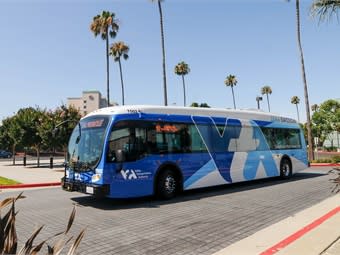
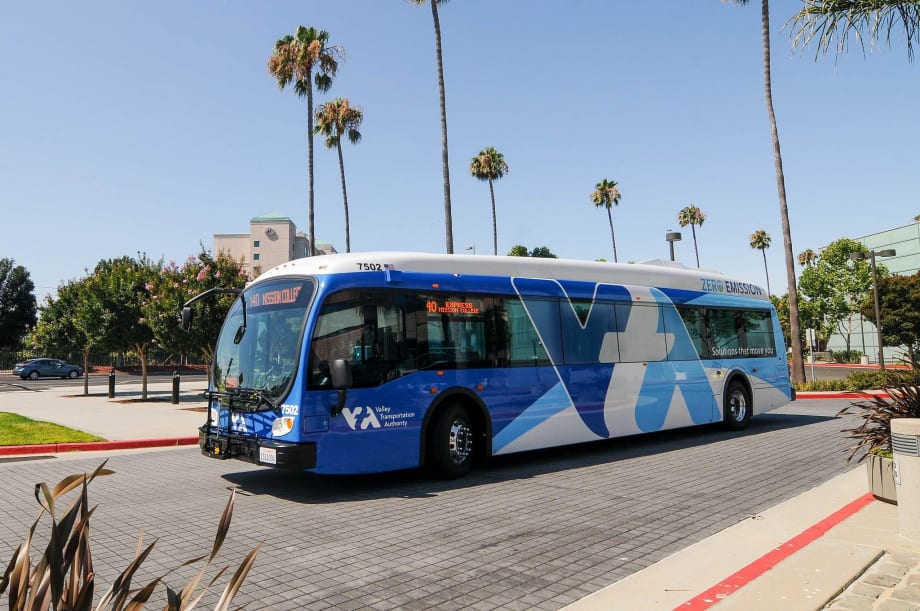
While fleet EVs can command high upfront capital investment, it’s critical to note electric buses have lower maintenance costs than their diesel or hybrid counterparts.

Santa Clara VTA

5 min to read


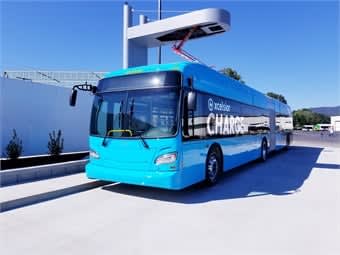
The U.S. government is doing its part to support the drive to zero-emissions transit, providing tens of millions in “No/Low-Emission” grants for vehicles and supporting infrastructure. New Flyer

With major cities across the U.S. having made the decision to shift to all-electric bus fleets, the question is no longer whether the transition to quiet, clean urban mass transit will occur: It’s already happening.

Roughly 5,000 public transit buses are purchased each year in the U.S. With more than 60 agencies demonstrating or deploying electric buses — 1,000 already are on order, with active requests for proposals for hundreds more — the number of fossil-fueled vehicles is about to shrink dramatically.

Ad Loading...

The benefits are far-reaching: new options that include electric- and hydrogen-powered buses will provide cleaner air and a better experience for passengers and drivers, while supporting the imperative to cut greenhouse gas (GHG) emissions.

Combustion engines contribute heavily to pollution in the urban environment. According to the U.S. Environmental Protection Agency, transportation accounts for more than one-quarter of the nation’s GHG emissions and is overtaking the power sector as the top GHG contributor as more renewables come online. Removing fossil fuels from mass transit will go far in reducing that carbon footprint, making electrification of mass transportation a top priority for city officials and utilities.

But as EV use continues to grow and more high-power capacity is needed, questions remain: What are the remaining roadblocks? What role will municipalities and transit agencies play in the shift from diesel to electric?  Who will develop the necessary infrastructure to support the charging of EV fleets and can they keep up with the growth?

Benefits Clear, funding is not
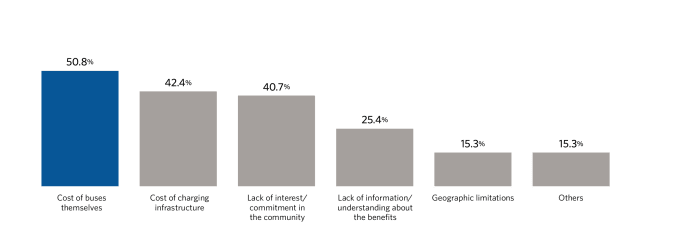
Although the benefits are strong, cost concerns continue to tamp down enthusiasm over fleet EVs. When industry leaders were surveyed on the main barriers preventing the adoption of electric city bus systems, more than one-half of respondents said they see the cost of fleet investment as the biggest obstacle, according to Black & Veatch’s “2018 Strategic Directions: Electric Report survey” (Figure 1).

Figure 1. What are the main barriers keeping your community from adopting an electric city bus system? (Select all that apply)

The report, part of an annual series that surveys utility, municipal, commercial, and community stakeholders, also found that 42% of respondents are concerned over the cost of the charging infrastructure necessary to support fleet needs.
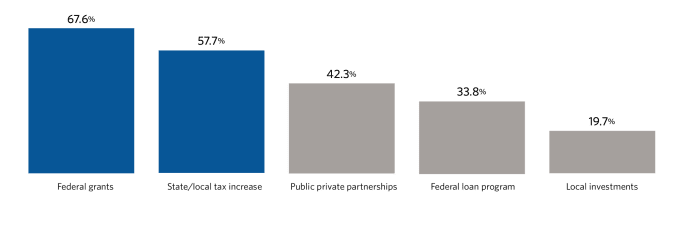
That said, federal grants — identified by the majority of respondents as the most likely approach to fund an all-electric transit system — appear to offer some salvation. The U.S. government is doing its part to support the drive to zero-emissions transit, providing tens of millions in “No/Low-Emission” grants for vehicles and supporting infrastructure. Other financing approaches include innovative public-private partnerships, federal loan programs and, to a lesser extent, local investment (Figure 2).

Ad Loading...

Figure 2. Which of the following methods would most likely be used to fund an all-electric transit system in your area? (Select all that apply)

While fleet EVs can command high upfront capital investment, it’s critical to note electric buses have lower maintenance costs than their diesel or hybrid counterparts. Much of this is due to the benefits of electric drive’s regenerative braking, which virtually eliminates brake pad replacement and electric motors that don’t require costly engine rebuilds that plague their internal combustion engine counterparts.

And as with any new technology gradually facing mainstream acceptance, costs continue to come down. Not that long ago, electric buses cost around $1 million each; today, this cost has decreased to approximately $750,000. With total lifetime cost of ownership already on par, we expect to see upfront cost parity — driven by economies of scale as demand and production volume increases — just a few years away. 

EVs Are on Rise; Can the Charging Network Keep Up?

Many utilities — large and small — struggle to manage their region’s daily load requirements. Now imagine adding a network of new, high-powered charging stations, which can deliver up to 350 kilowatts (kW) of power — seven times today’s standard 50kW capacity. Bringing online an entire network of these chargers could easily overload a power grid, not to mention alter a utility’s overall load profile and stretch its ability to plan for grid upgrades and operations.  

Although the benefits of EVs are profound — from cleaner air to lower vehicle costs — adding large numbers of them to the grid is raising questions about grid stability and energy management. To make large-scale electrification a reality, utilities need to start thinking about how they can scale up power infrastructure to meet increased charging demands.

Understanding EV Behavior
According to Black & Veatch’s 2018 Smart Cities & Utilities Report survey, 60% of utilities see studying EV charging ownership, behavior and rate impacts to be the most critical step when preparing for increased adoption. Fifty-one percent said “predicting areas of likely adoption” is second-most-important, showing a strong need for utilities to better understand the EV market, including when, where and how users charge their vehicles.
Utilities noted that other important activities include: incorporating EVs into each aspect of the business (43%), working with stakeholders to identify locations for large and/or high-speed charging infrastructure deployments (43%), and evaluating the distribution grid to determine energy supply (37%).

Deploying Managed Charging
To help control energy distribution at the charging hubs, 77% of utilities plan to adopt a managed charging approach. Managed charging — also called V1G, or intelligent, or smart charging — relies on communication signals sent by the utility through the charging hub that allows the utility to remotely control charging levels, turning charging up, down, or even preventing it altogether if a high-load event is occurring on the grid.

Utilities can use this control to turn charging hubs into a flexible load source to gain capacity, to reduce load in the event of an emergency, or even absorb excess energy from renewable energy resources like solar and wind. Managed charging might even allow utilities to generate revenue — for example, by enabling them to increase the load they serve, better balance grid demand and supply, and even integrate renewable energy from wind and solar. It can also help utilities provide grid services in wholesale electricity markets and spur new grid and charging infrastructure.

Planning for the Future
No matter which approach utilities decide to take in the EV game, it will be up to the many entities and stakeholders — from automakers to charging providers, and utilities to policymakers — to work together to develop solutions that support EV adoption and charging. As EV adoption rates continue to grow and high-power capacity is needed, there’s no time like now to address the issue. 
Ensuring Available Charging
Previously, battery capacity was a limiting factor in the widespread adoption of fleet EVs. But battery and vehicle technologies continue to advance, with some vehicle batteries already smashing the 200-mile-per-charge barrier. Now one of the main challenges to hastening broader EV adoption lies in changing customer perception of miles traveled, range, and reliability.

With battery technologies ready for demanding transit duty cycles, attention is now focused more heavily on having the widespread availability to EV infrastructure. Electrified mass transit has significant charging demands, and cities must determine how to scale charging infrastructure and manage increased electric loads.

Ad Loading...

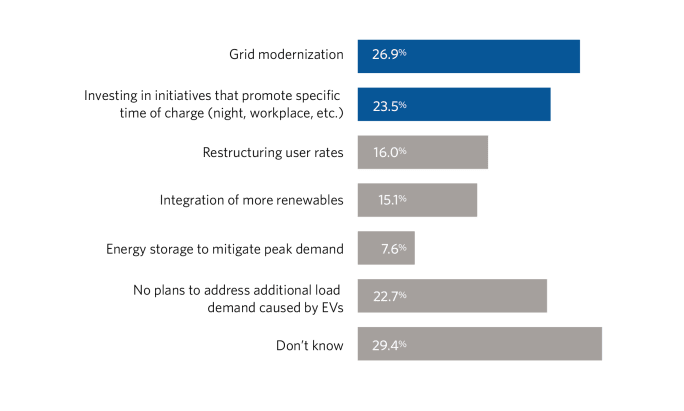
Currently, grid modernization efforts and managed charging top the list of strategies that utilities will use to manage the additional load demand on the grid (Figure 3).
But enabling a robust EV charging infrastructure for vehicles requires cross-cutting industry, municipal, and utility partnerships. Public transit agencies and utilities must develop infrastructure roadmaps to guide investment from pilot studies through mass deployment of on-route and depot charging scenarios to match their unique system and grid requirements. The battery charging demands of large buses — and fleets of those buses — will create substantial loads for the grid that will necessitate distribution grid upgrades.

Figure 3. How do you plan to manage the additional load demand on the grid caused by EV adoption? (Select all that apply)

These capital-intensive projects, such as new feeders, medium voltage service delivery, and substation upgrades, require careful coordination with the host utility and can have lead times measured in years to engineer, permit, and construct. Utilities and cities should begin preparations now to design, finance, and manage this new infrastructure. 

Working Towards the Future
Improvements in battery technology, longer battery ranges, lower costs, and increasing consumer confidence continue to encourage a significant increase in EV sales in the U.S. For transit providers and the communities they serve,

While fleet EVs can command high upfront capital investment, it’s critical to note electric buses have lower maintenance costs than their diesel or hybrid counterparts. Santa Clara VTA

what resembles exponential growth in adoption presents new challenges, requiring them to proactively and creatively engage now.

Ad Loading...

As the preference for EVs — from passenger cars to metro buses and enterprise fleets — continues to grow, expect to see greater pursuit and acceptance of electrified mass transit and the efficient, environment-friendly transportation solutions it provides.

Paul Stith is Director of Strategy & Innovation for Black & Veatch’s Transformative Technologies business.

More Technology

Bus driving down road demonstrating ACE
Technologyby StaffApril 10, 2026

New York MTA Extends Automated Camera Enforcement Program

Vehicles that improperly use busways and bus lanes, block bus stops, or illegally double-park will receive warning notices in the mail for an initial period of 60 days, followed by summonses thereafter.

Read More →
A product grouping image of the AngelTrax Vulcan Series VX4AI All-in-One MDVR and V1284HC MDVR
Security and Safetyby StaffApril 8, 2026

AngelTrax, City of Freeport Partnership to Enhance Fleet Safety

The project, finalized on February 12, provides the city with two different configurations of high-definition cameras to outfit 16 buses in the Pretzel City Area Transit fleet.

Read More →
A photo of Peoria MTD workers fro WeDriveU's contract
Technologyby Staff and News ReportsApril 7, 2026

WeDriveU Lands Paratransit Contract, Alstom Extended in ATL, and More

Stay informed with these quick takes on the projects and companies driving progress across the transportation landscape.

Read More →
Ad Loading...
A rider looking at a Via map on a smartphone
Technologyby StaffApril 6, 2026

NJ TRANSIT Introducing New Microtransit Pilot

The service will offer free connections to major bus stops and park-and-rides, linking customers to NJ TRANSIT’s fixed-route bus network.

Read More →
A look inside the new better Breeze ticket vending machines during installation at Lindbergh Center Station.
Technologyby Elora HaynesApril 6, 2026

Building Better Breeze: MARTA’s Fare System Rollout in Photos

See how MARTA’s better Breeze system came to life, from construction to installation across stations.

Read More →
A screenshot of a Clever Devices product
Technologyby StaffApril 2, 2026

Hitachi Rail Strikes Deal to Acquire Clever Devices

The proposed acquisition of a company with deep digital expertise and expected 2026 revenues of over $220 million marks a significant step in Hitachi Rail’s strategy to operate as a leading global digital mobility player, the company said.

Read More →
Ad Loading...
A white, blue, and black graphic with a black and white image of hands tapping a fare card and text reading "Transit Fare Systems Reimagined."
Technologyby Elora HaynesApril 1, 2026

Why Transit Agencies Are Rethinking the Farebox, and the Technology Behind It

The farebox is no longer just a payment machine. Learn how agencies are using new tech and pricing strategies to rethink how riders pay for transit.

Read More →
DART bus approaching waiting passengers
Technologyby StaffMarch 30, 2026

DART Approves Major Investment to Upgrade Bus Stop Amenities

The board authorized a five-year contract, with two one-year options, to Tolar Manufacturing Company Inc., for the fabrication and installation of upgraded passenger amenities at bus stops across the DART Service Area.

Read More →
Coach USA, Samsara cover shot
Technologyby Alex RomanMarch 30, 2026

How Coach USA Is Using AI to Prevent Bus Accidents

As motorcoaches navigate increasingly congested urban corridors filled with pedestrians, cyclists, scooters, and distracted drivers, safety leaders across the industry are confronting a growing challenge: visibility.

Read More →
Ad Loading...
A Houston automated people mover manufactured by Alstom.
Technologyby Staff and News ReportsMarch 26, 2026

Biz Briefs: Alstom in Houston, DATTCO Makes Acquisition, and More

In this edition of Biz Briefs, we highlight the latest developments shaping the future of mobility — from manufacturers and technology providers to transit agencies and motorcoach service operators.

Read More →