



Transit Profile: TCAT manages needs of 3 campuses, community
Tompkins Consolidated Area Transit operates 34 routes using a fleet of 55 buses, including eight electric diesel hybrid buses. The system originates from three systems operated by the City of Ithaca, Tompkins County and Cornell University, with each stemming as far back as far as a half of a century.

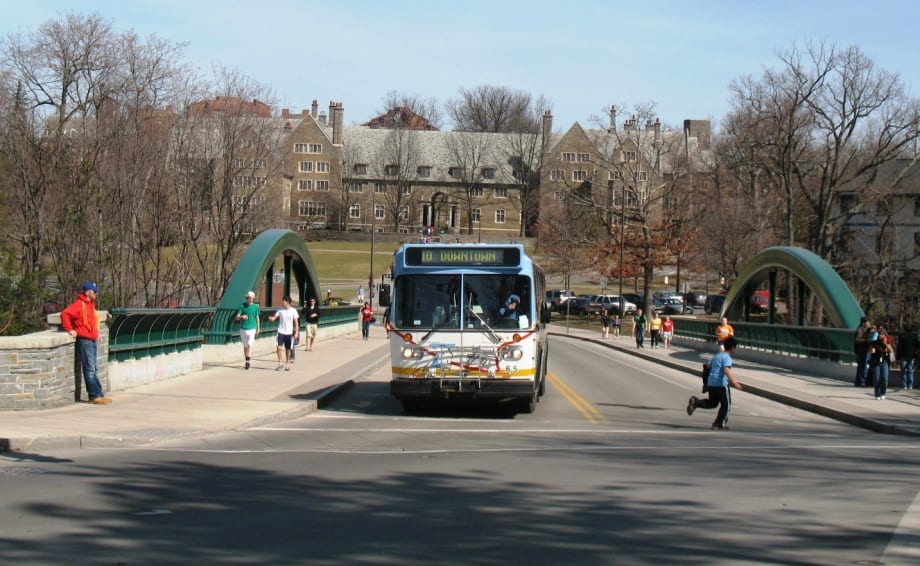
Based in the scenic Finger Lakes region in upstate New York, Tompkins Consolidated Area Transit (TCAT) is known for being a “small town bus system that provides big city service,” according to Patty Poist, communications and marketing manager for TCAT.
TCAT operates 34 routes using a fleet of 55 buses, including eight electric diesel hybrid buses. The system originates from three systems operated by the City of Ithaca, Tompkins County and Cornell University, with each stemming as far back as far as a half of a century.
“Leaders from all three systems recognized the inherent inefficiencies of having separate services, and in the early 1990s, began the consolidation process,” said Poist. “In January 2005, TCAT was reorganized as a private not-for-profit corporation with three individuals recommended each the city, county and Cornell to serve on its board of directors. The three entities provide equal local funding — about $830,000 each — to TCAT’s annual $13 million budget, which is also supported by state and federal funds.”
In 2011, TCAT completed its fifth straight year of ridership growth with 10.3% more boardings than 2010, with a total of 3,944,625 trips. Year to date, the system’s ridership numbers continue to grow in 2012, showing a 4.6% increase as of April. The system serves a semi-rural population of a little more than 100,000 in Tompkins County, which is home to Cornell University (CU), Ithaca College (IC) and Tompkins Cortland Community College (TC3.)
“We not only gain from ridership but from the wealth of talent from operating in a region with three outstanding institutions of higher learning,” said Joe Turcotte, GM at TCAT. “We have excellent representation on our board of directors from the university. We have been blessed with top-notch student interns, one, now a Cornell graduate, who became our service development manager, Doug Swarts, and another Cornell graduate, who was formerly our analyst. TCAT does not suffer from brain drain as do other smaller communities.”
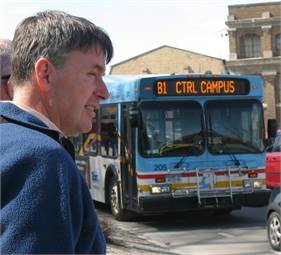
Joe Turcotte, GM of TCAT.
The system has unique partnerships with each of its campus communities, according to Poist:
Cornell University: In addition to it being a local funder, Cornell has a volume discount plan with TCAT, purchasing about $2.5 million worth of rides per year. The Cornell community accounts for 70% of TCAT’s ridership (2,725,731). All registered Cornell students, faculty and employees receive free unlimited rides on all buses after 6:00 p.m. and on weekends. The university’s photo ID card is the fare medium and must be presented at the fare box and read electronically. In addition, for students who want more privileges, Cornell sells OmniRides passes loaded right on to students ID cards. The passes cost $125 per semester and $200 a year. Cornell provides free OmniRide privileges to new to Cornell students matriculating for the first time. Students who purchase parking lot passes for the peripheral parking lots farther out on campus automatically receive OmniRide privileges at no additional fee. Faculty and staff who do not purchase a parking pass are given free OmniRide passes.
Ithaca College: As a result of TCAT’s new electronic, next generation fare collection system — RideLogic — that was implemented in January of 2010, TCAT worked with Ithaca College to design passes specifically for its students. IC subsidizes these passes. They are loaded right onto the students’ ID cards. Ithaca College annual ridership amounts to 114,502. Since the inception of this new system in 2010, Ithaca College ridership has increased 79.9% from 1.9% of total system ridership to 2.9% of total system ridership.
Tompkins County Cortland Community College: As a result of the new fare collection system, TCAT in 2010 teamed up with Tompkins Cortland Community College. TC3’s Faculty Student Association subsidize passes for its students, which are also loaded onto their student IDs, to include basic passes — two routes that serve TC3 — and unlimited use of the entire TCAT system. In just one year, TC3’s use jumped 71%, making up 0.4% of all TCAT rides.
“Cornell itself puts a huge effort [into] travel demand management; limiting parking on campus and dissuading the use of vehicles on campus with high parking fees. Cornell also subsidizes passes, which is of course, an added incentive," said Joe Turcotte, GM at TCAT. “Our relationship is symbiotic in that Cornell gives us the riders, and we give Cornell a way to curb traffic congestion and reduce the high cost of building and maintaining parking lots.”
Although each campus community and the services TCAT provides differ, the challenge is somewhat universal, explained Swarts.
“University populations tend to be highly transient in nature. With so many people moving in and out and around town on an annual or more frequent basis, we are constantly reassessing our assumptions about how much service is needed and where,” he said.
At the beginning of the 2011-2012 school year, Swarts worked with IC on a pilot project to offer more late night service to students traveling between the commons in downtown Ithaca and campus. The enhanced schedule provided service every half hour as opposed to every hour from Ithaca Commons to Ithaca College between 9:00 p.m. and 2:00 a.m., Thursdays and Fridays, and 11:00 p.m. to 2:00 a.m., on Saturdays.
“Transportation researchers have measured on average that for every 100 percent increase in service yields a 50 percent increase in ridership,” Swarts said. “We blew that right out of the water. Overall, our ridership increase was closer to 100 percent and on some trips it was off the charts with ridership jumping eight fold from what we saw the year before.”
Swarts said the pilot has demonstrated its success and hopes that Ithaca College will continue the partnership with TCAT going forward.
“This just goes to show that there is latent demand for affordable transportation in our community and, when we provide attractive service, the riders come out of the woodwork,” Swarts said.
More Bus

New York MTA Plans Largest Bus Fleet Upgrade in More Than a Decade
The agency is seeking manufacturers for 650 new CNG buses to replace aging vehicles, improve reliability, and advance its broader fleet modernization strategy.
Read More →
Building a Flexible Path to Transit Electrification
John Hroncich discusses BAE Systems’ modular and scalable approach, lessons learned from decades of real-world operations, and how agencies can identify electrification strategies that fit their fleets.
Read More →
Bus Tech Talk: Keeping Transit Technicians Ahead of the Technology Curve
LA Metro’s Obed Mejia discusses technician training, evolving maintenance technology, fleet replacement, and strategies for getting the most out of today’s transit fleets.
Read More →
Biz Briefs: RIPTA Unveils New Frontrunners, Clevland RTA Adds New Siemens, and More
In METRO's latest installment, we take a look at recent news from Siemens, Prevost, Dodge, and more partnerships making headlines across the transportation sector.
Read More →
People Movement: Holly Arnold Joins Transdev and More
In this edition, we also cover recent appointments and announcements at Pace, CamTran, MCI, and more, showcasing the individuals helping to shape the future of transportation.
Read More →
The High Cost of Transit Buses: Industry Leaders Look to Procurement Reform
Transit leaders and policymakers examine how standardized bus designs, streamlined procurement, and predictable funding could help agencies stretch budgets and deliver better service.
Read More →
The Business Voice Behind Public Transportation
As chair of APTA’s Business Members Board of Governors, Ray Melleady explains how more than 850 business members are partnering with transit agencies to advance funding, innovation, and industry-wide collaboration.
Read More →
From Surviving to Thriving: Building Stronger Transportation Organizations
Bus Business Consultants founder Brian Dickson shares lessons on leadership, organizational health, and creating options for long-term success in a changing transportation industry.
Read More →
Finding the ‘Happy Medium’: Optimizing Maintenance Without Sacrificing Reliability
The key to maintenance optimization isn’t doing less work—it’s doing the right work at the right time on the right assets.
Read More →
LA Metro, City of West Hollywood, and Partners Advance Smarter Bus Lane Enforcement
The award-winning partnership combines AI-powered detection with human oversight to improve bus reliability, accessibility, and enforcement efficiency.
Read More →