




RELATED: RTC's mobility center features blindness skills training
Mass. school to develop nav. app for visually impaired travelers
Perkins anticipates using crowdsourcing to provide detailed navigation clues to bring users to within four to five feet — the standard length of a white cane — of their precise destination.
June 13, 2016
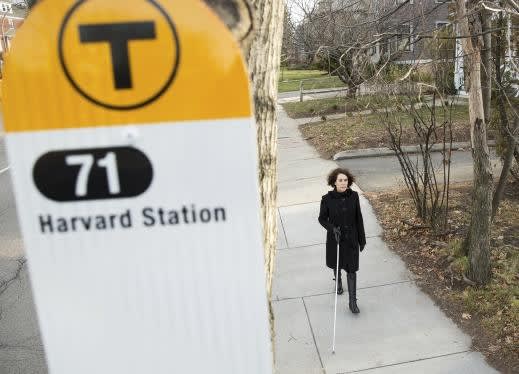
Joann Becker, whose experience inspired the proposal to build a micro-navigation app, navigates towards a bus stop. Photo: Perkins School for the Blind
2 min to read
Joann Becker, whose experience inspired the proposal to build a micro-navigation app, navigates towards a bus stop. Photo: Perkins School for the Blind
Perkins School for the Blind based in Watertown, Mass. has won a prestigious Google Impact Challenge: Disabilities grant with a proposal to create a micro-navigation solution for millions of commuters and travelers who are blind or have low vision. The $750,000 grant will fund the development of a mobile app to help travelers independently locate bus stops.
Perkins’ mobile app would pick up where many GPS systems leave off. Most commercially available GPS technology brings users no closer than 30 feet from their target. Perkins anticipates using crowdsourcing to provide detailed navigation clues to bring users to within four to five feet — the standard length of a white cane — of their precise destination.
Bill Oates, VP, Perkins Solutions, the accessibility services, products, and training division of Perkins School for the Blind, learned about the very real problem from a colleague who is blind and commutes by bus. “She told us that her GPS says ‘You’ve arrived,’ but leaves her 10 yards away from the bus stop,” said Oates. “That bus may just pass her by.”
The aim will be to solve that navigation problem and help people with impaired vision travel more independently, not just locally but anywhere in the world.
“The Google Impact Challenge: Disabilities set out to accelerate the use of technology to create meaningful change in the lives of the one billion people in the world with a disability, " said Brigitte Gosselink, Head of the Google Impact Challenge: Disabilities. "We’re eager to watch as today’s winners, selected from over 1,000 submissions from around the world, build new solutions that will transform lives and make the world more accessible for all.”
“This grant will allow us to address a technology gap that keeps many people who are blind from getting to work, exploring their surroundings and contributing to their communities,” said Dave Power, president/CEO of Perkins School for the Blind.
More Bus

New York MTA Plans Largest Bus Fleet Upgrade in More Than a Decade
The agency is seeking manufacturers for 650 new CNG buses to replace aging vehicles, improve reliability, and advance its broader fleet modernization strategy.
Read More →
Building a Flexible Path to Transit Electrification
John Hroncich discusses BAE Systems’ modular and scalable approach, lessons learned from decades of real-world operations, and how agencies can identify electrification strategies that fit their fleets.
Read More →
Bus Tech Talk: Keeping Transit Technicians Ahead of the Technology Curve
LA Metro’s Obed Mejia discusses technician training, evolving maintenance technology, fleet replacement, and strategies for getting the most out of today’s transit fleets.
Read More →
Biz Briefs: RIPTA Unveils New Frontrunners, Clevland RTA Adds New Siemens, and More
In METRO's latest installment, we take a look at recent news from Siemens, Prevost, Dodge, and more partnerships making headlines across the transportation sector.
Read More →
People Movement: Holly Arnold Joins Transdev and More
In this edition, we also cover recent appointments and announcements at Pace, CamTran, MCI, and more, showcasing the individuals helping to shape the future of transportation.
Read More →
The High Cost of Transit Buses: Industry Leaders Look to Procurement Reform
Transit leaders and policymakers examine how standardized bus designs, streamlined procurement, and predictable funding could help agencies stretch budgets and deliver better service.
Read More →
The Business Voice Behind Public Transportation
As chair of APTA’s Business Members Board of Governors, Ray Melleady explains how more than 850 business members are partnering with transit agencies to advance funding, innovation, and industry-wide collaboration.
Read More →
From Surviving to Thriving: Building Stronger Transportation Organizations
Bus Business Consultants founder Brian Dickson shares lessons on leadership, organizational health, and creating options for long-term success in a changing transportation industry.
Read More →
Finding the ‘Happy Medium’: Optimizing Maintenance Without Sacrificing Reliability
The key to maintenance optimization isn’t doing less work—it’s doing the right work at the right time on the right assets.
Read More →
LA Metro, City of West Hollywood, and Partners Advance Smarter Bus Lane Enforcement
The award-winning partnership combines AI-powered detection with human oversight to improve bus reliability, accessibility, and enforcement efficiency.
Read More →