



Duke U. BRT seminar focuses on building the industry
Featured the demo of a first-of-its-kind global database, developed by the International Energy Agency and EMBARQ, reporting data on all of the world’s BRT systems, including those already in operation and those in the planning.


Photo courtesy Duke University.

Photo courtesy Duke University.
Experts from industry and the bus rapid transit (BRT) research community gathered at Duke University on March 8 for a one-day working meeting hosted by the Center on Globalization, Governance & Competitiveness (CGGC). Participants in “BRT in the United States: Building a Business Constituency,” will focus on how to build a bus rapid transit industry as an assertive constituency, similar to those for light rail and high-speed rail.
BRT is a transit innovation that can achieve the speed and efficiency of a subway, at only a fraction of the cost. In BRT, the bus typically travels in its own lane, receives traffic signal priority and stops only briefly because passengers pay their fares before the bus arrives, making the bus system more efficient and removing the hassle of putting coins in the farebox.
The Rockefeller Foundation-funded event posed the question, “How can the whole supply chain — i.e., firms that provide BRT design, engineering, vehicles, equipment and services — work as an industry to promote BRT?”
Marcy Lowe, senior research analyst at CGGC, said value chain analysis can play a key role in the effort to develop a BRT industry in the U.S.
“By studying a number of clean tech industries, we’ve learned how important it is to map out the roles, identify the key players, and find the leverage points that can move an industry forward,” said Lowe. “BRT is the perfect example of a little-understood industry that comes into focus when you create a clear picture of the value chain.”
The Duke meeting featured the demo of a first-of-its-kind global database, developed by the International Energy Agency (IEA) and EMBARQ, reporting data on all of the world’s BRT systems, including those already in operation and those in the planning. EMBARQ is a program of the World Resources Institute (WRI) and a member of the BRT-ALC Center of Excellence.
IEA energy analyst Tali Trigg — who is also an alumnus of the Nicholas School (MEM 2010) and a former research associate at CGGC—developed the database in cooperation with EMBARQ.
“This joint effort results in the most comprehensive and robust database for a cost-effective transit option that improves mobility and reduces carbon,” said Trigg. “It will also help assess the market potential for BRT goods and services, including buses, bus replacements, potential for upgrades and expansions.”
Several of the worlds’ cities, most notably Bogotá, Colombia and Curitiba, Brazil, have adopted BRT systems and achieved stunning success.
The IEA plans to recognize the extensive potential of BRT in its upcoming biennial report, Energy Technology Perspectives. According to IEA senior transport analyst Lew Fulton, “In the 2012 edition, the IEA will call for a doubling of the world’s BRT systems by 2020.”
In the U.S., interest in BRT has built gradually over the years, and it is now heating up, said Cliff Henke, a senior analyst at Parsons Brinckerhoff, an international engineering firm.
“The Duke event builds on work begun by the FTA nearly a quarter century ago. Now is a great time for all facets of the industry to come together again to revisit goals and develop recommendations for the next wave of BRT in the U.S.”

Seminar attendees (from left): Marcy Lowe - Senior Research Analyst, Duke University Center on Globalization; Kim R. Green - President, GFI Genfare; Robert Puentes - Senior Fellow, Brookings Institution.

Bill Coryell - VP of Sales, Western Region, NABI; Tali Trigg - Energy Analyst, International Energy Agency
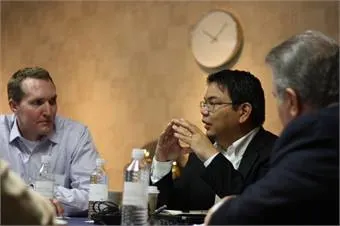
Jason Hellendrung, Principal, Sasaki Associates; Benjamin De La Pena - Associate Director for Urban Development, Rockefeller Foundation
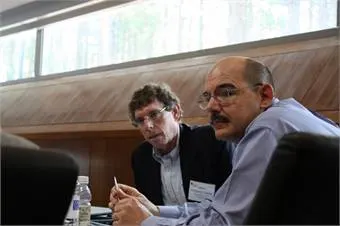
John Hodges-Copple - Planning Director, Triangle J Council of Governments, North Carolina; Doug Roberts - CEO, Global Traffic Technologies

Brendon Hemily - Public Transportation Consultant, ITS America; Amanda Sevareid - Associate, Rockefeller Foundation
More Bus

People Movement: Dan Dipert Coaches Adds Third-Generation Leader, Keolis Names New Valley Metro VP/GM, and More
In this edition, we also cover recent appointments and announcements at the Wabtec, SilverRide, HNTB, and more, showcasing the individuals helping to shape the future of transportation.
Read More →
New York MTA Plans Largest Bus Fleet Upgrade in More Than a Decade
The agency is seeking manufacturers for 650 new CNG buses to replace aging vehicles, improve reliability, and advance its broader fleet modernization strategy.
Read More →
Building a Flexible Path to Transit Electrification
John Hroncich discusses BAE Systems’ modular and scalable approach, lessons learned from decades of real-world operations, and how agencies can identify electrification strategies that fit their fleets.
Read More →
Bus Tech Talk: Keeping Transit Technicians Ahead of the Technology Curve
LA Metro’s Obed Mejia discusses technician training, evolving maintenance technology, fleet replacement, and strategies for getting the most out of today’s transit fleets.
Read More →
Biz Briefs: RIPTA Unveils New Frontrunners, Clevland RTA Adds New Siemens, and More
In METRO's latest installment, we take a look at recent news from Siemens, Prevost, Dodge, and more partnerships making headlines across the transportation sector.
Read More →
People Movement: Holly Arnold Joins Transdev and More
In this edition, we also cover recent appointments and announcements at Pace, CamTran, MCI, and more, showcasing the individuals helping to shape the future of transportation.
Read More →
The High Cost of Transit Buses: Industry Leaders Look to Procurement Reform
Transit leaders and policymakers examine how standardized bus designs, streamlined procurement, and predictable funding could help agencies stretch budgets and deliver better service.
Read More →
The Business Voice Behind Public Transportation
As chair of APTA’s Business Members Board of Governors, Ray Melleady explains how more than 850 business members are partnering with transit agencies to advance funding, innovation, and industry-wide collaboration.
Read More →
From Surviving to Thriving: Building Stronger Transportation Organizations
Bus Business Consultants founder Brian Dickson shares lessons on leadership, organizational health, and creating options for long-term success in a changing transportation industry.
Read More →
Finding the ‘Happy Medium’: Optimizing Maintenance Without Sacrificing Reliability
The key to maintenance optimization isn’t doing less work—it’s doing the right work at the right time on the right assets.
Read More →