



Community Transit aims for 25% ridership boost
Has cut its service by 37% over the past three years, but hopes to increase ridership by making its services more productive.
Before the recession hit in 2009, Everett, Wash.-based Community Transit was well on its way to reaching its goal of 12 million annual boardings. Now, after being forced to cut 37% of its service over the past three years, the agency is ready to bounce back — by being more productive with its existing service.
“We can’t add service because we don’t have the money to do it,” said Martin Munguia, public information officer for Community Transit. “But at the same time, we know that there’s a lot of demand, so we’ve made a goal for ourselves to increase our ridership about 25% over the next five years.”
The agency is looking to scrap underutilized service and focus its efforts on providing more effective routes. With this approach, it hopes to increase the 9.2 million riders it saw in 2012 to 12 million by 2017.
“We want to find a way to shift some of our service around — maybe not run as many of the unproductive trips and add those trips to the highly productive routes, where we’re going to see a lot more ridership,” Munguia explained.
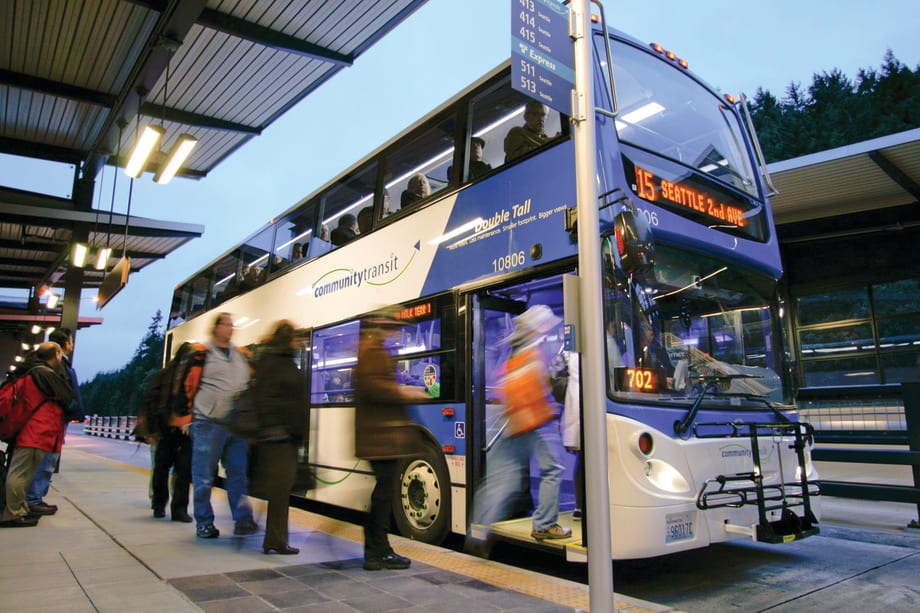
In 2011, the agency replaced some of its 60-foot articulated buses used for commuter service to Seattle with double-decker buses, called “Double Talls,” which added 30% passenger capacity without increasing operating costs. Despite this, one of the problems Community Transit has seen, according to Munguia, is excessive numbers of standees on these popular routes.
“We have some double-decker buses, and they have 77 seats. We see many trips with over 100 passengers on those buses,” he said.
To reduce the number of passengers without seating, the agency will now move buses from quiet routes to busier ones. Community Transit will also be able to add 30 trips a day to the Seattle commuter service starting next month, thanks to a grant from the Federal Transit Administration.
Moreover, to cultivate ridership during off hours, the agency is looking to use promotional advertising and social media campaigns to urge riders to use public transit during lunch time or to get to recreational activities.
“Through our peak times — the morning and afternoon rush hours — that’s when we have about 75% of all of our riders onboard. So that means, in the evening and in the middle of the day, the buses are less full,” Munguia said. “We are trying to get people excited about using the bus on those off periods.”
Munguia also pointed out that the best part of Community Transit’s new plan is that it focuses on data, rather than trial and error.
“Back [before the recession], a lot of transit agencies put bus service out in communities to see if people would come,” he explained. “And now, we’re taking much more of a data-driven, productivity-conscious approach.
“Any new service we’re going to add, we’re really going to analyze the statistics,” he added. “We’re only going to put service where we know people are going to ride it.”
More Bus

New York MTA Plans Largest Bus Fleet Upgrade in More Than a Decade
The agency is seeking manufacturers for 650 new CNG buses to replace aging vehicles, improve reliability, and advance its broader fleet modernization strategy.
Read More →
Building a Flexible Path to Transit Electrification
John Hroncich discusses BAE Systems’ modular and scalable approach, lessons learned from decades of real-world operations, and how agencies can identify electrification strategies that fit their fleets.
Read More →
Bus Tech Talk: Keeping Transit Technicians Ahead of the Technology Curve
LA Metro’s Obed Mejia discusses technician training, evolving maintenance technology, fleet replacement, and strategies for getting the most out of today’s transit fleets.
Read More →
Biz Briefs: RIPTA Unveils New Frontrunners, Clevland RTA Adds New Siemens, and More
In METRO's latest installment, we take a look at recent news from Siemens, Prevost, Dodge, and more partnerships making headlines across the transportation sector.
Read More →
People Movement: Holly Arnold Joins Transdev and More
In this edition, we also cover recent appointments and announcements at Pace, CamTran, MCI, and more, showcasing the individuals helping to shape the future of transportation.
Read More →
The High Cost of Transit Buses: Industry Leaders Look to Procurement Reform
Transit leaders and policymakers examine how standardized bus designs, streamlined procurement, and predictable funding could help agencies stretch budgets and deliver better service.
Read More →
The Business Voice Behind Public Transportation
As chair of APTA’s Business Members Board of Governors, Ray Melleady explains how more than 850 business members are partnering with transit agencies to advance funding, innovation, and industry-wide collaboration.
Read More →
From Surviving to Thriving: Building Stronger Transportation Organizations
Bus Business Consultants founder Brian Dickson shares lessons on leadership, organizational health, and creating options for long-term success in a changing transportation industry.
Read More →
Finding the ‘Happy Medium’: Optimizing Maintenance Without Sacrificing Reliability
The key to maintenance optimization isn’t doing less work—it’s doing the right work at the right time on the right assets.
Read More →
LA Metro, City of West Hollywood, and Partners Advance Smarter Bus Lane Enforcement
The award-winning partnership combines AI-powered detection with human oversight to improve bus reliability, accessibility, and enforcement efficiency.
Read More →