



Proterra to Power S.C. town
The bus manufacturer is helping the City of Seneca reach its goal of having an all-electric bus fleet by the summer. The city partnered with nearby Clemson Area Transit to obtain a grant to fund the four vehicles and charging infrastructure.

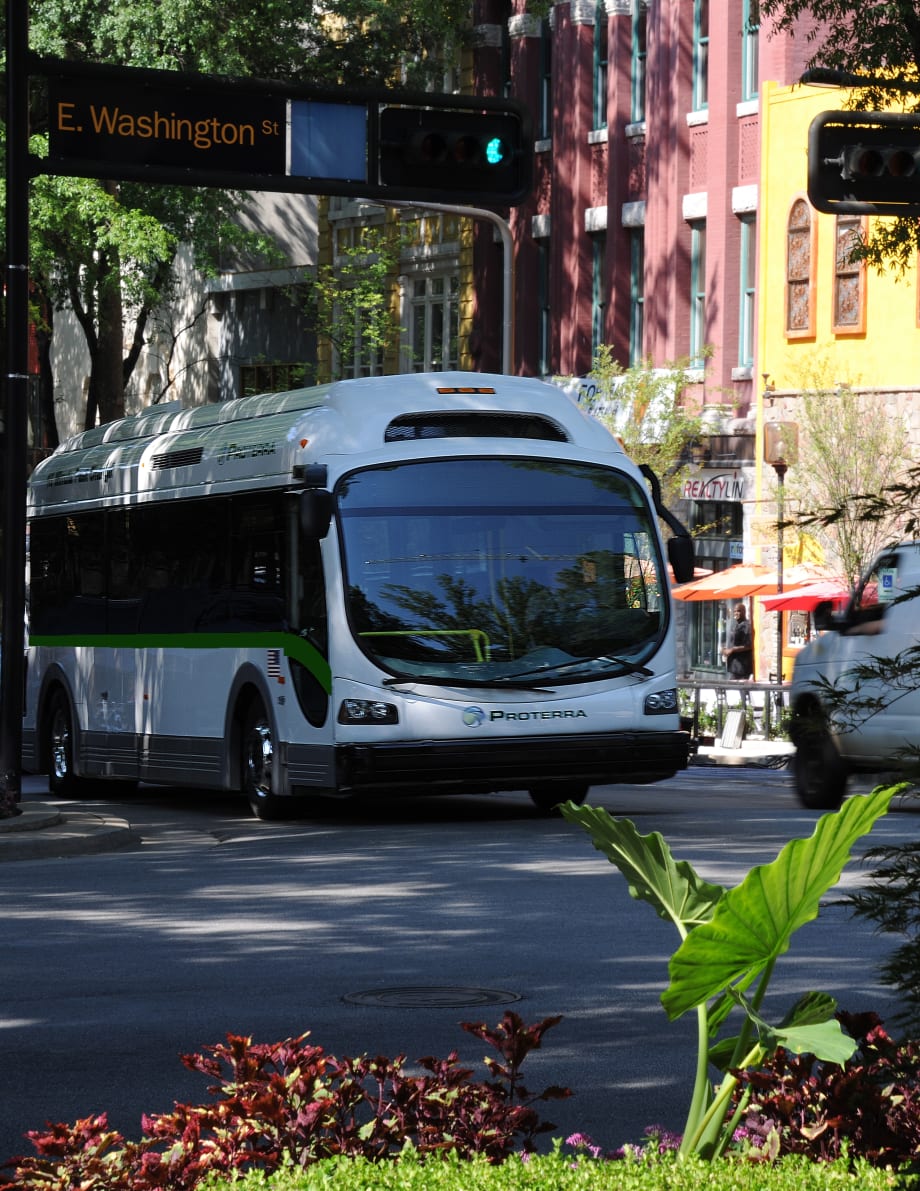
The City of Seneca is switching its three-vehicle fleet to four 35-foot EcoRide BE35 all-electric buses, to be operated by Catbus.
Electric buses tend to be quiet, more lightweight and environmentally-friendly than diesel-fueled or even hybrid buses. Fuel savings and quick charging times are other benefits for transit operations. Additionally, public transit is an ideal application for the electric bus, because of predictable routes.
One transit system is about to convert their diesel-powered fleet to all-electric with the help of Greenville, S.C.-based bus manufacturer Proterra, with the aim of going greener and reaping these benefits.
The City of Seneca (S.C.) is switching its three-vehicle fleet to four 35-foot EcoRide BE35 all-electric buses, to be operated by Clemson Area Transit (Catbus). In November 2011, the city secured funds to buy the vehicles and install two chargers. The vehicles are expected to arrive this summer. Proterra started production on the first bus in November 2012, according to Ian Shackleton, VP, sales and marketing, Proterra.
The City received $1.8 million from the South Carolina Department of Transportation for two of the buses and a grant from the Federal Transit Administration (FTA) for $4 million for the other two buses and charging infrastructure.
The buses will run on a fare-free express route from Seneca to Clemson, S.C.’s Clemson University.
Proterra
Proterra’s vision is to transform public transit as we see it today, Dave Bennett, CEO, Proterra, says. The manufacturer focuses on clean energy solutions that have an environmental impact with zero emissions; make buses lighter and perform better and safer; and deliver significant value in operating costs and energy savings.
The manufacturer enables 10 minute on-route charging, faster than a mobile phone, according to Bennett.
“Proterra’s solution is very focused around what operators need, which is a quick recharge time and an ability to run 24/7,” he says.
Range varies, though, because in some operations, buses need to run 20 hours to 24 hours a day.
“We’ve worked [with] the infrastructure charging system to make it easy, provide a turnkey solution vehicle, project manage it, install it, and work with city utility people and the agency,” Bennett explains. “It’s new to them. They are used to [installing] a CNG or diesel station, and now, they’re putting in a connection to an electric grid.”
Proterra increased safety features for the EcoRide BE35 battery system, designing it to be fireproof, and placed the batteries down low between the wheels for vehicle stability. The durable vehicle bodies are all-composites, made of carbon and other fibers.
“We are excited to have a great set of customers and working on the deployment of more vehicles in the industry,” Bennett adds. “It takes a while for the early adopters to work through the startup issues you always have. Proterra’s made phenomenal progress in the last year-and-a-half, focusing on reliability and affordability.”
Seneca will be the sixth agency to use the buses. Other Proterra all-electric vehicles in operation, or going into operation at other transit agencies, include Calif.’s Foothill Transit and Stockton Transit; Regional Transportation Commission of Washoe County, Nevada; San Antonio, Texas-based VIA Metropolitan Transit; Worchester Mass.’s Worchester Regional Transit Authority; and Tallahassee, Fla.’s StarMetro.
“A lot of other customers are trying [a few] and seeing if electric meets their requirements,” Shackleton says. “The City of Seneca and Catbus jumped in with both feet and gave us a huge vote of confidence. Our other customers are out there working with us; it’s just that [Seneca and Catbus are] small transit operations, but they’re going in 100%.”
Proterra is continually developing the technology to get more range and efficiency out of the vehicle; drive down the cost of purchase and ownership; and get the electric bus to be the number one choice for transit agencies, Bennett adds. [PAGEBREAK]
The City of Seneca is switching its three-vehicle fleet to four 35-foot EcoRide BE35 all-electric buses, to be operated by Catbus.
Benefits
Both Bennett and Thomas Small, director, new product development, New Flyer, agree that transit seems ideal for electric bus use, since most routes are very predictable, allowing the driver to charge the bus at set times.
The EcoRide BE35’s on-route charging feature can keep it on the road all day and recharge in three minutes to five minutes. Since a full charge takes about 10 minutes in most cases, operators can keep their schedules without interruption as long as chargers are strategically placed.
Transit operators, such as Catbus, will realize significant fuel savings, ranging from $35,000 to $55,000 a year. While an average diesel bus gets somewhere between three miles and four miles per gallon in daily operation, the EcoRide BE35 gets a diesel equivalent of 21 miles per gallon. Additionally, it offers a significant operational expense reduction with no oil, belts, alternators, or starters to maintain and replace, says Shackleton.
He also estimates a one-third maintenance cost savings, overall, including fuel, for most operators. Electricity the bus would burn on a yearly basis would cost between $8,000 and $12,000, depending on what the agency pays for electricity.
Greg Dietterick, city administrator, City of Seneca, says that as a small city that handles its own utilities, it can set up a steady cost based on its electrical rate and the consumption of the buses. The benefit is not only a matter of savings, but also of consistency.
“Our routes don’t change that much,” Ed Halbig, director, planning and development, City of Seneca, explains. “There should be no reason for charging costs to fluctuate as greatly as fuel costs.” The length of Catbus’ routes will only require a few minutes to boost the battery back to 100%.
The projected savings to run electric buses, instead, is between $40,000 and $80,000, he adds.
The City also expects that as its bus drivers become more familiar with the vehicles, they’ll learn to drive the buses even more efficiently, using regenerative braking, and knowing when to accelerate, decelerate and bypass a charge when they don’t need one.
With zero emissions, the vehicles not only reduce pollution, but noise as well.
“This bus can go through the streets, even residential areas, with no disruptive noise,” Shackleton says.
Some electric bus manufacturers, such as DesignLine Corp. and New Flyer, are even considering adding a beeping mechanism to alert people that the bus is coming. [PAGEBREAK]Collaboration
When Seneca formed its transit authority in 2006, it established an agreement with Catbus to handle the operation and maintenance of the buses and supply drivers. The partnership helped both operations with their budgets, Dietterick says.
“They were already in business, and Clemson and Seneca are only eight miles apart,” he says. “Instead of duplicating efforts, we partnered with them. That relationship is much more efficient and flexible. You [don’t have] two presidents and double [the number of] drivers and mechanics. That’s very expensive. By working together, we benefit the whole community.”
The collaborative relationship between the two cities was helpful — perhaps even instrumental — in gaining an FTA grant for the buses.
“Certainly we couldn’t have gained the grant if we were not partnering with Clemson,” Halbig says. “We would have been a fledgling bus system trying to reinvent it all ourselves. By relying on their 15-plus years of experience, we are able to offer a better product for the residents of Seneca.”
Because the agencies collaborated, the U.S. Department of Transportation combined their ridership, which qualified both systems for more federal and state operating funds.
The City is currently designing and building the charging infrastructure. Construction is expected to be complete in spring 2013.
The City also sees the project as a good economic tool because it will bring a lot more exposure for Seneca.
“People will come in to look at the Proterra system from all around the world,” Dietterick says. “We are only about 30 miles away from the plant. People can come in, tour the plant, and see [the buses] in action. We see that as a win-win for everybody.”
For more, click here.
More Bus

New York MTA Plans Largest Bus Fleet Upgrade in More Than a Decade
The agency is seeking manufacturers for 650 new CNG buses to replace aging vehicles, improve reliability, and advance its broader fleet modernization strategy.
Read More →
Building a Flexible Path to Transit Electrification
John Hroncich discusses BAE Systems’ modular and scalable approach, lessons learned from decades of real-world operations, and how agencies can identify electrification strategies that fit their fleets.
Read More →
Bus Tech Talk: Keeping Transit Technicians Ahead of the Technology Curve
LA Metro’s Obed Mejia discusses technician training, evolving maintenance technology, fleet replacement, and strategies for getting the most out of today’s transit fleets.
Read More →
Biz Briefs: RIPTA Unveils New Frontrunners, Clevland RTA Adds New Siemens, and More
In METRO's latest installment, we take a look at recent news from Siemens, Prevost, Dodge, and more partnerships making headlines across the transportation sector.
Read More →
People Movement: Holly Arnold Joins Transdev and More
In this edition, we also cover recent appointments and announcements at Pace, CamTran, MCI, and more, showcasing the individuals helping to shape the future of transportation.
Read More →
The High Cost of Transit Buses: Industry Leaders Look to Procurement Reform
Transit leaders and policymakers examine how standardized bus designs, streamlined procurement, and predictable funding could help agencies stretch budgets and deliver better service.
Read More →
The Business Voice Behind Public Transportation
As chair of APTA’s Business Members Board of Governors, Ray Melleady explains how more than 850 business members are partnering with transit agencies to advance funding, innovation, and industry-wide collaboration.
Read More →
From Surviving to Thriving: Building Stronger Transportation Organizations
Bus Business Consultants founder Brian Dickson shares lessons on leadership, organizational health, and creating options for long-term success in a changing transportation industry.
Read More →
Finding the ‘Happy Medium’: Optimizing Maintenance Without Sacrificing Reliability
The key to maintenance optimization isn’t doing less work—it’s doing the right work at the right time on the right assets.
Read More →
LA Metro, City of West Hollywood, and Partners Advance Smarter Bus Lane Enforcement
The award-winning partnership combines AI-powered detection with human oversight to improve bus reliability, accessibility, and enforcement efficiency.
Read More →