



N.Y. MTA Works to Fix Impacts of Storms Past and Future
The entire MTA transportation network suffered an estimated $4.755 billion worth of damage as a result of Superstorm Sandy. To address the damage, NYC Transit set up dedicated staff in all departments to develop and implement a massive reconstruction and mitigation campaign.
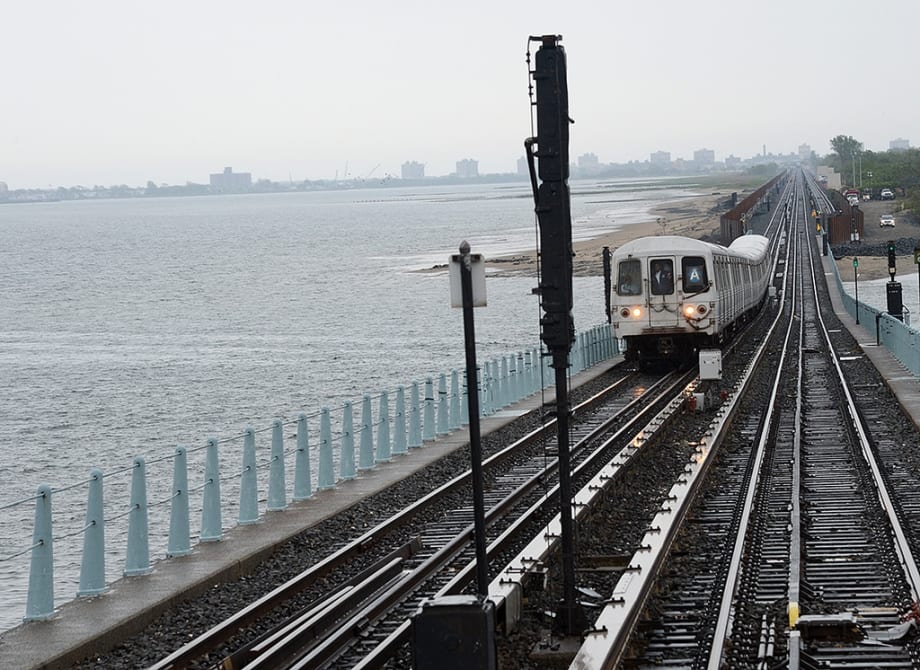
Post-Sandy repair jobs included the Rockaway segment of the A Line.Repairs have already been completed.
All photos by Marc A. Hermann
Post-Sandy repair jobs included the Rockaway segment of the A Line.Repairs have already been completed.
All photos by Marc A. Hermann
One year after Superstorm Sandy ravaged the Northeast region with destructive winds and record-breaking storm surges, MTA New York City Transit (NYCT) is in the early stages of “Fix&Fortify” — a massive reconstruction and mitigation campaign designed to repair severely damaged infrastructure, while at the same time working to develop innovative approaches to protecting vulnerable segments of the system from future storms.
Adherence to well-developed plans saved rolling stock and work equipment valued at billions of dollars from harm, but the infrastructure took a severe battering that will take years to repair. The entire MTA transportation network suffered an estimated $4.755 billion worth of damage as a result of the most destructive storm in New York City’s history. It took only a scant few hours for millions of gallons of water to pour in and flood the subway system’s most vulnerable areas. To address the damage, NYC Transit has set up dedicated staff in all departments to develop and implement the Fix&Fortify campaign. Executive guidance to this effort is provided through a Steering Committee.
The funding for Fix&Fortify was secured and administered through the efforts of New York State Gov. Andrew M. Cuomo, the Federal Transit Administration (FTA) and the Federal Emergency Management Agency (FEMA). The MTA has been allocated nearly $3.8 billion in funding from the FTA for repair, resiliency, and disaster relief work for NYCT, Metro-North Railroad, Long Island Rail Road and other MTA divisions, as well as $3 million from FEMA for MTA Bridges and Tunnels.
“We maintain a high level of concern over future weather events even as we work to reduce the vulnerability of one of the region’s most vital, but fragile resources. We do not have the luxury of saying that we have 99 years to wait until the next hundred-year storm,” said MTA Chairman/CEO Thomas F. Prendergast. “We are extremely grateful to Gov. Cuomo, the FTA and FEMA for their assistance in funding this massive repair and recovery effort.”
Tube repair
The summer marked the start of two major projects to repair under river tubes flooded during the massive storm. The subway system’s Montague and Greenpoint Tubes were placed near the top of the list of post-Sandy jobs that also include the Rockaway segment of the A Line, upon which repairs have already been completed, and the ruined South Ferry Terminal Station, which has been temporarily replaced by the reactivation of the original South Ferry Loop Station.
The Montague Tube is a mature piece of infrastructure built by the BMT to carry Fourth Ave. Line subway trains between Brooklyn and Manhattan. Originally built during the First World War, it is part of the intricate network of subway lines connecting the two boroughs. Construction work began in October 1914 and the tube was opened for service on August 1, 1920. In contrast to today’s figures, the construction cost was a bargain at about $9.8 million.
Work is currently underway on the 14-month project to repair the Montague Tube, which carries the R train between Downtown Brooklyn and Lower Manhattan and is the longest under river tube in the system and the third of five subway tubes to be built connecting the two neighborhoods.
Nine of the system’s 14 tubes were hard hit by Sandy, most notably the Montague Tube, which was flooded with salt water to a depth of 15 feet. Loss of electricity to Lower Manhattan delayed the onset of water evacuation, leaving the tube flooded for ten days after the storm passed. Once power was restored, more than 27 million gallons of water had to be pumped out before work was begun to make it useable.
The Whitehall St. pump plant on the Manhattan side of the tube was completely submerged when the Montague flooded, rendering inoperable all of the stationary pumping equipment, electrical feeds and controls. Track, third rail and communications systems also suffered major damage along with electrical relays, switch machines and cables. Salt water damaged approximately 50 cables to the relay rooms at the Whitehall St. and Broad St. stations, 48 signal locations and track relays along with associated equipment.
It was necessary for the Signal Division to replace relays, transformers, resistors, fuses, LEDs, pins and switch machines, and two power locations in order to get service up and running again. When trains did resume operation, however, component failures rose dramatically, a clear indication that the service lifecycle of vital equipment, components and systems would be severely reduced. This proved true as the number of trains delayed due to signal failures increased up until the shutdown.
“The reality here was that the useful service life of hundreds of systems, components and segments of infrastructure were going to be substantially shortened. Nothing in those tubes was going to last as long as originally designed,” Prendergast says. “The work that we had ahead of us was the closest thing to building a tube from scratch.” [PAGEBREAK]
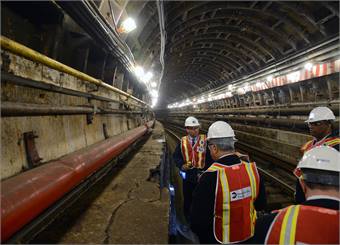
The Montague Tube was flooded with salt water to a depth of 15 feet.
Salt water takes a toll
Major areas of concern included the stubborn layer of corrosion that resulted from the saltwater contamination of the tube’s mechanical and electrical systems and the damage to the miles of electrical cables in the tube.
“This was an historic storm that did a tremendous amount of damage to our system and this damage was broad and deep and will take a significant period of time to repair. In the meantime, we will be designing in new means of protecting the system,” says NYC Transit Acting President Carmen Bianco. “The majority of the work we are doing is infrastructure repair incorporating mitigation.”
Work on the Montague Tube to permanently repair the damage began August 3, shortly after the last train rolled through. Months earlier the decision was made to perform the work during a complete shutdown (24/7) rather than confining the work periods to nights and weekends.
“Conducting this project under temporary service stoppages would have stretched the completion date out to sometime in 2017. This would have been completely unacceptable to us and the 65,000 riders who depend on this tube every weekday,” Bianco says.
The current work amounts to a nearly complete reconstruction with everything except the tunnel shell being replaced and upgraded. Repairs to the tube include the replacement of 11,000 track-feet of rails and other track components, and approximately 14,000 feet of tunnel lighting stretching from Whitehall Street station (R line) and Broad Street station (J/Z lines) in Manhattan to Court Street station (R line) in Brooklyn. The new lighting will conform to the latest federal and transit lighting standards. Battery back-up for emergency lighting will also be installed.
Two circuit breaker houses will be rebuilt and a third will be rehabilitated and expanded. Work includes replacing or refurbishing all existing circuit breakers, cables, conduits, lighting, heaters and control terminal boxes. Two power substations on the Manhattan side will be repaired. The battery panel and components of high tension wire will be replaced at the at Broadway/Park Row substation and control cables will be replaced at the Centre/Pearl Street substation.
All three of the tube’s pumps will be replaced — two pump out 200 gallons per minute each and the third has a 1,500-gallons-per-minute capacity. Included in this job is the relocation of cabinets, lighting and pump room controls to a nearby fan plant. Damaged fan plant equipment will be also be replaced, specifically the damper operator at the track level and associated cables.
The tube has four concrete benchwalls, which contain terra cotta duct banks totaling about 30,000 feet. These duct banks house power, communications and fiber-optic cables. All cable will be replaced, and cable termination points will be relocated from the Whitehall Street shaft to station communication rooms. All four benchwalls are badly damaged and will be rebuilt. The duct banks located inside the benchwalls were visibly deteriorated as evidenced by a patina of rust that coated all metal objects.
In addition, signal repair work in the Montague Tubes is being performed via a third-party contract, which will replace damaged signal equipment, such as signal cases, stop machines, switch machines, along the entire length of the tube. The fix for the Montague Tube will cost $308.6 million.
Several times prior to the service shutdown, the media was escorted into the tube to see conditions up close.
“Walking through the tube with transit workers and seeing the type of work that had to be performed was incredibly revealing,” says Ted Mann, transit beat reporter for the Wall Street Journal. “None of the workers had to be prompted to show us the damage that the flooding had caused. Many of them pointed to the high water mark in the tunnel, which was well above our heads.”
Mann and his colleagues saw first-hand how difficult it would be to make repairs in the tube under anything other than a complete closure. “I was there one night and watched workers replacing an impedance box — a device that allows AC and DC current to coexist on the rails while preventing physical damage to the sensitive train detection equipment. Just performing this one task was very tough under normal procedures.”[PAGEBREAK]
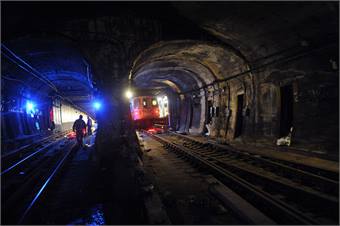
Signal repair work in the Montague Tubes is being done by a third-party contract and will cost $308.6 million.
Different approach
Meanwhile, a different approach is being taken with the Greenpoint Tube, which carries G service beneath Newtown Creek and connects the Greenpoint section of Brooklyn with the neighborhood of Long Island City in Queens. Rather than completely shutting down the tube, initial work efforts here are being performed over a series of 12 weekend shutdowns, disrupting service only during periods when ridership is lightest.
The Greenpoint Tube was filled with three million gallons of salt water at the height of the storm. Tracks and equipment were totally submerged, and the tunnel’s pump controls, electrical, communications, fan control and signal equipment were all seriously damaged as a result. Power cables that were immersed in salt water were assessed and determined to be corroding from the inside. Worsening corrosion was also found on the outside of rails and fasteners raising the potential for short circuits. The controls for ventilation, lighting and communication systems were destroyed.
Tunnel lighting and emergency lights are being replaced along approximately 1.8 track miles to conform to the latest federal and Transit Lighting Standards. Additionally, four-hour battery backup of emergency lighting will also be installed. Greenpoint work also includes the replacement of existing track components, including 1,200 track feet of rails, plates and tie blocks along each of the tube’s two trackways. The repair cost for the Greenpoint Tube, including in-house and contractor components, is $66.1 million.
Blunting future effects
Of course, with the growing threat of climate change and the city’s vulnerabilities laid bare as a result of two storms in a row, NYC Transit’s Fix&Fortify effort is also concentrating on blunting the effects of future severe weather events.
Two major contributing risk factors are the city’s nearly 600 miles of waterfront and the shape of the surrounding coastline — also known as the New York Bight. Forecasts call for more severe storms in the future and predictions of sea-level rise make Sandy a wake-up call with a very loud alarm. The vulnerability of New York City and its subway system is no longer theoretical. So, while work is underway to repair damage done last year, NYC Transit is also focused on developing ways of protecting the system.
Climate change is expected to generate more severe heat waves, higher storm surges and more intense downpours of the type that prompted the MTA, only a few years back, to design and develop a successful storm water mitigation project. In the aftermath of a severe rainstorm on August 8, 2007, which saw up to 3.5 inches of rain dumped on the city in a two-hour period — too much too quickly to be handled by normal drainage either on the streets or in the subway — NYC Transit raised vent gratings at flood-prone locations around the system. Additionally, stair entrances at some stations were raised to prevent water from cascading into the stations. Ever since, these changes have kept the subway in these locations free of flooding from heavy rainfall even while the streets above were waterlogged.
“We are currently investigating, designing and testing mitigation features to protect the system through the area of Lower Manhattan. We want to keep water out of the system in the first place. This means identifying points of entrance and then coming up with appropriate ways of stopping the inflow of water,” says Fred Smith, NYC Transit’s senior VP, capital program management.
The focus is currently on six stations and 400 openings in Lower Manhattan. These openings include station entrances, ventilation bays and sub-surface vaults, and subway envelope penetrations. Other efforts include the rewiring of electrical systems to make them less vulnerable, modification of tunnel lighting, power cables and controls to move them out of harm’s way. Additionally, any other points of entry such emergency exits, fan plants and power cable conduits will be modified to help prevent the inflow of water.
NYC Transit is also working in consultation with countries in Europe and Asia that already have experience with the damaging effects of sea water intrusions.
“What we are seeking to do is consult with those who have already faced this issue and are successfully addressing it,” says Smith.
The work currently underway and on the drawing board is focused on making the subway system better able to withstand the effects of climate change and sea-level rise. As the MTA and NYC Transit look ahead, there’s one thing that is known for sure: the lessons learned from the past two hurricane seasons are proving invaluable.
Charles F. Seaton is New York City Transit’s director, customer communications, Sandy Recovery Program.
More Management

METRO Opens Submissions for 2026 Motorcoach Awards
Nominations are now being accepted for METRO Magazine’s Operator of the Year and Innovative Operator of the Year awards.
Read More →
New York MTA Advances Final Contract for Second Avenue Subway Expansion
Contract Four is the largest in the Second Avenue Subway Phase 2 project and includes construction of station infrastructure, tracks, and signals for the subway expansion, MTA officials said. Work on Contract Four will begin in 2027.
Read More →
Transit Agencies Highlight Safety Gains at National Summit
Leaders from 15 major transit systems shared crime-reduction results and safety initiatives while discussing the role of continued federal support.
Read More →

NITA Names New Leadership, Expands Reduced-Fare Program at First Board Meeting
The new regional transit authority appointed its first board chair and interim executive director while extending reduced fares across CTA, Metra, and Pace for eligible riders.
Read More →
Beyond the Checklist: A Structured Approach to Transit Maintenance
Reliability-Centered Maintenance helps transit agencies move beyond routine checklists to focus limited resources on the assets and failures that have the greatest impact on safety, reliability, and service.
Read More →
APTA 2026 Nominating Committee Selects Leadership Slate, Names Chair and Vice Chair Nominees
Leadership changes will help shape the association’s priorities and its representation of the transportation industry during the 2026–2027 term.
Read More →
DART Launches Major Security, Fare Enforcement Initiative
The 90-day demonstration will deploy coordinated security teams at five light rail stations while testing controlled access and gathering data to guide future investments.
Read More →
Advancing Fare Collection Through Technology and Innovation
Learn about delivering 1300 gates at 91 stations while managing fare evasion. Explore the large scale deployment, solution customization and real-world results that affect the region. Prepare for deployment in your region now.
Read More →
Game Day in Motion: Moving Millions During the 2026 World Cup
Between packed transit stations and team motorcoaches, see how agencies and operators across North America tackled the transportation demands of the 2026 FIFA World Cup.
Read More →
Surface Transportation Extension Averts Shutdown, Leaves Transit Funding Gap
The stopgap keeps federal transportation programs moving, but missing advance funding could complicate the transit and rail projects agencies are planning next.
Read More →