



Colo. BRT project controls growth, cultivates development
In addition to improving mobility in the region, Fort Collins, Colo.-based Transfort’s new BRT route, the MAX, will help manage growth and spur economic development.

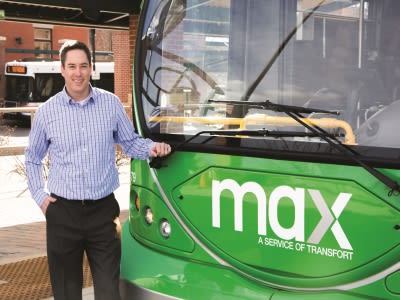
Kurt Ravenschlag, GM of Transfort, says that the new MAX BRT service, will operate with six North American Bus Industries vehicles.
Kurt Ravenschlag, GM of Transfort, says that the new MAX BRT service, will operate with six North American Bus Industries vehicles.
In addition to improving mobility in the region, Fort Collins, Colo.-based Transfort’s new BRT route, the MAX, will help manage growth and spur economic development.
Slated to open this May, the line is part of a strategy to increase transportation capacity to accommodate higher densities in key corridors, enabling the community to grow upward instead of outward. MAX covers that first corridor, a primary arterial through the community, Kurt Ravenschlag, GM, City of Fort Collins, Transfort, says.
Throughout the course of construction, MAX has already created hundreds of millions of dollars of economic activity in the region.
“We’re already seeing probably 20-plus projects occurring, [including] mixed-use development, residential and retail services and haven’t even begun operations yet,” Ravenschlag says.
Conceived in the mid-1990s, the project progressed after a few years to the development stage, securing FTA support, as well as gaining other project funding partners, including the state of Colorado and Colorado State University (CSU), Fort Collins.
The $87 million line is the single largest capital project in Fort Collins, according to Ravenschlag.
MAX will be operated by Transfort, the city’s bus system. Transfort runs about 22 routes and approximately 50 fixed-route, heavy-duty buses and complementary paratransit service.
The fleet is composed of a mix of Gillig and North American Bus Industries vehicles, including the six new BRT buses.
This year the agency has an operating budget of $10.5 million. Next year, that will increase to $15 million due to increased funding from the City, as well as support from funding partners such as CSU; Transfort recently came to a nearly $1 million agreement to increase services to the CSU campus.
MAX is already generating demand from the public for more service frequency, hours of service and coverage because people want more ways to connect to it.
“We’re leveraging MAX to increase transit services in our entire community,” Ravenschlag says. “That’s why we have significant increases in funding from our city to increase services to complement MAX.”
Now, the biggest challenges facing Transfort are keeping up with requests for new services, such as more night service and Sunday service, which it hasn’t provided in the past, and having the rolling stock and staffing to meet the service demand.
“It’s a project that has been long in the works, and we’re very excited to [start operating],” Ravenschlag says.
More Bus

Scenes from APTA TRANSform & EXPO 2026
Transit leaders, manufacturers, and industry professionals gathered in Chicago to explore new technologies, share ideas, and discuss the future of public transportation.
Read More →
More Than a Summer Job: Building the Next Generation of Transit Talent
The Delaware River Port Authority and PATCO have transformed their internship program into a hands-on professional development experience that introduces students to the breadth of transportation careers — and creates a pipeline for future employees.
Read More →
LA Metro Board Awards 220 Battery-Electric Bus Contract to ENC
The contract, which is the largest base award of battery-electric buses by a U.S. transit agency, will be built in Southern California, sustaining good jobs as LA prepares to welcome the world in 2028
Read More →
Public Transit Conference Returning to GFX in 2027, Call for Papers Now Open
The Call for Papers is now open, allowing transit agency professionals and industry experts to help shape the PTC educational program by submitting session ideas for consideration.
Read More →
Indian River Transit’s Community-Focused Approach Earns National Recognition
Named APTA’s 2026 Outstanding Public Transportation System in its size category, Florida’s Indian River County transit system continues to grow ridership through fare-free service and a focus on evolving community needs.
Read More →
ENC Lands MATA Contract and More in Biz Briefs
In this edition of Biz Briefs, we spotlight the latest developments shaping the future of mobility.
Read More →
From Surviving to Thriving: Building Stronger Transportation Organizations
Bus Business Consultants founder Brian Dickson shares lessons on leadership, organizational health, and creating options for long-term success in a changing transportation industry.
Read More →
Everett Transit, Community Transit Outline Consolidation Agreement
The proposed agreement calls for a 50% increase in bus service in Everett, a new microtransit zone, continued paratransit service, and the transfer of Everett Transit operations to Community Transit.
Read More →
SEPTA Details Accelerate Vision for Transit System
The plan outlines investments in trolley modernization, new Metro and Regional Rail vehicles, accessible stations, and more frequent bus and rail service.
Read More →
Report: Transit Bus Manufacturing Supports 34,100 Jobs, $5.1B in GDP
The “Buses Mean Business” report examines the transit bus manufacturing industry’s economic footprint, supply chain, and rising demand for vehicle replacements.
Read More →