



Q&A: FTA Acting Administrator Therese McMillan
Prior experience working with the Metropolitan Transportation Commission in the San Francisco Bay Area prepared her well for tackling transportation and transit issues on the national stage.
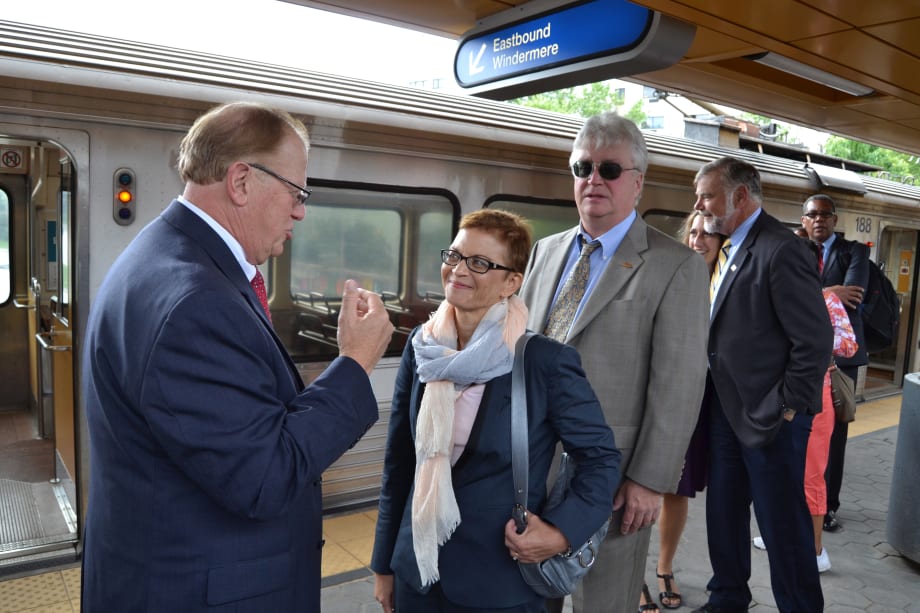
McMillan talks with Greater Cleveland Regional Transit Authority CEO
Joe Calabrese during a tour of the new Cedar-University Rapid Station.
McMillan talks with Greater Cleveland Regional Transit Authority CEO
Joe Calabrese during a tour of the new Cedar-University Rapid Station.
At the start of the year, Therese McMillan was named acting administrator of the Federal Transit Administration (FTA). She joined FTA as deputy administrator in July 2009. As deputy, McMillan assisted the administrator in leading a staff of more than 500 in the Washington D.C. headquarters office and 10 regional offices throughout the U.S., and implementing an annual budget approximating $10 billion. We spoke with Acting Administrator McMillan to discuss her new role and how she is working to forward the agency’s agenda.
METRO: What are some of the most challenging aspects of your job as FTA Acting Administrator?
McMillan: In the short term, the most challenging aspect of my job is getting things done in the incredibly short window of an Administration. You have four years — at best eight years — to develop an agenda and deliver it to the American people. You also have to work hard to build foundations that can be built upon after you are gone. That requires establishing relationships and credibility with a range of key actors — local elected officials, congressional representatives, transit providers and most importantly, the public. There is never enough time or money to do what needs to be done. Balancing unwavering advocacy for more resources, while responsibly delivering results with the resources you do have is at the core of my job.
What aspects of your job bring you the greatest satisfaction? Why?
Working with a tremendous team at the FTA has been amazing — these are public servants in the best sense of the term, dedicated to the mission of providing transit to all who need it and protecting taxpayer dollars along the way.
Working with such a talented team reinforces the external rewards of this position — traveling across the country to talk to devoted industry folks who provide transit every day — and meeting the riders that need and use those services.
Whether they take the commuter train to work because they choose not to sit in traffic, or take a late night bus because they have no other option — those riders have a voice that deserves to be heard.
How has your education and experience prior to joining FTA helped prepare you for the national stage?
Prior to joining the FTA, I worked for 25 years with the Metropolitan Transportation Commission in the San Francisco Bay Area. Working in that rich and diverse region —and in California, the most populous and complex state in the country — prepared me well for tackling transportation and transit issues on the national stage. My education in urban and transportation planning was and continues to be particularly valuable. These 30 years have affirmed that providing effective transportation is inherently multi-disciplinary — tangled, messy, very grey and enormously challenging.
Whether you are embracing a transportation profession as a planner, engineer or business person, transportation is never an end to itself, but a critical piece of moving people, or the goods and services that people need. As such, providing effective transportation has a fundamental role in shaping things that we can’t absolutely control — cities, economies, landscapes.
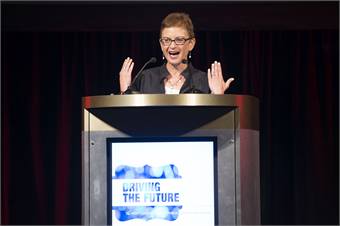
Speaking at a Central Ohio Transit Authority luncheon this summer.
How is working for the federal government different from other jobs you’ve had?
Making good national policy is hard. Think about it: We have to develop and implement policies that are going to work equally well in Lexington, Massachusetts, and Lexington, Kentucky; in Portland, Oregon, and Portland, Maine; and all points in between. And yet, different communities need different solutions. We have a saying at FTA: ‘If you’ve seen one transit system, you’ve seen one transit system.’ We have an important role in partnering with local and state governments to help realize community visions. So on the one hand, we need to work with Congress to frame policies and programs broad enough to serve the nation — yet flexible enough to meet the needs of local communities, which are all somewhat different.
What are some of the biggest challenges facing the transit industry, and what is FTA doing to address them?
We are at a crossroads in terms of how we build 21st century transportation infrastructure that meets the needs of riders today and for future generations. Transit ridership is at record levels, with more than 10 billion trips taken last year — while at the same time our transit systems face an $86 billion backlog in much-needed repairs and replacements. In addition, the U.S. population is expected to grow by one-third between now and 2050. We are facing a serious infrastructure deficit in this country, and we must find ways to address it. President Obama and Secretary [Anthony] Foxx have put forward a plan to do just that. The GROW AMERICA Act is a bold legislative initiative that would provide $302 billion for transportation over the next four years, including $72 billion for transit. For FTA, that’s a 70 percent increase over current spending —enough to allow us to increase our core formula grant programs to both expand services and invest in state of good repair.
How do these priorities specifically help working families to join or participate in the middle class and access jobs and opportunities in their communities?
President Obama and Secretary Foxx have spoken passionately and persuasively about the need to create ‘ladders of opportunity.’ Public transit, in many ways, is tailor-made to provide these ‘ladders’ to help people climb toward more economic security and social stability, provide for their families and achieve a better quality of life. Many individuals in underserved communities depend on public transit services to access jobs, education, health care and other basic needs like groceries. Our goal is to make sure that transit services across the country are safe, reliable and affordable, and meet the needs of the riding public.
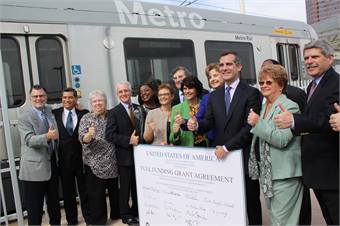
In California to announce a $670 million construction grant agreement to help build the Regional Connector light rail line in the heart of Los Angeles.
How do these priorities reflect Secretary Foxx’s ‘National Vision for Transportation’?
Public transit is a key element of a national, multimodal network that must effectively provide a range of transportation options to move the American public and the goods and services they use. DOT’s TIGER program, for example, initiated under the Obama Administration, recognizes that we must look beyond siloed investment programs to those that support transformation, multi-modal and multi-jurisdictional projects. Since 2009, Congress has dedicated more than $4.1 billion for six rounds of TIGER grants to fund projects that have a significant impact on the nation, a region or a metropolitan area. The latest round of grants will help build new bus rapid transit lines and streetcar projects from Omaha, [Neb.] to Providence, [R.I.]. But beyond that, TIGER is funding projects that truly reflect a national vision for transportation, such as the ‘Vision Zero’ project to bolster New York City’s multi-agency plan to reduce traffic-related deaths and injuries by redesigning intersections near schools, create safer pedestrian access to transit and fill a major gap in the city’s protected bicycle lane network that will connect lower-income communities to industrial zones.
What steps has FTA taken to operate more efficiently and help communities build projects in less time?
To preserve the integrity of the New Starts program — FTA’s flagship capital investment grant program — as its impact grows around the nation, we have worked diligently to improve its capacity to oversee and manage the billions of dollars traditionally awarded annually to state and local transportation providers, and ensure that taxpayers’ transportation dollars are wisely spent. The Administration has been committed to streamlining and consolidating core programs to improve efficiency and become even more responsive to local transportation priorities — while saving money along the way. Specifically, we recognize it is vitally important to strike the right balance between good stewardship and the need to advance capital transportation projects in a reasonable timeframe. We have never lost sight of the fact that the New Starts program brings taxpayer dollars back to communities to improve the quality of life in neighborhood after neighborhood, and all along Main Street. We must be responsible stewards of those dollars.
That is why, in recent years, FTA has taken additional steps to improve the New Starts program’s accountability, to streamline its administration, and to allocate resources to projects that truly make a difference. MAP-21 places new emphasis on improving the efficiency of grant program operations through consolidation of some programs; streamlining some grant processes; and renewing focus on improved public transportation access, operating conditions and safety. We’ve also streamlined some aspects of the vitally important environmental review process for capital transit projects seeking federal funds, to help accelerate the development and delivery of capital transportation projects.
How should our nation address the ‘transportation infrastructure deficit’?
We need bipartisan support for a long-term transportation funding bill in this country. We can’t keep kicking the can down the road with short-term funding extensions that really are just a Band-Aid on our infrastructure deficit. Without long-term, predictable funding from the federal government, local leaders may lose the confidence needed to pursue a bigger vision, and instead, turn to less ambitious projects that fill immediate needs, without adequately preparing for the challenges and opportunities of growth. Many states — like Wyoming, Michigan, Pennsylvania and Virginia — have begun to take action with voter-approved referendums and other legislative action to direct more taxpayer dollars to transportation projects because they simply cannot wait for Congress to bring more resources to the table.
How is FTA implementing The new regulatory authority for transit safety and what does this mean for the industry?
We are working closely with industry stakeholders while we build a 21st-century regulatory safety program over a period of several years. We are moving safety management in the transit industry — at the agency, state and federal oversight levels —to a formal safety management systems (SMS)-based approach. SMS is a well-established collaborative approach that will build on the industry’s existing safety foundation to control risk better, detect and correct safety problems earlier, share and analyze safety data more effectively, and measure safety performance more accurately. Developing a shared “safety vocabulary” and understanding of transit industry risks will enable the industry to improve safety as we identify, assess, mitigate and manage hazards in our industry. It will allow FTA to better communicate safety information and to more effectively use limited resources to tackle the highest priority safety risks.
What are some ‘game-changing’ projects you have visited in the U.S.?
It’s an exciting time to be at the FTA. We’re working with state and local partners all over the country that are addressing transportation needs in innovative and forward-thinking ways. One project that stands out is the Regional Connector light rail line that will better link downtown Los Angeles with the rest of L.A. County. The Regional Connector is one of several projects that FTA has invested in to help transform L.A. from an area synonymous with gridlock to a place where trains, buses, cycling and walking are all convenient modes of transportation. This is a huge achievement for such a car-dependent area. Elsewhere, I recently celebrated the grand opening of the first bus rapid transit line in Michigan, in Grand Rapids. It’s a terrific addition to local transportation choices that will offer faster, more convenient access to major downtown employers along one of the city’s busiest commercial corridors. Of course, these are just the tip of the iceberg. From El Paso to the Choctaw Nation, from Cleveland to Miami, I am proud of the difference we help to make in the quality of life for residents in hundreds of urban and rural communities around the nation.
Is it important for someone in your position to be a mentor?
Absolutely. I would not be where I am today without the support of many mentors throughout my career — many with whom I remain in touch. I have been a mentor through teaching and participating for many years in organizations like the Women’s Transportation Seminar. You can mentor just by helping colleagues day to day — a philosophy I genuinely believe in, and try to live by.
More Bus

New York MTA Plans Largest Bus Fleet Upgrade in More Than a Decade
The agency is seeking manufacturers for 650 new CNG buses to replace aging vehicles, improve reliability, and advance its broader fleet modernization strategy.
Read More →
Building a Flexible Path to Transit Electrification
John Hroncich discusses BAE Systems’ modular and scalable approach, lessons learned from decades of real-world operations, and how agencies can identify electrification strategies that fit their fleets.
Read More →
Bus Tech Talk: Keeping Transit Technicians Ahead of the Technology Curve
LA Metro’s Obed Mejia discusses technician training, evolving maintenance technology, fleet replacement, and strategies for getting the most out of today’s transit fleets.
Read More →
Biz Briefs: RIPTA Unveils New Frontrunners, Clevland RTA Adds New Siemens, and More
In METRO's latest installment, we take a look at recent news from Siemens, Prevost, Dodge, and more partnerships making headlines across the transportation sector.
Read More →
People Movement: Holly Arnold Joins Transdev and More
In this edition, we also cover recent appointments and announcements at Pace, CamTran, MCI, and more, showcasing the individuals helping to shape the future of transportation.
Read More →
The High Cost of Transit Buses: Industry Leaders Look to Procurement Reform
Transit leaders and policymakers examine how standardized bus designs, streamlined procurement, and predictable funding could help agencies stretch budgets and deliver better service.
Read More →
The Business Voice Behind Public Transportation
As chair of APTA’s Business Members Board of Governors, Ray Melleady explains how more than 850 business members are partnering with transit agencies to advance funding, innovation, and industry-wide collaboration.
Read More →
From Surviving to Thriving: Building Stronger Transportation Organizations
Bus Business Consultants founder Brian Dickson shares lessons on leadership, organizational health, and creating options for long-term success in a changing transportation industry.
Read More →
Finding the ‘Happy Medium’: Optimizing Maintenance Without Sacrificing Reliability
The key to maintenance optimization isn’t doing less work—it’s doing the right work at the right time on the right assets.
Read More →
LA Metro, City of West Hollywood, and Partners Advance Smarter Bus Lane Enforcement
The award-winning partnership combines AI-powered detection with human oversight to improve bus reliability, accessibility, and enforcement efficiency.
Read More →