



Sacramento RT Begins Transformation with Bus Upgrades, New Rail Services
In addition to adding 30 new CNG buses built by Gillig, the agency is developing a 3.3-mile streetcar line to complement its existing light rail services.
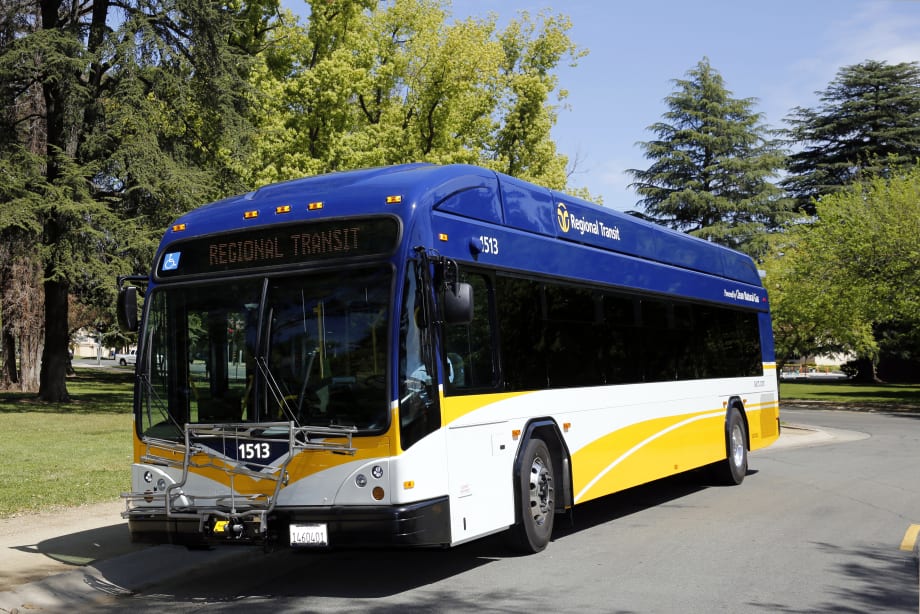
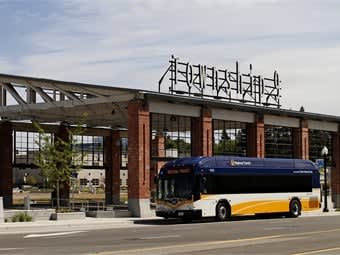
In April, Sacramento RT debuted the first 30 CNG buses built by Gillig, which were designed with the customer and operator in mind.
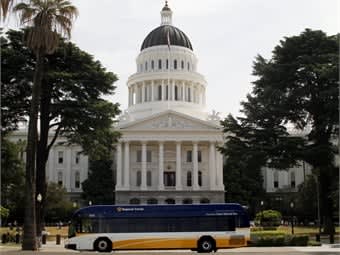
All photos couresy Phil Kampel Photography
This year is proving to be a very busy and productive one for California’s Sacramento Regional Transit District (RT). With a new bus fleet taking shape, a light rail extension nearing completion (see story pg. 24) and a streetcar system in the works, as well as planning services to meet the demand from a new entertainment and sports center under construction, the agency is “actively working to enhance the system,” says RT GM/CEO Mike Wiley.
At a glance
According to RT data, the agency operates 69 fixed routes and one general public dial-ride-service, and 38.6 miles of light rail that covers a 418-square-mile service area. The fixed-route bus fleet is comprised of 205 buses, powered by compressed natural gas (CNG), and 27 shuttle vans, while the light rail service utilizes 76 vehicles. RT contracts with a local private non-profit, Paratransit Inc., to operate its door-to-door paratransit service.
“They are a Consolidated Transportation Service Agency (CTSA) in Sacramento, so they coordinate with social service agencies and are able to consolidate resources and provide a collective service that’s more cost-effective,” says Wiley adding that RT pays about 90% of the cost of ADA demand-response service, while the CTSA picks up about 10%.
Additionally, RT operates a smaller circulator bus, “Neighborhood Ride,” which provides service to seven neighborhoods in Sacramento County. This fleet is comprised of smaller, primarily ElDorado National-branded cutaway vehicles, making them more compatible for the smaller community areas that can’t accommodate 40-foot buses, Wiley says.
RT system passenger amenities include 50 light rail stations, 31 bus and light rail transfer centers, and 19 park-and-ride lots, according to RT data. The agency also serves over 3,100 bus stops throughout Sacramento County. Annual ridership on both bus and light rail systems has steadily increased over the years, with 27.8 million passengers served in FY 2014.
The agency is governed by an 11-member Board of Directors and employs a workforce of approximately 941 people, 77% of whom are dedicated to operations and maintenance of the bus and light rail systems. RT’s FY 2015 operating budget is $147.5 million, with a capital budget of $51 million. Fare revenues provide approximately 20% of the money needed for bus and rail services, while a combination of federal and state funds, developer fees and local sales taxes provide bus, light rail, supply capital and operating revenues.
In April, Sacramento RT debuted the first 30 CNG buses built by Gillig, which were designed with the customer and operator in mind.
New bus fleet
One of the many aforementioned initiatives that RT has begun to advance is the upgrading of its fixed-route bus fleet.
Currently, the agency has around 210 fixed-route buses. In early April, the agency debuted the first 30 CNG buses built by Gillig, which replace buses that have reached the end of their useful life. This time next year, the agency will have incorporated 96 new buses into the fleet, essentially replacing nearly half of its fleet.
The new Gillig BRT-Plus vehicles were designed with the customer and operator in mind, according to Wiley. When developing its CNG vehicle, Gillig engineers met with RT mechanics to get input for its design, he adds. When discussing the operational and mechanical features of the new BRT-Plus fleet, Wiley says it was important to build a roof platform that runs the length of the bus, so that mechanics could easily access the CNG tanks to do repair work. Additionally, RT opted to go with disc brakes for this particular bus.
“It’s our hope that we’ll extend the life of the brakes, reducing the frequency of brake jobs, and therefore, reduce the downtime and maintenance time on the bus,” he says.
From a driver’s standpoint, the agency elected to go with adjustable foot pedals for the accelerator and brake.
“In the past, all of our foot pedals were fixed, so our taller and shorter drivers struggled with it,” Wiley says. “It’s more ergonomically designed to meet their needs because it’s fully adjustable.”
Other operator-based amenities include seat adjustment options for improved ergonomics and windshield visibility.
In terms of the interior seating configuration and wheelchair placement, RT opted to go with a new design option that seats the wheelchair user on the right side of the vehicle, which provides them a view of the operator as well as an enhanced view out the front windshield, Wiley says. Additional interior features include fold-away stanchion seating up front as well as a section of flip-up seating to accommodate folded carts and packages; increased legroom; and a clear rooftop emergency hatch that allows in natural light.
Wiley also points out that the contoured metal seating in the front of the bus is designed with cloth inserts that feature a different design and pattern that distinguishes it from the other parts of the bus, which he says will “hopefully encourage passengers without disabilities and non-seniors to give those seats up to those that need them.”
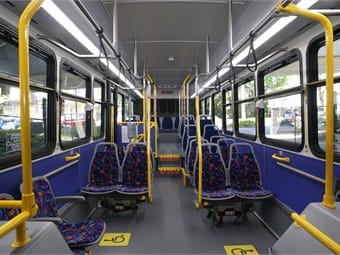
Interior features of Sacramento RT’s buses include foldaway stanchion seating up front as well as a section of flip-up seating to accommodate folded carts and packages, increased legroom and a clear rooftop emergency hatch that allows in natural light.
Future Bus Technology
During his annual “State of RT” address discussing RT’s various initiatives, Wiley said the agency “needs to give serious consideration to electric battery-powered buses in the future and eventually phasing out compressed natural gas.” Given the environment in Sacramento and RT’s investment in electricity with its rail system, the agency already has a strong base with the ability to maintain electric motors and electrical propulsion, he explains.
“We were one of the first ones to adopt compressed natural gas and it’s been tremendously successful for us. From my standpoint, as we look at our replacement needs and our expansion needs for buses in the future, we’re really very open-minded about the next platform we will transition to,” says Wiley.
Bus Service Expansion
Another initiative Wiley says needs to be addressed by the system is expansion of its bus services.
“At this point, our ability to add new services is extremely limited,” he adds. RT receives 38% of a half-cent sales tax, with 32% basically going into the operating budget and the remainder into the capital program. To be able to grow the system further, he says the agency plans to return to the ballot box in November 2016 to hopefully increase the local sales tax.
“We have developed a long-range and a short-range improvement plan that’s basically resource-driven,” Wiley says. “As the resources become available and the service can become sustainable, we’ve already identified how we would grow the system and where, whether it’s new service or increasing frequency or converting some services to a BRT-like service.”
Streetcar project
In addition to expanding bus services, RT’s long-range plan envisioned streetcars connecting downtown Sacramento to West Sacramento.
“Initially, the City of West Sacramento has been advocating for this for quite some time,” Wiley says of the primary drivers for the development of the streetcar project.
RT is working in partnership with the Cities of Sacramento and West Sacramento, Yolo County Transportation District and the Sacramento Area Council of Governments to deliver the Downtown/Riverfront Streetcar project, which includes a 3.3-mile initial line that will extend from the West Sacramento Civic Center to the midtown entertainment and retail district in Sacramento. Environmental work on this project is nearing completion, he says.
To help fund the project, RT is moving forward with a local vote to create a benefit assessment district that will fund approximately $30 million of the $150 million project through property assessments.
“We are proposing to create a private nonprofit that will actually own the streetcar. They will then contract with us to do the final design, construction and operation,” says Wiley. “Unlike our light rail, which we own, the private nonprofit will own it.”
This option will be more cost-effective for the agency, as it will be an area where RT already has a high level of service, which enables it to utilize existing resources, he explains.
“At least 25% or more of the [streetcar service] will operate on our current tracks, so we don’t have to build additional tracks, string more wire and add substations downtown,” Wiley says, adding that the agency plans on using its existing light rail control center for its streetcar and use its current facilities for heavy-duty repair and maintenance.
While the streetcar technology RT plans to tap for the system is “up in the air to a certain extent,” the agency has made a policy decision to go with a modern streetcar design versus a replica, Wiley says.
Challenges
When asked about the agency’s greatest challenge, Wiley cites the need to replace its orignial fleet of 36 railcars, as well upgrade its aging rail infrastructure that dates back to 1987 when its light rail system began operation.
“The biggest challenge is funding that whole replacement and upgrade program for the aspect of the system that is aging,” Wiley says. “So much of the funding that is available from various federal and state sources is really all directed toward ‘cutting ribbons.’ People want to build new, cool stuff…It’s just not sexy to put money into replacing track or overhead wire.”
Development ‘Opportunities’
Other challenges and hurdles RT is faced with Wiley views as “an opportunity.” There is a significant amount of development occurring in the downtown area in support of a new $477 million arena, the Sacramento Entertainment and Sports Center, the future home of the NBA’s Sacramento Kings, which is slated to open October 2016. With the construction of this new arena, he says there is a “tremendous opportunity to reach out to a whole new set of riders.”
Wiley explains that people, many of whom may have never been on the system before, who choose to drive their cars to the arena events.
“They are going to be fairly frustrated very quickly with the traffic, before and after events, and the cost of parking,” he says. “From my standpoint, we need to make sure that we provide an extremely effective alternative for them.”
A major benefit of the downtown arena is that the transportation infrastructure is already in place. Light rail is at the doorstep of the new arena, Wiley says.
“We have the capacity on the rail system to carry thousands and thousands of people to these events,” he explains.
RT has already figured out the staging plans to stage trains for the “take-away movement” after the events are over.
“The challenge is to make sure we have very effective communications, that we have a high-level of security and to make sure it’s easy for them to pay fares and have good information at their disposal,” Wiley says of new riders using the system to attend arena events. “My hope is that we can actually extend [people’s] experience from the arena onto our trains,” Wiley says. “We are looking at how we may be able to accomplish that.”
More Bus

New York MTA Plans Largest Bus Fleet Upgrade in More Than a Decade
The agency is seeking manufacturers for 650 new CNG buses to replace aging vehicles, improve reliability, and advance its broader fleet modernization strategy.
Read More →
Building a Flexible Path to Transit Electrification
John Hroncich discusses BAE Systems’ modular and scalable approach, lessons learned from decades of real-world operations, and how agencies can identify electrification strategies that fit their fleets.
Read More →
Bus Tech Talk: Keeping Transit Technicians Ahead of the Technology Curve
LA Metro’s Obed Mejia discusses technician training, evolving maintenance technology, fleet replacement, and strategies for getting the most out of today’s transit fleets.
Read More →
Biz Briefs: RIPTA Unveils New Frontrunners, Clevland RTA Adds New Siemens, and More
In METRO's latest installment, we take a look at recent news from Siemens, Prevost, Dodge, and more partnerships making headlines across the transportation sector.
Read More →
People Movement: Holly Arnold Joins Transdev and More
In this edition, we also cover recent appointments and announcements at Pace, CamTran, MCI, and more, showcasing the individuals helping to shape the future of transportation.
Read More →
The High Cost of Transit Buses: Industry Leaders Look to Procurement Reform
Transit leaders and policymakers examine how standardized bus designs, streamlined procurement, and predictable funding could help agencies stretch budgets and deliver better service.
Read More →
The Business Voice Behind Public Transportation
As chair of APTA’s Business Members Board of Governors, Ray Melleady explains how more than 850 business members are partnering with transit agencies to advance funding, innovation, and industry-wide collaboration.
Read More →
From Surviving to Thriving: Building Stronger Transportation Organizations
Bus Business Consultants founder Brian Dickson shares lessons on leadership, organizational health, and creating options for long-term success in a changing transportation industry.
Read More →
Finding the ‘Happy Medium’: Optimizing Maintenance Without Sacrificing Reliability
The key to maintenance optimization isn’t doing less work—it’s doing the right work at the right time on the right assets.
Read More →
LA Metro, City of West Hollywood, and Partners Advance Smarter Bus Lane Enforcement
The award-winning partnership combines AI-powered detection with human oversight to improve bus reliability, accessibility, and enforcement efficiency.
Read More →