



Q&A with Jacksonville Transportation Authority CEO Ford
As CEO of the JTA, Nathaniel P. Ford Sr. leads an agency with an annual budget of $230 million and 850 employees, which provides transportation planning, road and bridge construction and transit services for the Northeast Florida region. Among his most recent accomplishments is the development and implementation of the Blueprint for Transportation Excellence (BTE) strategy that lays the foundation for JTA to become a regional, multimodal transportation leader in Northeast Florida.

Prior to joining JTA in December 2012, Ford lead Atlanta’s MARTA and the San Francisco MTA. He was recently named one of Northeast Florida’s Ultimate CEOs.

As CEO of the Jacksonville Transportation Authority (JTA), Nathaniel P. Ford Sr. leads an agency with an annual budget of $230 million and 850 employees, which provides transportation planning, road and bridge construction and transit services for the Northeast Florida region. Among his most recent accomplishments is the development and implementation of the Blueprint for Transportation Excellence (BTE) strategy that lays the foundation for JTA to become a regional, multimodal transportation leader in Northeast Florida.
Under his leadership, the JTA implemented the most aggressive transformation in the authority’s history by launching Blueprint 2020, a subset of the BTE, that represents already planned or ready-to-go projects that can be implemented within the next five years. The projects include a Route Optimization Initiative (ROI), the First Coast Flyer bus rapid transit system and $100 million for road and bridge projects in the JTAMobiityWorks initiative, funded by the extension of the Local Option Gas Tax that was scheduled to sunset in 2016.
In addition to his prior positions as CEO of the San Francisco Municipal Transportation Agency and the Metropolitan Atlanta Rapid Transit Authority, Ford is also an active mentor and was recently named one of Northeast Fla.’s Ultimate CEOs by the Jacksonville Business Journal.
One of the first aspects of Blueprint 2020 that JTA worked on was the Route Optimization Initiative (ROI), how did that project come together?
When I came to Jacksonville one of the first things I did was to meet with stakeholders including business leaders, elected officials, customers and the community at large.
During these “listening” sessions I received their input and heard their concerns about the quality and frequency of service and suggestions about how we could improve. I saw with my own eyes the conditions of our bus stop shelters and thought about the amenities that could be added. Ridership was stagnant, if not slowly declining, and it was clear that we could increase it by providing a better service to existing customers and implementing amenities that would attract new customers.
While there had been a great deal of focus on the road and highway side of our operation, it was clear we could enhance transit operations.
During those meetings and through an independent peer analysis, I found that the JTA had numerous routes where the frequency of service was an hour or longer. I knew that for Jacksonville to have a robust economy and to position ourselves as a regional transportation leader, we had to do better in terms of our transit operation, frequency of service, the quality of the equipment and passenger amenities.
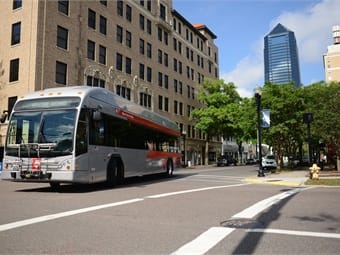
One of the first projects in the JTA’s Blueprint 2020 was its Route Optimization Initiative, which resulted in improved routes and both increased frequencies and service hours.
We started out by looking at our on-time performance. Throughout the organization, anyone that I asked gave me a different number, a different performance level, so that gave me an indication that on-time performance wasn’t being measured through a accurately or with a standard measurement system. After a peer analysis found the JTA was spending the same amount of revenue per passenger hour, but carried fewer passengers than our peers, we started a campaign called ‘OTTO,’ or On-Time Transit Operations. With that initiative, we selected our lowest performing routes and assigned managers from across the organization to work with the operators on those routes to improve performance. We broke down silos by having individuals from from other department assigned to the routes to determine what the problem was and what could be done to improve.
Through OTTO, we were able to achieve some success by raising our on-time performance on our lowest performing routes from 68.5 percent to about 75 percent.
However, we also identified some systemic issues created from a route system that was simply too outdated to handle 21st century commuting patterns. I asked our planning staff to start from scratch with a totally brand new route structure. Through extensive planning and community input, they developed what we thought was an optimal system. Then, the tough work of implementing those changes began.
What was that process like and what was the end result?
It was an 18 month process from planning to implementation, which involved unprecedented public outreach. We made sure the process was transparent and kept the JTA board informed every step of the way. It was the first total overhaul of the system in recent history, so internal and external communication was critical. We also wanted to make sure the new route structure was a net zero cost to the JTA. We weren’t going to increase our budget on an annual basis. We were going to have the same number of service hours, buses and operators, so it had to be a net zero cost, operationally.
The ROI was a mammoth undertaking for a transit authority of any size, but the dedicated executives and staff at the JTA pulled it off successfully, without any major problems. We accomplished a lot with that initiative. At a one-time cost of $2.1 million in operating and capital funds, the ROI also enabled the JTA to:
• Remove 30 percent of bus stops to reduce travel time between stops.
• Install 128 new ADA compliant stops.
• Increase the number of routes with 30-minute frequency from two to 20.
• Install 10 routes with 15-minute frequency — a first in JTA’s history.
• Double routes operating after 11 p.m. from 11 to 22.
• Increase routes operating after midnight from three to 16.
• Speed up weekend service to run more frequently.
• Increase route supervision, system branding, safety and security and adopted new protocol for naming routes.
• Adopt a new, more professional dress code for operators.
• Install nearly 2,900 new bus stop signs.
• Implement the Real-Time Passenger Information systemwide.
• Install more than 200 community shuttle map kiosks.
• Solidify concept of teamwork among JTA staff.
Because the ROI represented a total system change, we adopted the ROI motto: ‘New Routes, New System, New Way.’
Why do you feel mentoring others is important, especially right now with so much change over expected to continue to occur?
Mentoring is important to me both professionally and personally. I would not be in this position today, or accomplished a lot of what I’ve accomplished in my career, if I had not had mentors to provide guidance and advice from my early days as a train conductor for the Metropolitan Transit Authority in New York through my tenure in C-Suites. Even today, I can call one of my mentors for an informal consult on a best practice or how they approached a policy matter.
I also value being a mentor to others. It is a way to give back for what others have done for me. Mentoring also helps me to learn and grow because it enables me to reflect on my career and provide sound advice for a new or better way of doing things. So I see mentoring as a win-win; I can give back and learn in the process.
I’m a second generation transit professional. My father worked almost 40 years for New York City Transit. I’ve got a sister and brother-n-law who’s at New York City Transit now as a superintendent.
In addition to my sister, I have individuals around this country who have mentored me and individuals who have worked for me who I have mentored and stay in close contact with. We talk quite frequently about the industry, what they’re facing at their property, how they’re managing expectations, and in some cases, helping them prepare for their next opportunity.

Prior to joining JTA in December 2012, Ford lead Atlanta’s MARTA and the San Francisco MTA. He was recently named one of Northeast Florida’s Ultimate CEOs.
I am active with the American Public Transportation Association, The Eno Center for Transportation and the Conference of Minority Transportation Officials, because it’s a part of my DNA to help others. I think if you really look at this industry, to be a transit CEO is about helping people and helping our communities.
You were recently named one of the region’s ultimate CEOs. Can you talk about what you think makes you a solid leader?
From the first day that I started my career with the Metropolitan Transportation Authority in New York City, I loved this transit industry. I love the excitement. I love the challenge. I love what it means to people in the community, in terms of helping them get to work, the doctor or school. It may not be so plainly obvious to everybody who sees what we do, but I do recognize what my responsibilities are every morning when I listen to the morning traffic while I’m getting ready for work and smile because I strive to provide the kind of public transit experience that will encourage people to get out of the gridlock and leave the driving to us.
Within months after I was hired at the JTA, I reorganized my executive team and asked people to apply for leadership positions if they possessed the 12 characteristics or traits I wanted in the new JTA leader. Those traits were:
• Critical thinker
• Accountable
• Engaged
• Innovative
• High Energy
• Good Communicator
• Change Agent
• Team Player
• Customer focused
• Inspirational
• Courageous
• Strategic thinker
I look for those traits in my executive team because those are the skills I believe I bring to the table, so I am not asking more of them than I am willing to give of myself.
I am honored to receive the Ultimate CEO award. It’s an indication of the quality of the team I have in Jacksonville. We share a common vision and mission, we have a purpose that they’ve been able to rally around.
What do you feel is the future for JTA in the next five years and beyond?
Within the next five years all of the transformative, Blueprint 2020 initiatives will be fully implemented. All 57 miles of the First Coast Flyer bus rapid transit will be completed, making it the largest BRT system in the Southeast. By the year 2020, the JTA should have eight to 10 transit oriented developments (TODs) either completed or underway, and we will have an upgraded bike and pedestrian network in Duval County.
Equally as exciting will be the development of the Jacksonville Regional Transportation Center (JRTC),that will serve as the backbone of a robust, regional transportation network with Greyhound, Megabus, commuter rail and the JTA headquarters.
We will also be completing the JTAMobilityWorks road projects and examining the aging infrastructure of our bridges with the Florida Department of Transportation.
With that accomplished by the year 2020, the JTA’s position as the regional transportation leader in Northeast Florida will be solidified.
More Bus

New York MTA Plans Largest Bus Fleet Upgrade in More Than a Decade
The agency is seeking manufacturers for 650 new CNG buses to replace aging vehicles, improve reliability, and advance its broader fleet modernization strategy.
Read More →
Building a Flexible Path to Transit Electrification
John Hroncich discusses BAE Systems’ modular and scalable approach, lessons learned from decades of real-world operations, and how agencies can identify electrification strategies that fit their fleets.
Read More →
Bus Tech Talk: Keeping Transit Technicians Ahead of the Technology Curve
LA Metro’s Obed Mejia discusses technician training, evolving maintenance technology, fleet replacement, and strategies for getting the most out of today’s transit fleets.
Read More →
Biz Briefs: RIPTA Unveils New Frontrunners, Clevland RTA Adds New Siemens, and More
In METRO's latest installment, we take a look at recent news from Siemens, Prevost, Dodge, and more partnerships making headlines across the transportation sector.
Read More →
People Movement: Holly Arnold Joins Transdev and More
In this edition, we also cover recent appointments and announcements at Pace, CamTran, MCI, and more, showcasing the individuals helping to shape the future of transportation.
Read More →
The High Cost of Transit Buses: Industry Leaders Look to Procurement Reform
Transit leaders and policymakers examine how standardized bus designs, streamlined procurement, and predictable funding could help agencies stretch budgets and deliver better service.
Read More →
The Business Voice Behind Public Transportation
As chair of APTA’s Business Members Board of Governors, Ray Melleady explains how more than 850 business members are partnering with transit agencies to advance funding, innovation, and industry-wide collaboration.
Read More →
From Surviving to Thriving: Building Stronger Transportation Organizations
Bus Business Consultants founder Brian Dickson shares lessons on leadership, organizational health, and creating options for long-term success in a changing transportation industry.
Read More →
Finding the ‘Happy Medium’: Optimizing Maintenance Without Sacrificing Reliability
The key to maintenance optimization isn’t doing less work—it’s doing the right work at the right time on the right assets.
Read More →
LA Metro, City of West Hollywood, and Partners Advance Smarter Bus Lane Enforcement
The award-winning partnership combines AI-powered detection with human oversight to improve bus reliability, accessibility, and enforcement efficiency.
Read More →