




Bravo! Route 543
Length: 12.8 miles
Vehicles: 12
Frequency: 12 minutes
Stops: 15
Operational cost: $5.5 million
Service begins: 2013
BRT Focus: Orange County Transportation Authority - Orange, Calif.
The agency's two limited-stop routes offer more frequent service and faster commute times along two of the County's busiest transit corridors.
April 13, 2017
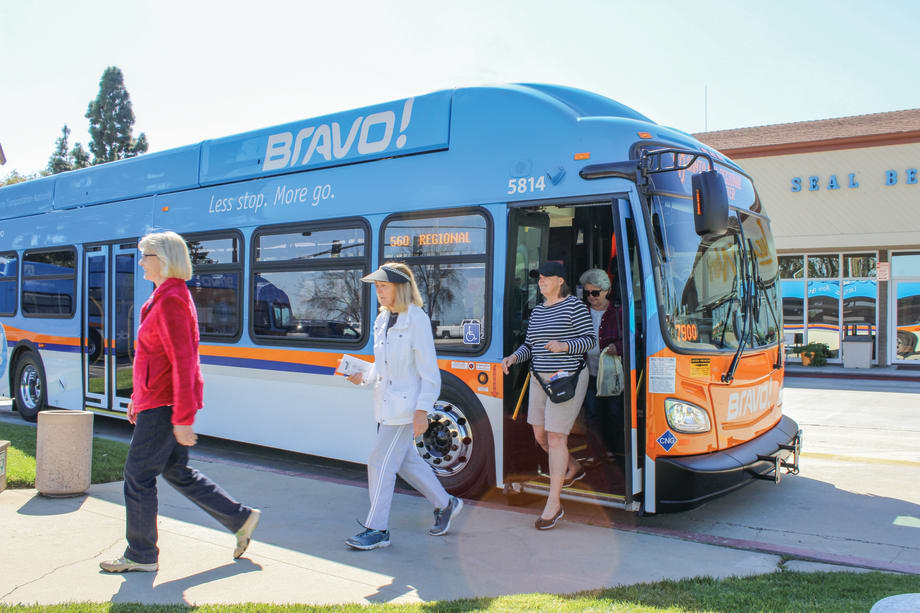
Bravo! Route 560, which runs along an 18-mile corridor, features five newly purchased CNG buses manufactured by New Flyer Industries. Photo: OCTA
6 min to read
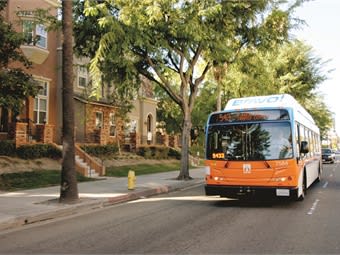
OCTA launched its first BRT line, Bravo! Route 543, in June 2013. Photo: OCTA
The Orange County Transportation Authority (OCTA) has spent more than two years focusing on an effort to reinvent the transit system in Orange County, Calif. The reinvention, called OC Bus 360°, led to reducing or eliminating service in areas with unproductive routes, as well as introducing new services.
For some of these new options, this meant introducing community shuttles that circulate to key employment, shopping, and civic centers. Also, last year, OCTA worked with the beach city of San Clemente on an innovative partnership with the on-demand service Lyft to provide an alternate to unproductive fixed-route bus service.
The agency also added two limited-stop corridors, which “mirror the best parts of bus rapid transit” (BRT), to its new spectrum of services. Bravo!, as the lines are branded, offer more frequent bus service, and faster commute times along two of Orange County’s busiest transit corridors.
“As we looked to improve service for existing riders and attract new ones, one consistent message we heard was that people wanted improved travel times and more frequency of service, especially in our most-heavily traveled, core areas of ridership,” says OCTA CEO Darrell Johnson.
Service features
Bravo!’s Route 543, which launched in June 2013, runs 12.8 miles and traverses four cities from Fullerton to Santa Ana seven days a week. Because it originates at the Fullerton Transportation Center, it serves business professionals and service-industry workers who use Orange County’s Metrolink commuter rail station and connects from other bus routes, Johnson explains.
“This route stops near the front entrance of Disneyland along Harbor Boulevard, so on any given day, it carries both people headed with their families for a day at the theme park and employees dressed in costumes on their way to work,” Johnson says. “Alongside them, are employees with computers and briefcases headed to jobs further south.”
Bravo! Route 560, which runs along an 18-mile corridor, features five newly purchased CNG buses manufactured by New Flyer Industries. Photo: OCTA
In June 2016, OCTA launched its second BRT corridor, Route 560, which runs 18 miles from Long Beach to Santa Ana on weekdays. This Bravo! Route, which also serves Metrolink commuters, links students to Santa Ana College and California State University, Long Beach, and connects military veterans to the VA hospital in Long Beach.
These two corridors, along with one other, which runs through the county seat of Santa Ana, account for approximately 25% of all of OCTA’s ridership. “So, efficient service has always been a high priority,” Johnson says.
OCTA considered implementing BRT service on these major corridors much earlier, but the sharp economic decline from the “Great Recession” made it challenging. Once the economy recovered, the agency’s board determined that starting the Bravo! service would be the quickest, most cost-effective way to enhance service, Johnson explains.
Federal CMAQ funds were used to cover the cost of operating each of the new routes (Route 543: $5.5 million; Route 560: $5.9 million) for the first three years of service. “After that, local funds will be used, and OCTA will continue to explore all grant funding options,” he says.
Route 543 operates 12 buses along the route during peak hours. Existing buses in OCTA’s fleet were rebranded to use for this service. The newer line, Bravo! 560, operates 14 buses during peak hours and features five newly purchased buses manufactured by New Flyer.
“California State cap-and-trade funding was used to buy four of the [buses], and OCTA bought one as a match,” Johnson says of the newest fleet additions to Route 560.
Real-time arrival information for the buses, which are tracked through a central dispatch system, is available to riders via the agency’s website or mobile app. Another added amenity was the introduction of mobile ticketing last year, which enables passengers to purchase fares through the OC Bus mobile app and show the bus operator their mobile “ticket.”
“This year, mobile ticketing readers are being installed on the buses to make the process more efficient, and ultimately, save riders even more travel time,” Johnson says.
Challenges faced
One of the primary challenges faced by OCTA initially was getting bus riders to recognize what the Bravo! service was and how it worked. This led to the unique branding of the service, repainting of buses, and marking the route stops with easy-to-spot signage. To that end, OCTA launched a multi-pronged marketing campaign to educate riders, which included placing informational cards on existing buses and reaching riders through social media, newspapers, and other traditional media, Johnson explains.
“We also sent out more than 100 administrative employees as ‘transit ambassadors’ for the first week of service to talk to riders, answer questions, and collect feedback,” he says. “We surveyed customers on board the buses as well to get their feedback.”
Over time, OCTA made minor adjustments to the routes to ensure they were providing the best level of service. This resulted in adding weekend service to the first Bravo! line, and adjusting its operation from 10-minute intervals to a more optimal 12-minute interval during peak hours.
When asked about the impact the BRT service has had, Johnson says, “Orange County, like bus systems across the U.S., is facing the challenge of declining ridership overall, but customer feedback has been overwhelmingly positive about the Bravo! service based upon onboard surveys.”
Ridership on Route 543 draws 3,900 riders daily, while Route 560 attracts 3,000 riders daily.
OCTA is currently working on planning studies with the aim of better serving riders through these corridors and throughout the county for the long-term, Johnson says. “The agency is also working on a Transit Master Plan, which will be an integrated vision of the future in Orange County, including bus, rail, and paratransit,” he says. “These plans will help determine if more Bravo! service is needed or what else will best improve mobility throughout the region.”
According to the BRT Centre of Excellence, BRT is a major source of transportation for millions every day. There are 69 cities across Latin America that have a BRT system, transporting nearly 21 million people on a daily basis. Asia has 9.2 million daily BRT users in 42 cities, while Europe has two million passengers in 59 cities. By comparison, the U.S. has only 471,000 passengers using BRT systems in 21 cities across the country.
That said, more cities are considering BRT as a cost-effective mode of transportation. In February, a Minnesota County’s Board of Commissioners approved a funding commitment to complete planning for the Gateway Gold Line BRT corridor in downtown St. Paul, while in March, the San Francisco Municipal Transportation Agency broke ground on their Van Ness Bus Rapid Transit and Corridor Improvement Project.
But, what about the public — will they ride BRT? The mode fits into the 80/20 Rule. This means BRT can often cost 20% of a light rail system but typically captures 80% to 85% of light rail riders, if LRT is not available.
The Rules of BRT
A great Class A BRT system can be built in an area that comprises 27 feet in width without a station and another 13 feet with a station. Larger buses in dedicated lanes move faster along the route due to traffic signal priority systems, allowing for more people moving quicker from origin to destination. These dedicated lanes are considered critical to make a BRT system successful.
The most important lesson learned is that the “R,” or rapid, in BRT is critical — keep it rapid. Key rules to follow:
1. Transit stops in one- to two-mile intervals.
2. High density (20-50 DU’s acre minimum) at transit stops.
3. Do your best to have the dedicated lanes in the median area of a road.
4. Traffic signal priority (TSP).
5. Level boarding, with at least two entry doors/vehicle.
6. Off-vehicle payment systems.
Subscribe to Our Newsletter
More Bus

New York MTA Plans Largest Bus Fleet Upgrade in More Than a Decade
The agency is seeking manufacturers for 650 new CNG buses to replace aging vehicles, improve reliability, and advance its broader fleet modernization strategy.
Read More →
Building a Flexible Path to Transit Electrification
John Hroncich discusses BAE Systems’ modular and scalable approach, lessons learned from decades of real-world operations, and how agencies can identify electrification strategies that fit their fleets.
Read More →
Bus Tech Talk: Keeping Transit Technicians Ahead of the Technology Curve
LA Metro’s Obed Mejia discusses technician training, evolving maintenance technology, fleet replacement, and strategies for getting the most out of today’s transit fleets.
Read More →
Biz Briefs: RIPTA Unveils New Frontrunners, Clevland RTA Adds New Siemens, and More
In METRO's latest installment, we take a look at recent news from Siemens, Prevost, Dodge, and more partnerships making headlines across the transportation sector.
Read More →
People Movement: Holly Arnold Joins Transdev and More
In this edition, we also cover recent appointments and announcements at Pace, CamTran, MCI, and more, showcasing the individuals helping to shape the future of transportation.
Read More →
The High Cost of Transit Buses: Industry Leaders Look to Procurement Reform
Transit leaders and policymakers examine how standardized bus designs, streamlined procurement, and predictable funding could help agencies stretch budgets and deliver better service.
Read More →
The Business Voice Behind Public Transportation
As chair of APTA’s Business Members Board of Governors, Ray Melleady explains how more than 850 business members are partnering with transit agencies to advance funding, innovation, and industry-wide collaboration.
Read More →
From Surviving to Thriving: Building Stronger Transportation Organizations
Bus Business Consultants founder Brian Dickson shares lessons on leadership, organizational health, and creating options for long-term success in a changing transportation industry.
Read More →
Finding the ‘Happy Medium’: Optimizing Maintenance Without Sacrificing Reliability
The key to maintenance optimization isn’t doing less work—it’s doing the right work at the right time on the right assets.
Read More →
LA Metro, City of West Hollywood, and Partners Advance Smarter Bus Lane Enforcement
The award-winning partnership combines AI-powered detection with human oversight to improve bus reliability, accessibility, and enforcement efficiency.
Read More →