




RELATED: Florida's TriRail adds bike car
New York City Transit introduces bicycle racks to buses
Racks available on S53, S93 Routes for 1-Year pilot testing feasibility and impact to service.
September 1, 2015
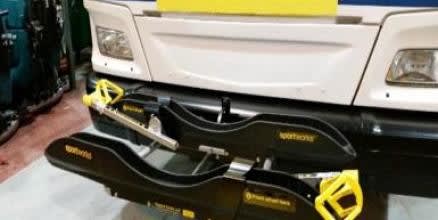
Sportworks Veloporter
2 min to read
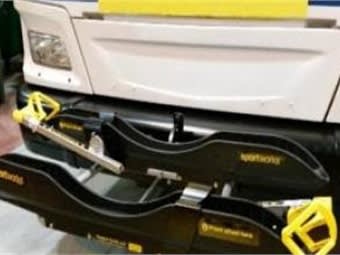
Sportworks Veloporter
Starting on Sunday, Sept. 6, MTA New York City Transit will add bicycle racks on two Staten Island bus routes, the first time that such equipment has been made available for public use on NYC Transit.
The yearlong Bike & Ride pilot will roll out on the S53 and S93 routes, which run between Staten Island and the Bay Ridge section of Brooklyn over the Verrazano-Narrows Bridge. The two lines were chosen for their safe access to current and planned bicycle paths, ridership and routes, which serve a major college campus where bicycling is a popular commuting option.
“Bringing the Bike & Ride program to the S53 and S93 will increase the mobility of students who are traveling between home and campus. Before this program, our customers had no direct way to travel with their bicycles on public transportation between Brooklyn and Staten Island. Now customers can take advantage of the city’s bike lanes and greenways without worrying about how to transport their bicycles,” said Darryl C. Irick, president, MTA Bus, and sr. VP, NYC Transit Department of Buses. “A future expansion will depend on results of this pilot and will most likely focus on routes that cross bridges.”
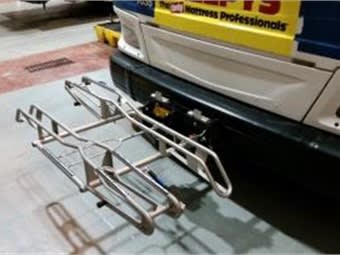
Byk-Rak 2 position
The bike racks have been installed on a dedicated fleet of buses that serve the two routes. During the pilot, NYC Transit will test the use of three types of front-mounted racks, each of which can fit up to two non-collapsible conventional bicycles. The racks have a mechanism that secures the bicycle in place during transit. Customers are responsible for loading and unloading their own bicycles by following instructions that are affixed to the racks.
Over the course of the pilot, NYC Transit will study the feasibility of continuing and/or expanding the program to other boroughs by looking at any impacts on service, safety, fleet maintenance, training, operations, costs and legal issues. A test run in March was conducted with no major issues, though managers noted possible locations with tight turns along the routes and the inability to machine-wash the fronts of buses as potential safety and maintenance issues, which are being addressed.
NYC Transit has purchased a total of 38 racks at a cost of $42,000. The S53, the second busiest bus route on Staten Island, serves an average of 10,100 customers on an average weekday. The S93 route has an average weekday ridership of 3,250 customers.
More New Mobility

From Hardware to Digital Partner: Luminator Charts Its Next Chapter
CEO Magnus Friberg discusses Luminator’s shift toward becoming a digital partner, the growing importance of software and interoperability, and how AI can help agencies improve operations and passenger experience.
Read More →
Biz Briefs: Alstom Lands Canadian Contract, LYT to Supply California TSP, and More
In METRO's latest installment, we take a look at recent news from Complete Coach Works, Beep, FlixBus, and more partnerships making headlines across the transportation sector.
Read More →
CharterUP’s Armir Harris on Technology, AI, and the Future of Group Mobility
In a recent episode of METROspectives, CharterUP Founder/CEO Armir Harris discussed the company’s evolution from an online charter bus marketplace into a technology platform supporting public- and private-sector mobility and much more.
Read More →
Jacksonville’s NAVI Project Charts a New Course for Autonomous Public Transportation
Through its NAVI program, JTA is showing how autonomous vehicles, intelligent infrastructure, and coordinated operations can work together to deliver everyday public transportation.
Read More →
Biz Briefs: Luminator Marks Milestone and More
From manufacturers and suppliers to transit agencies and motorcoach operators, these updates offer a snapshot of the projects, partnerships and business moves driving the industry forward.
Read More →
New Tricks for Old Bureaucracies: Joshua Schank on Making Transit Innovation Stick
Former LA Metro Chief Innovation Officer Joshua Schank discusses why good ideas aren't enough, how transit agencies can overcome resistance to change, and why today's challenges demand more innovation.
Read More →
How DART's GoPass Is Redefining Regional Mobility
Serving 14 transit agencies, GoPass simplifies multimodal travel by allowing riders to plan, pay for, and manage an entire trip through one app.
Read More →
Biz Briefs: OCTA Taps Clean Energy for Hydrogen Station, Stadler to Supply Via Rail Vehicles, and More
From manufacturers and suppliers to transit agencies and motorcoach operators, these updates offer a snapshot of the projects, partnerships and business moves driving the industry forward.
Read More →CharterUP Expands Into New Mobility and Autonomous Transportation
Vice President of New Mobility Stephen Joos discusses how CharterUP is leveraging its nationwide transportation network, technology platform, and autonomous vehicle partnerships to expand into workforce mobility, campus shuttles, and transit solutions.
Read More →
METRO Magazine Announces 2026 Innovative Solutions Awards Winners
Projects Recognized for Advancing Mobility Through Technology, Accessibility, Workforce Innovation, and Operational Excellence
Read More →