




RELATED: New Flyer opens NY component manufacturing and assembly facility
New Flyer to offer fuel-saving Allison Transmission tech
Also announced that the Government of the District of Columbia is purchasing 26 Xcelsior clean diesel 40-foot buses.
August 3, 2017
2 min to read
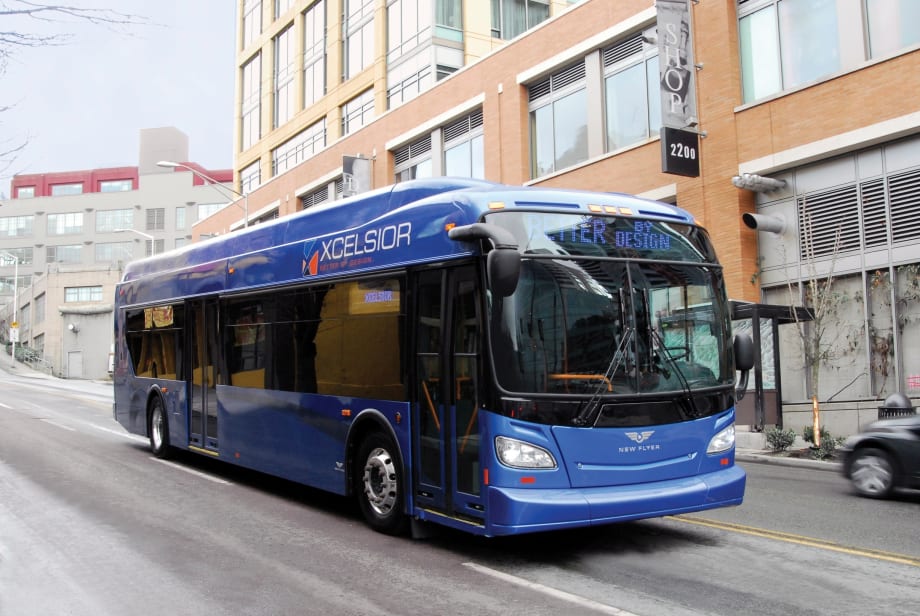
New Flyer of America Inc., the U.S. subsidiary of New Flyer Industries Inc., announced that it will offer FuelSense 2.0 featuring DynActive™ Shifting beginning October 2017. The fuel-saving technology from Allison Transmission delivers up to 6% additional fuel savings beyond the company’s original FuelSense software.
“New Flyer is proud to enhance the efficiency of Xcelsior® buses with FuelSense technology,” said Wayne Joseph, president, New Flyer of America. “Through constant innovation and working closely with companies like Allison, we are able to offer customers a cleaner, greener bus that lends greater sustainability and environmental stewardship to their communities.”
Introduced in March 2014, Allison’s FuelSense packages enabled significant fuel economy improvements. Through a set of proprietary software enhancements, the new FuelSense 2.0 technology uses DynActive Shifting to provide an infinitely variable combination of shift points. FuelSense 2.0 uses a learning algorithm to continuously find the ideal balance of fuel economy and performance.
“This latest technology further reduces fuel consumption in all segments of a vehicle’s duty-cycle,” said Heidi Schutte, VP, marketing and sales for the Americas, with Allison Transmission. “FuelSense 2.0 offers increased specification flexibility and delivers the best economic value to our customers.”
Providing maximum value for applications with heavy start-stop needs, FuelSense 2.0 is ideally suited for New Flyer’s transit customers. With more than three million test miles in customer fleets representing a variety of duty-cycles, the fleets have experienced fuel economy gains up to 6%. This fuel economy improvement resulted in an estimated annual per vehicle savings of up to $900 based on duty cycle, annual mileage, and fuel price.
The available packages are FuelSense 2.0, FuelSense 2.0 Plus and FuelSense 2.0 Max. All three include DynActive Shifting. FuelSense 2.0 Plus and Max include improved Neutral at Stop. FuelSense 2.0 Max includes enhanced Acceleration Rate Management.
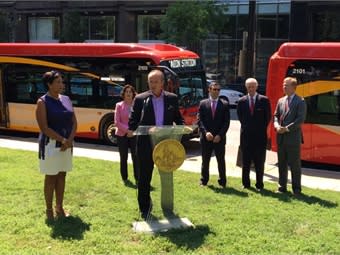
Left to right: Mayor Muriel Bowser; DC Councilmember Mary Cheh; Paul Smith, executive VP, sales & marketing, New Flyer of America; DDOT Deputy Director Jeff Marootian; DC Councilmember and WMATA Chair Jack Evans; and DDOT Director Leif Dormsjo.
New Flyer also announced that the Government of the District of Columbia is purchasing 26 Xcelsior clean diesel 40-foot buses.
The City continues to replace its existing fleet and is using local funding for the purchase. The buses, which feature custom interior and exterior design, will be operated exclusively on the City’s DC Circulator service in Washington, DC, which caters to over 20 million annual visitors to America’s Capital each year.
More Bus

New York MTA Plans Largest Bus Fleet Upgrade in More Than a Decade
The agency is seeking manufacturers for 650 new CNG buses to replace aging vehicles, improve reliability, and advance its broader fleet modernization strategy.
Read More →
Building a Flexible Path to Transit Electrification
John Hroncich discusses BAE Systems’ modular and scalable approach, lessons learned from decades of real-world operations, and how agencies can identify electrification strategies that fit their fleets.
Read More →
Bus Tech Talk: Keeping Transit Technicians Ahead of the Technology Curve
LA Metro’s Obed Mejia discusses technician training, evolving maintenance technology, fleet replacement, and strategies for getting the most out of today’s transit fleets.
Read More →
Biz Briefs: RIPTA Unveils New Frontrunners, Clevland RTA Adds New Siemens, and More
In METRO's latest installment, we take a look at recent news from Siemens, Prevost, Dodge, and more partnerships making headlines across the transportation sector.
Read More →
People Movement: Holly Arnold Joins Transdev and More
In this edition, we also cover recent appointments and announcements at Pace, CamTran, MCI, and more, showcasing the individuals helping to shape the future of transportation.
Read More →
The High Cost of Transit Buses: Industry Leaders Look to Procurement Reform
Transit leaders and policymakers examine how standardized bus designs, streamlined procurement, and predictable funding could help agencies stretch budgets and deliver better service.
Read More →
The Business Voice Behind Public Transportation
As chair of APTA’s Business Members Board of Governors, Ray Melleady explains how more than 850 business members are partnering with transit agencies to advance funding, innovation, and industry-wide collaboration.
Read More →
From Surviving to Thriving: Building Stronger Transportation Organizations
Bus Business Consultants founder Brian Dickson shares lessons on leadership, organizational health, and creating options for long-term success in a changing transportation industry.
Read More →
Finding the ‘Happy Medium’: Optimizing Maintenance Without Sacrificing Reliability
The key to maintenance optimization isn’t doing less work—it’s doing the right work at the right time on the right assets.
Read More →
LA Metro, City of West Hollywood, and Partners Advance Smarter Bus Lane Enforcement
The award-winning partnership combines AI-powered detection with human oversight to improve bus reliability, accessibility, and enforcement efficiency.
Read More →